Global is not a customer journey. Show where money can go, what it costs and what happens next—with keywords, screenshots and copy built around a real transfer.
By Gabriel Machuret · US iOS competitor research · reviewed 27 October 2026 · iOS and Google Play guidance
AI CONCEPT · ONE QUOTE. BOTH SIDES.
MONEY TRANSFER APP ASO
Make the route, the cost and the recipient outcome clear.
A money-transfer app is not selling a moving arrow on a map. It is helping a person answer a specific question: can I send from here to that recipient, using this payment method, for an acceptable total cost? A beautiful global headline can leave every part of that question unanswered. The ASO brief should begin with a supported transfer journey.
A corridor is a directional route: sender country to recipient country. A country appearing in a destination list does not mean people there can also send. Delivery method is a separate dimension: a bank deposit, a mobile-wallet payout and cash pickup are different recipient experiences. Funding method describes how the sender pays. Keeping those terms separate prevents confused keywords, screenshots and paid campaigns.
This playbook covers personal international transfers and remittance. Domestic peer-to-peer payments, business payouts, travel cards and bank account management can overlap with the same app but need their own intent decisions. Start with the finance category guide; use the banking playbook for account access, and the budgeting guide for allocation rather than transfer execution.
1. Define the route before promising global reach.
OriginWhere is the eligible sender based?
DestinationWhere will the recipient receive money?
MethodBank, wallet, card or cash pickup?
ProofShow the supported route and its real requirements.
Swipe horizontally to compare all columns →
The transfer brief: six decisions behind one download
Dimension
Example question
Evidence needed before copy
Sender origin
Can a resident of this market start this transfer?
Current sender eligibility and onboarding path
Destination
Can this recipient receive this currency here?
Supported corridor and recipient requirements
Funding
Does the sender use a bank account, card, wallet or cash?
Eligible instrument, funding fees and verification
Delivery
Bank deposit, wallet, card or pickup?
Available recipient method and local partner coverage
Cost
What is charged, converted and received?
Complete quote, exchange-rate context and any applicable charges
Timing
Is this an estimate, processing state or confirmed receipt?
Actual product-state definitions and current route estimates
Create a route matrix with product operations before writing. Include origin, destination, currencies, sender funding, recipient method, limits, required details, timing language and help route. Do not put every row into screenshots. Use the matrix to choose one truthful opening and to exclude promises the product cannot support. That is a category-specific foundation for ASO strategy.
The competitor sample below is eight verified public US iOS listings, chosen for contrasts in positioning, not ranked by market share. Five sets of Apple-served iPhone screenshot assets were captured and individually inspected on 27 October 2026. Feed order can differ from a live storefront or device. No private transfers were executed, and we have no competitor conversion data. Google Play guidance is included, but Android competitor creative has not been audited in this report.
MONEY TRANSFER APP ASO
Research the sender’s decision and the recipient’s reality.
The following are potential audiences, not demographic measurements. Research across adult age bands, preferred language, sender location, recipient access and transfer frequency. Do not infer income, immigration status or digital confidence from a destination country or surname. A repeated family transfer, a one-off move and urgent cash collection can involve the same person at different times.
Recruit around a recent task, using redacted or fictional details. Ask what triggered the transfer, how the recipient wanted to receive it, what the sender compared and which words they used to describe the process. Record whether the sender and recipient use the same language. Interview recipients where appropriate: the person installing the app may not be the person interpreting pickup instructions.
Swipe horizontally to compare all columns →
Audience hypotheses to validate for money-transfer ASO
Potential audience
Job
Recruitment dimensions
Question to ask
Screenshot proof
First-time family sender
Understand the route and recipient requirements
Adult age bands, destination, preferred language, first-time digital use
What must the recipient have before you can send?
Origin, destination, delivery method and required details
Repeat family sender
Repeat a familiar task without assuming the old rate
Sending frequency, saved-recipient use, pay cycle
What do you expect to stay the same when you send again?
Saved recipient followed by a fresh quote
Cost-conscious comparer
Compare like-for-like recipient amounts
Transfer size, payment method, comparison habits
Which amount are you comparing: fee, sender total or recipient net?
Matched funding and delivery assumptions
Sender arranging cash collection
Know where and when collection can happen
Recipient access to branches, travel time, local opening hours
Does ready mean already collected?
Actual status, pickup details and collection requirements
Bank-deposit sender
Send to the correct supported account
Recipient bank, currency, account ownership
What details would you double-check before confirming?
Destination account summary and recipient amount
Mobile-wallet sender
Understand wallet and recipient eligibility
Wallet provider, local terminology, recipient setup
Is this a personal transfer or an account-opening product?
Own-account route with accurate verification steps
Sender helping with education costs
Choose the right recipient type
Family transfer versus direct institution payment
Are you paying a person or an institution?
Only the supported personal or business journey
Sender needing help in another language
Read the quote and resolve uncertainty
Preferred reading language, support language, literacy and accessibility
Can you explain the total cost in your own words?
Localized quote, tracking and actual help coverage
Existing customer checking a delayed transfer
Find status and a useful next step
Current transaction state, device changes, access needs
Are you trying to install an app or get help with a payment?
Status and support route; separate from acquisition intent
Use three comprehension questions after showing an opening frame briefly: where can this money go, how will the recipient get it, and what amount does each side see? Follow with an unfinished-status screen and ask what has happened so far. If someone reads “payment received” as “my family has the money,” record the exact language that caused that inference. A small interview sample reveals misunderstandings; it does not establish market-wide percentages.
Prioritize the audience where product fit, business priorities and credible search evidence overlap. The largest-looking destination keyword is not automatically the best opportunity. A narrower bank-deposit route may have stronger product proof than a broad global promise. Connect value proposition, search intent and test hypotheses before commissioning artwork.
MONEY TRANSFER APP ASO
Start with 100 candidates. Keep only the promises you can prove.
These 100 unique candidates are research inputs, not measured volume, ranking difficulty or recommended bids. Countries and methods are deliberately conditional. Remove any phrase that implies a route, funding instrument or recipient journey the app does not support. Some entries will prove informational or support-led rather than suitable for store metadata.
Check before targeting: Verify both sending country and destination; these country names are research candidates, not coverage claims.
send money to philippinessend money to mexicosend money to indiasend money to nigeriasend money to pakistansend money to bangladeshsend money to colombiasend money to kenyasend money to ghanasend money to vietnam
Specific corridors
Check before targeting: Each directional route must be supported for the sender, recipient and method.
send money us to philippinessend money us to mexicosend money us to indiasend money uk to nigeriasend money uk to pakistansend money canada to indiasend money australia to philippinessend money uk to kenyasend money us to colombiasend money canada to philippines
Recipient delivery methods
Check before targeting: Confirm the receiving bank, wallet, card or pickup network; do not confuse delivery with funding.
international bank depositcash pickup transfersend money to mobile walletsend money to bank account abroadinternational card transfersend money for cash collectionremittance to savings accountoverseas bank account paymentmobile wallet remittancecash collection money transfer
Sender funding choices
Check before targeting: Confirm eligible funding instruments, origin and costs for each route.
send money with debit cardfund transfer by bank accountpay remittance with bank transferinternational transfer with apple paysend money with credit cardcash funded money transferpay for transfer onlinebank funded remittancedebit card international transferfund money transfer in app
Quote and cost research
Check before targeting: Show the actual quote inputs, recipient amount, fees and rate; no cheapest or free claim inferred.
money transfer feesremittance exchange rateinternational transfer quotecompare transfer total costrecipient amount calculatormoney transfer fee calculatorexchange rate for remittancecheck transfer exchange rateinternational payment chargesmoney transfer cost estimate
Tracking and timing
Check before targeting: Use real transaction states and supported estimates rather than instant guarantees.
track money transferremittance transfer statuscash pickup statusinternational transfer trackingmoney transfer delivery estimatebank deposit transfer statuspayment under reviewmoney ready for collectionrecipient payment confirmationtrack overseas payment
Repeat and recipient management
Check before targeting: Recipient reuse must lead to a fresh quote and confirmation; verify each management feature.
send money againsaved transfer recipientsrepeat international transfermanage remittance recipientsresend money to familyedit money transfer recipientview remittance historydownload transfer receiptsave recipient bank detailsrepeat overseas payment
Family and own-account jobs
Check before targeting: Verify personal-transfer eligibility and recipient relationship; these are hypotheses, not demographic findings.
send money to family abroadsupport parents overseassend money for school feessend money for family expensestransfer money to own account abroadsend savings overseassend money after moving abroadtransfer relocation fundssend money for household billsinternational family support
Narrow method and language needs
Check before targeting: Validate end-to-end method, local terminology and language coverage before targeting.
send money philippines bank depositsend money mexico cash pickupsend money kenya mobile wallettrack international cash pickupremittance app in spanishmoney transfer app in tagaloginternational transfer with receiptsend money abroad without recipient appreview exchange rate before sendingcash pickup location finder
Build the next layer of the worksheet from live results. For each phrase record store, storefront, language, date, product types returned and whether the query is about sending, comparing or solving a current problem. A transfer-status query can come from an existing customer; treating it as new-customer intent will distort acquisition reporting. Start with the research process and relevance checks.
Expand a promising corridor only after the gate passes: destination → destination plus method → sender origin plus destination plus method. Do not generate hundreds of country combinations and call them opportunities. Verify natural phrasing with native speakers and actual search evidence. Keep volume estimates and difficulty estimates separate from known product fit.
Competitor names belong in a separate research and campaign decision sheet. Their appearance in results does not make them appropriate metadata for your app. An unsupported word such as instant, free or guaranteed also stays out until its meaning is both accurate and approved. Use prioritization to record keep, test or reject decisions, not just a long export of phrases.
MONEY TRANSFER APP ASO
Find a specific transfer problem—not another generic global page.
A narrow angle works when the user’s question becomes more specific and the product has better proof for that question. Adding a country name to a generic screenshot is not enough. The route, method, quote and follow-through should all match. None of the following has been established as low competition or high demand.
Swipe horizontally to compare all columns →
Long-tail opportunities to investigate, with explicit product gates
Niche hypothesis
Long-tail candidates
Opening proof
Go / no-go question
Philippines bank-deposit intent
send money philippines bank deposit; send money us to philippines
Origin, recipient bank delivery and complete quote
Does this exact route and bank delivery work?
Mexico cash collection
send money mexico cash pickup; track international cash pickup
Pickup method, status and collection details
Can the recipient find an eligible location and requirements?
Kenya wallet delivery
send money kenya mobile wallet; send money uk to kenya
Named supported wallet and recipient flow
Is the specific wallet available from this origin?
Repeat household support
resend money to family; saved transfer recipients
Saved recipient followed by fresh pricing
Can the app reuse details without implying unchanged costs?
Own-account relocation
transfer money to own account abroad; transfer relocation funds
Supported own-account route and required account details
Does the product accept this purpose and customer type?
Recipient without the sender app
send money abroad without recipient app
Actual bank or pickup flow without invented recipient signup
Is recipient app installation genuinely unnecessary?
Spanish quote comprehension
remittance app in spanish; review exchange rate before sending
Localized quote and matching tracking/help scope
Are the promised journey and support terms understandable end to end?
Transfer records
international transfer with receipt; download transfer receipt
A real dated record with status
Does a receipt show funding, submission or actual payout?
For a corridor pilot, compare its phrase family with the broader category results using keyword gap analysis. Then inspect whether current creative answers the method question. If visitors already know the destination but cannot tell how cash is collected, a method-first screen could be more useful than another flag. This is a hypothesis to validate, not a conversion forecast.
Some niches deserve help content rather than an acquisition page. “Payment under review” is often a problem to resolve, not a benefit to advertise. Support findings can still improve a tracking screenshot or onboarding explanation. The long-tail guide helps separate install intent from informational demand. Avoid thin pages that differ only in a country name; each route page needs substantive product and local-language differences.
MONEY TRANSFER APP ASO
Compare eight real apps without copying their promises.
Read these as positioning examples from public US listings, not a recommendation of transfer providers. A familiar name or a broad country count does not verify eligibility for any particular sender. Title, subtitle, seller identity and description were checked together so similarly named products are not mixed up.
Swipe horizontally to compare all columns →
Eight verified US iOS listings — reviewed 27 October 2026
Paysend: Send Money Worldwide Subtitle: Fast Global Money Transfers
Describes card, bank and other supported recipient routes with quote details.
Keep the receiving method distinct from the sender’s payment instrument.
Category descriptors recur in this sample, while screenshots do much of the work of distinguishing cost, delivery, breadth and reassurance. For your own brief, record one job per competitor screen and ask what visible UI proves it. Do not treat download counts, rating claims, speed percentages or promotional rates as independently verified evidence. We have not tested their transfer performance.
Repeat the competitor research in your actual target storefront before choosing metadata. A US English snapshot cannot establish the best wording in Spanish, Tagalog or another market. Also inspect the current Android listing if Android is in scope; assets and descriptions may differ.
MONEY TRANSFER APP ASO
Use the store tools to test clarity, not to hide complexity.
Swipe horizontally to compare all columns →
Platform guidance checked 27 October 2026
Surface
Current rule or capability
How to use it for this category
iOS name and subtitle
30 characters each
Recognizable identity plus a clear transfer descriptor; use the subtitle for a concrete task
iOS keywords
100-character field
Select relevant nonduplicative terms; research destination and method wording by locale
iOS product page optimization
Tests icons, screenshots and previews
Compare one quote or method hypothesis while holding unrelated creative steady
iOS custom product pages
Tailored screenshots, previews and promotional text; supported keyword assignment and deep links
Connect a supported corridor or method with matching creative and a real in-app destination
Google Play text
Title 30; short description 80; full description 4,000 characters
Explain route scope and the supported transfer journey naturally
Google Play experiments
Tests graphics and localized text
Use a focused asset test and inspect both acquisition and relevant downstream signals
Apple’s optimization tool supports controlled creative treatments. It is not a test of every metadata field. Custom product pages can carry tailored assets and selected search keywords; keep each assignment aligned with page intent and verify deep-link support. A corridor page must still represent a supported product journey.
Apple’s screenshot guidance calls for showing the app in use. The AI concepts later in this guide are teaching material, not real product screenshots. Production creative needs actual UI and accurate route, pricing and status information.
MONEY TRANSFER APP ASO
Read the real screenshots like a sender—not a designer.
These are twenty original Apple-served panels, not AI recreations or low-resolution browser captures. Open any image for its full-size asset. Four retrieved iPhone panels from each of five apps are shown in feed order; live storefront presentation can vary. Each set links to its source listing and capture date.
Inspect at two scales. At thumbnail size, can the person recognize the transfer job and method? At full size, do amounts, currencies, states, map details and caveats support that message? A readable slogan with an unreadable quote is not enough. Use readability principles to decide which UI detail needs enlargement.
Wise: Quote detail within a broader money product
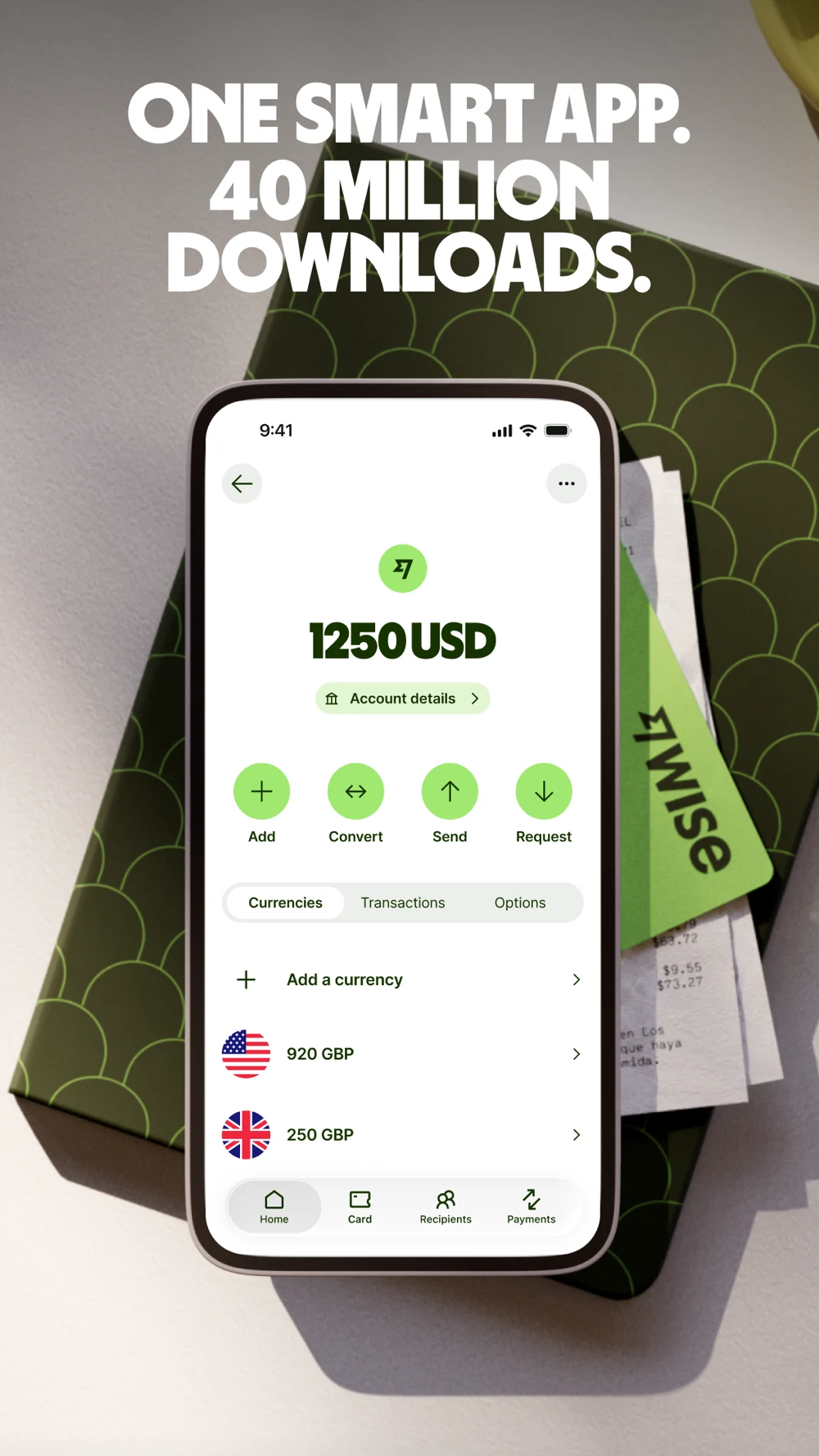
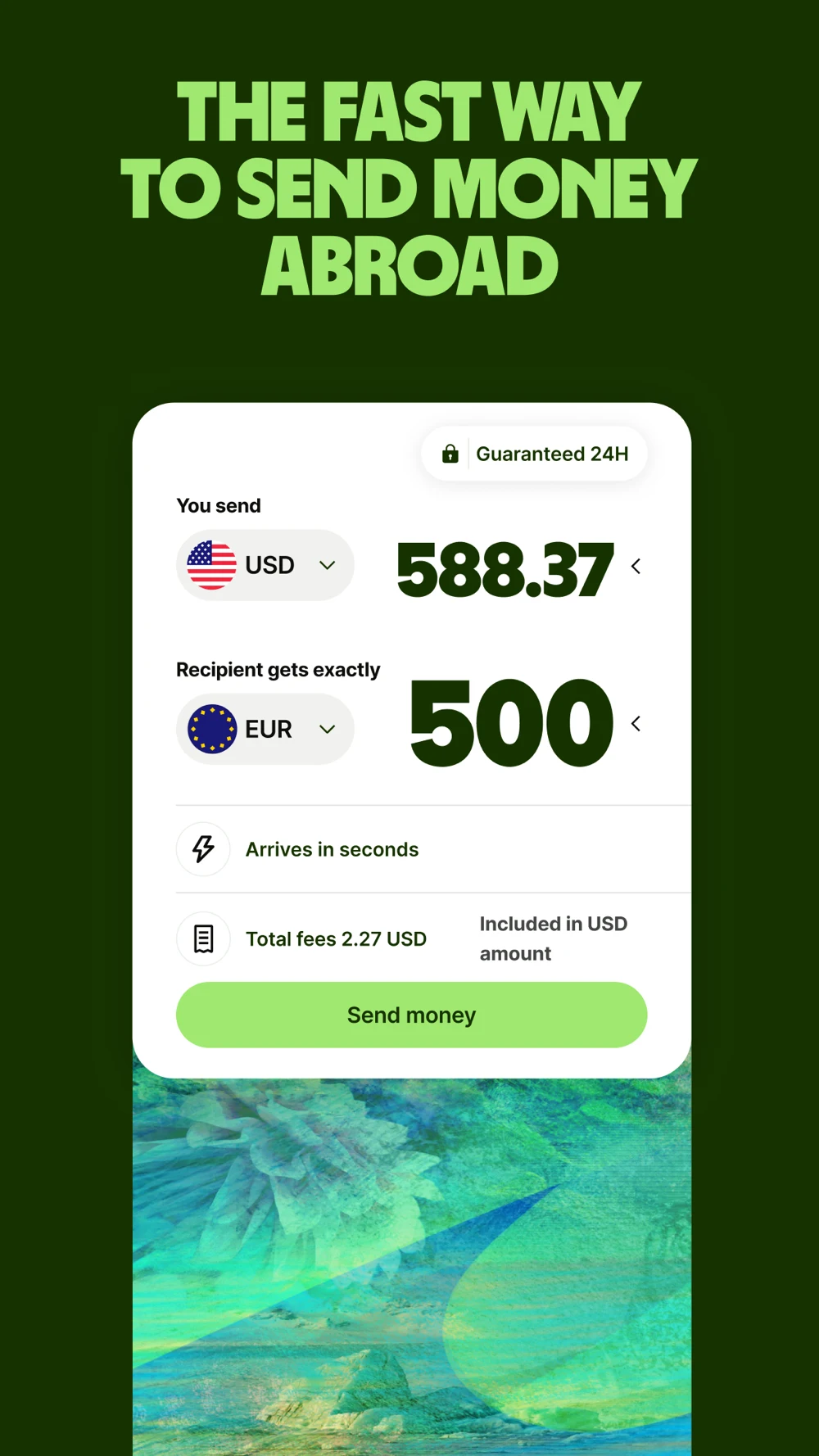
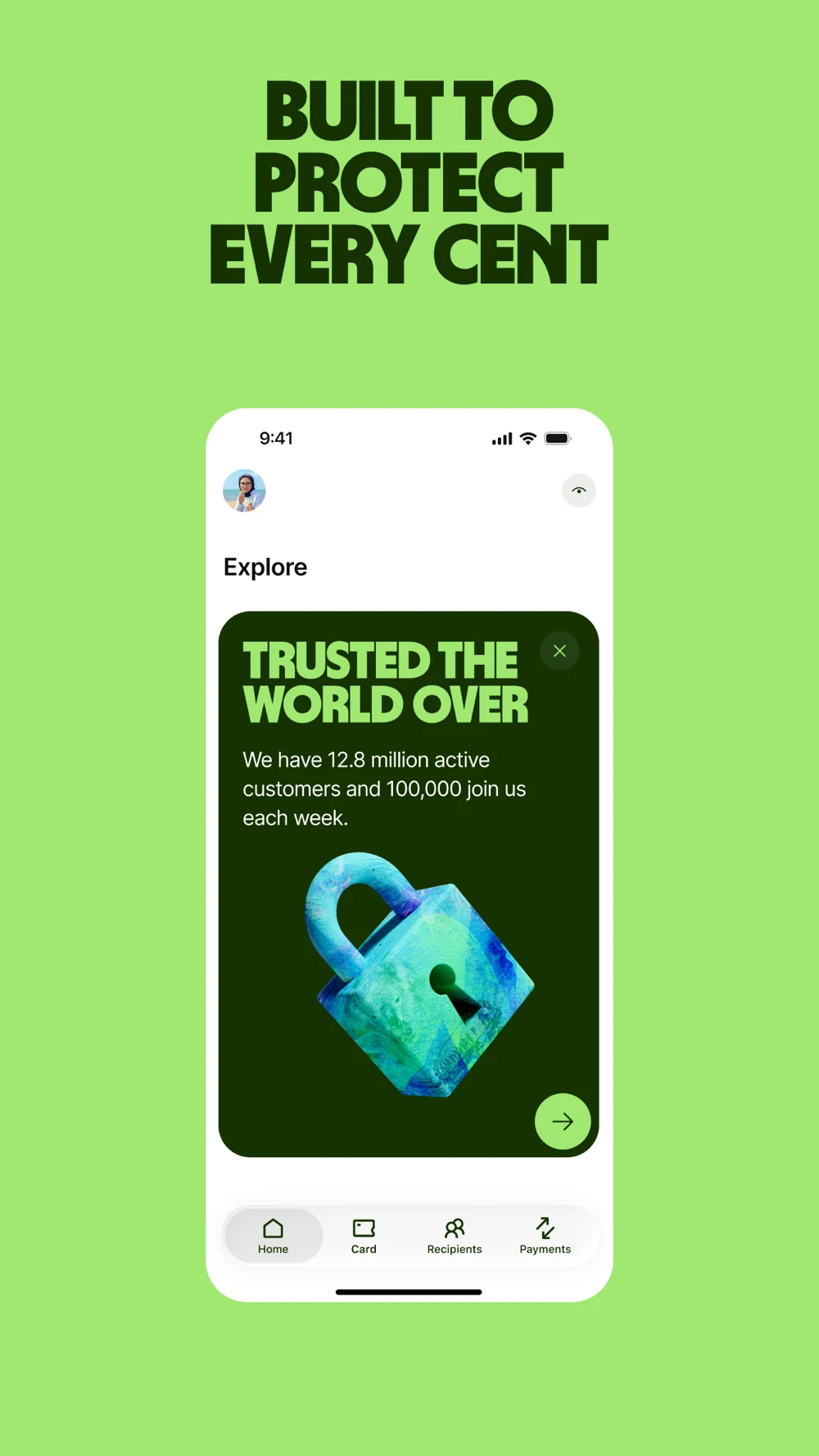
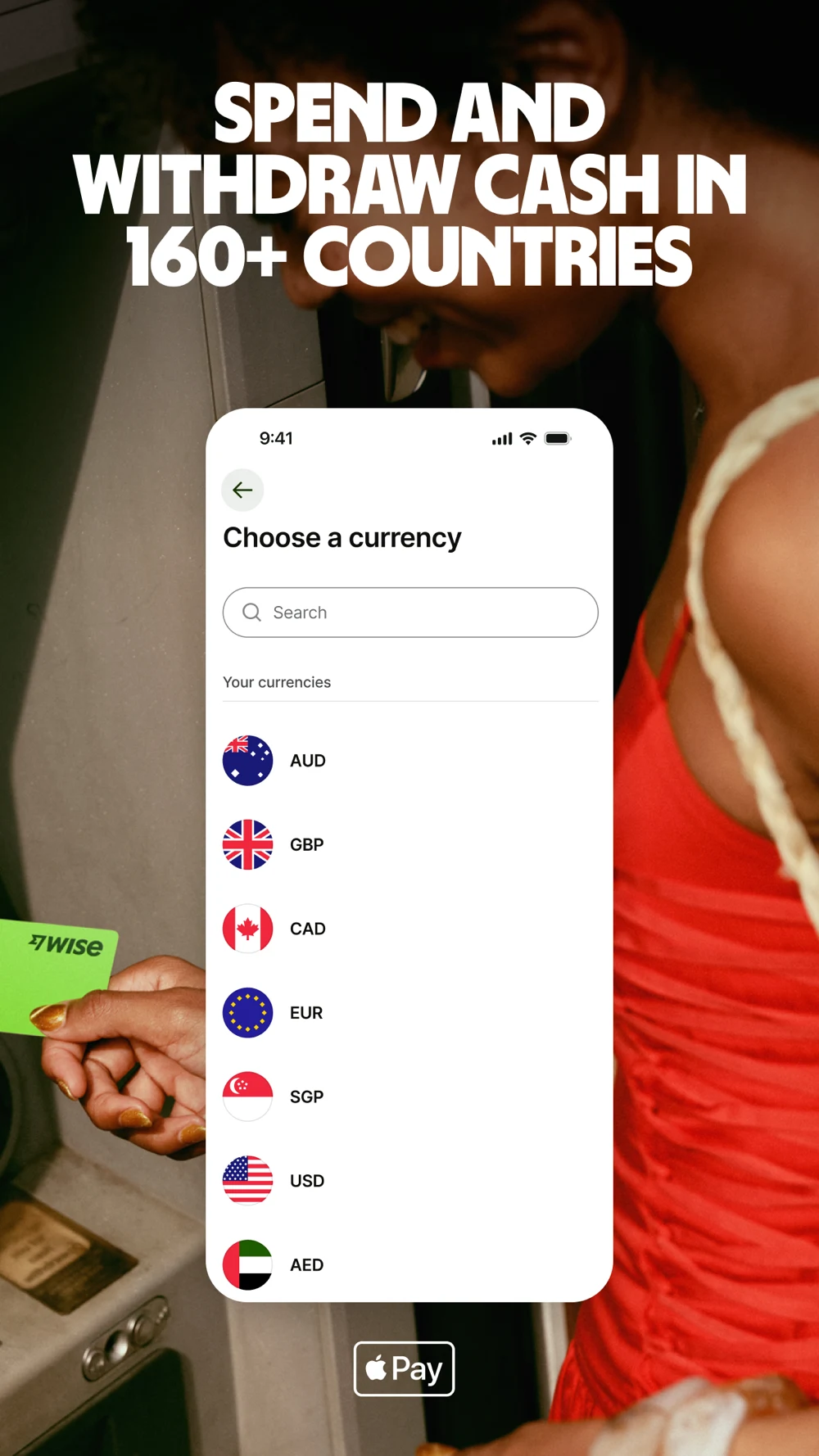
Panel 1 · A green opening combines social proof with a balance screen.Panel 2 · A large quote shows converted amounts and fee context.Panel 3 · A protection message uses a large padlock and trust claims.Panel 4 · A travel-oriented panel shifts the story to spending and currencies.
The quote crop is easier to inspect than the broader lifestyle scenes. For transfer-specific intent, test that quote earlier and make rate validity distinct from delivery timing. The sample currency labels also deserve an asset QA check. Public creative is not a live exchange quote or verified performance result.
Remitly: Emotion, a detailed quote and a first-transfer offer
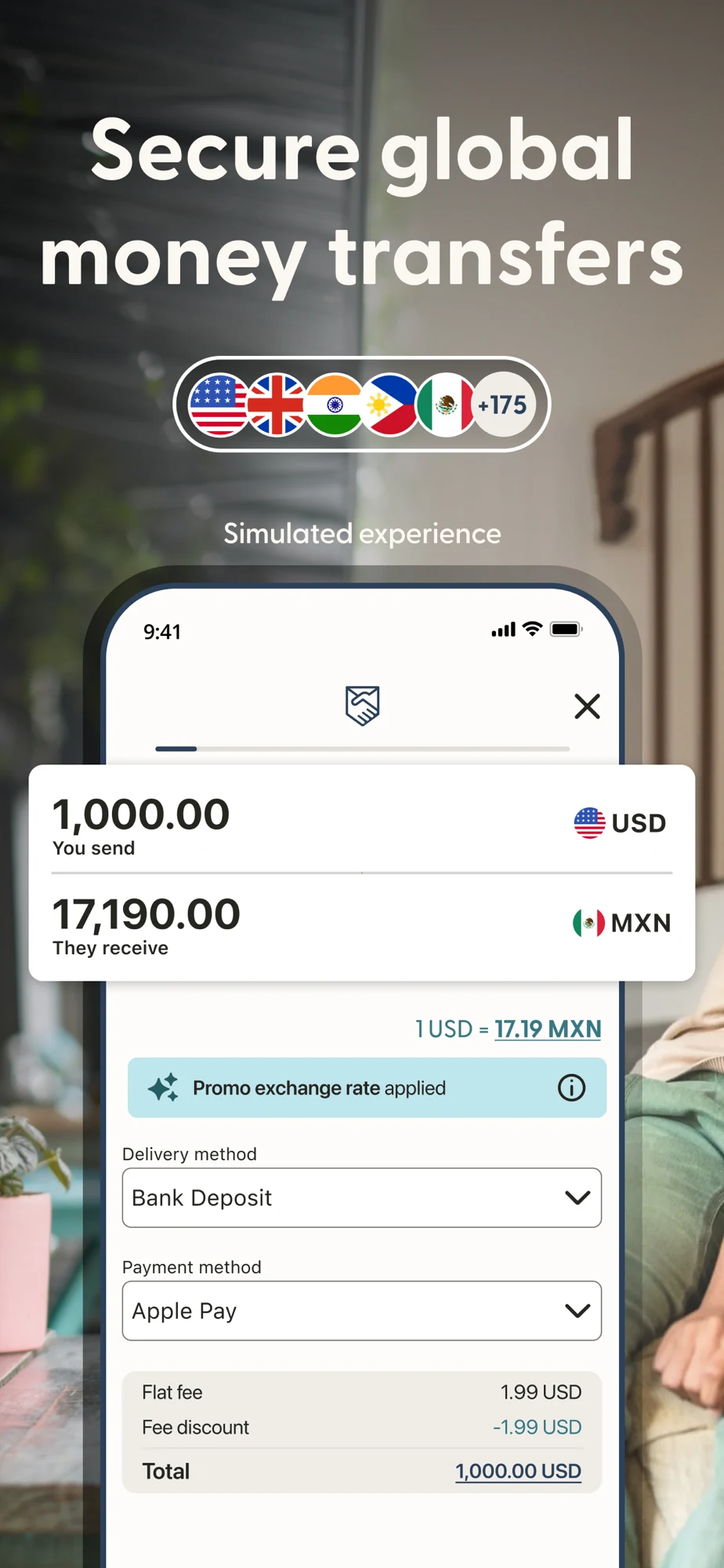
Panel 1 · A person and a sent notification introduce the transfer story.Panel 2 · A quote example includes funding, fee and discount details.Panel 3 · A family-call image supports a promotional message.Panel 4 · A country list and currency imagery communicate breadth.
The second panel provides more concrete transaction proof than the lifestyle frames. Test a method-specific quote opening for route-led searches, keeping the emotional approach as a control. Promotional eligibility and cost details must remain readable. We do not know which sequence converts better.
WorldRemit: A quote in progress, then reach, speed and rates
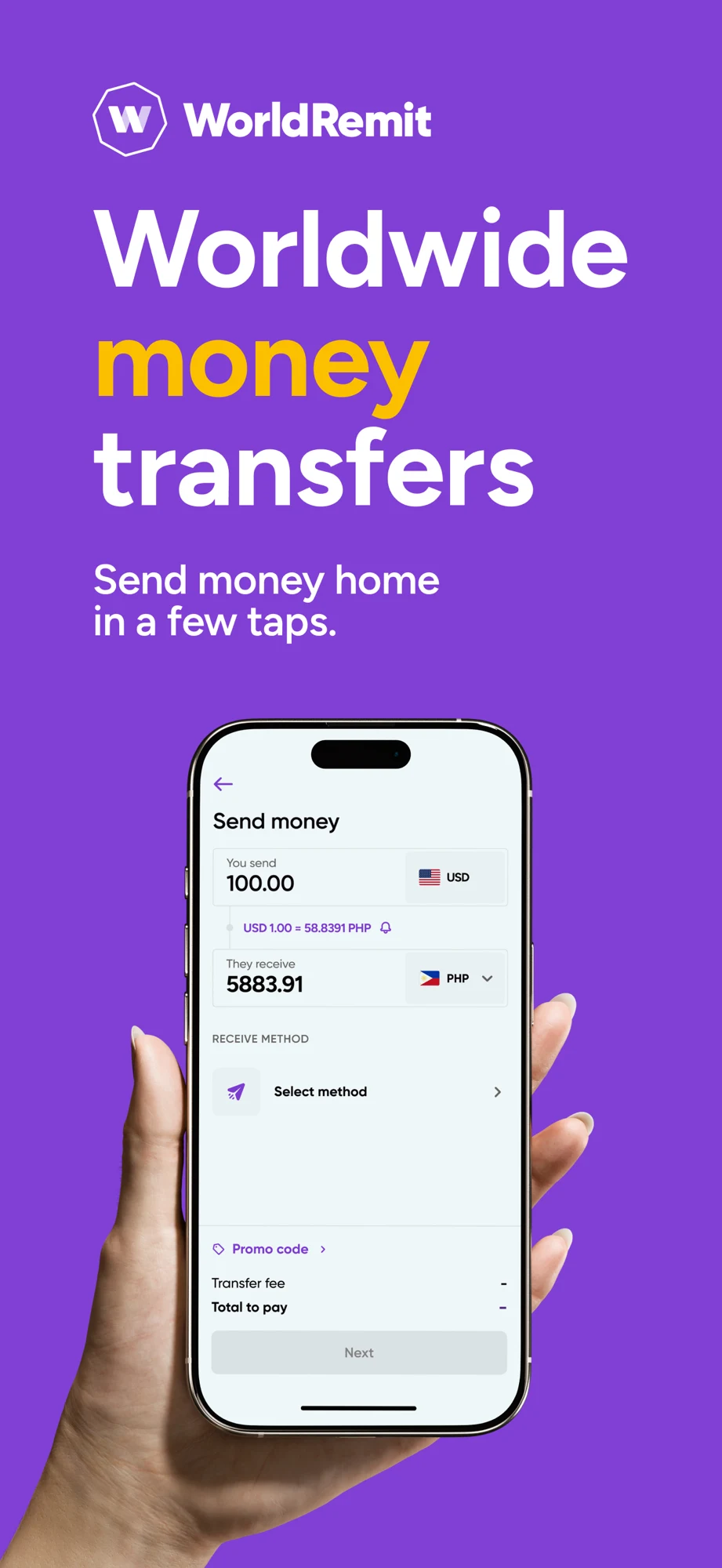
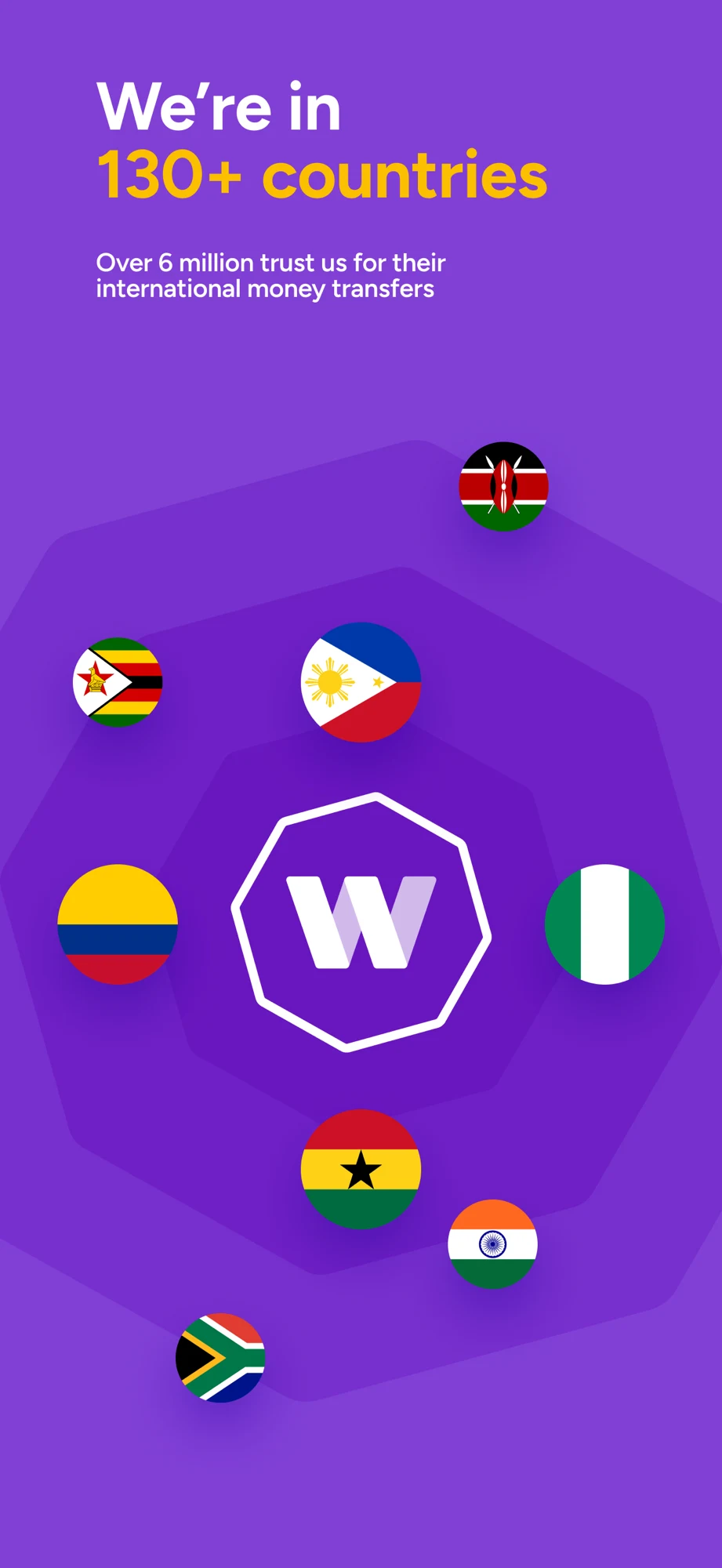
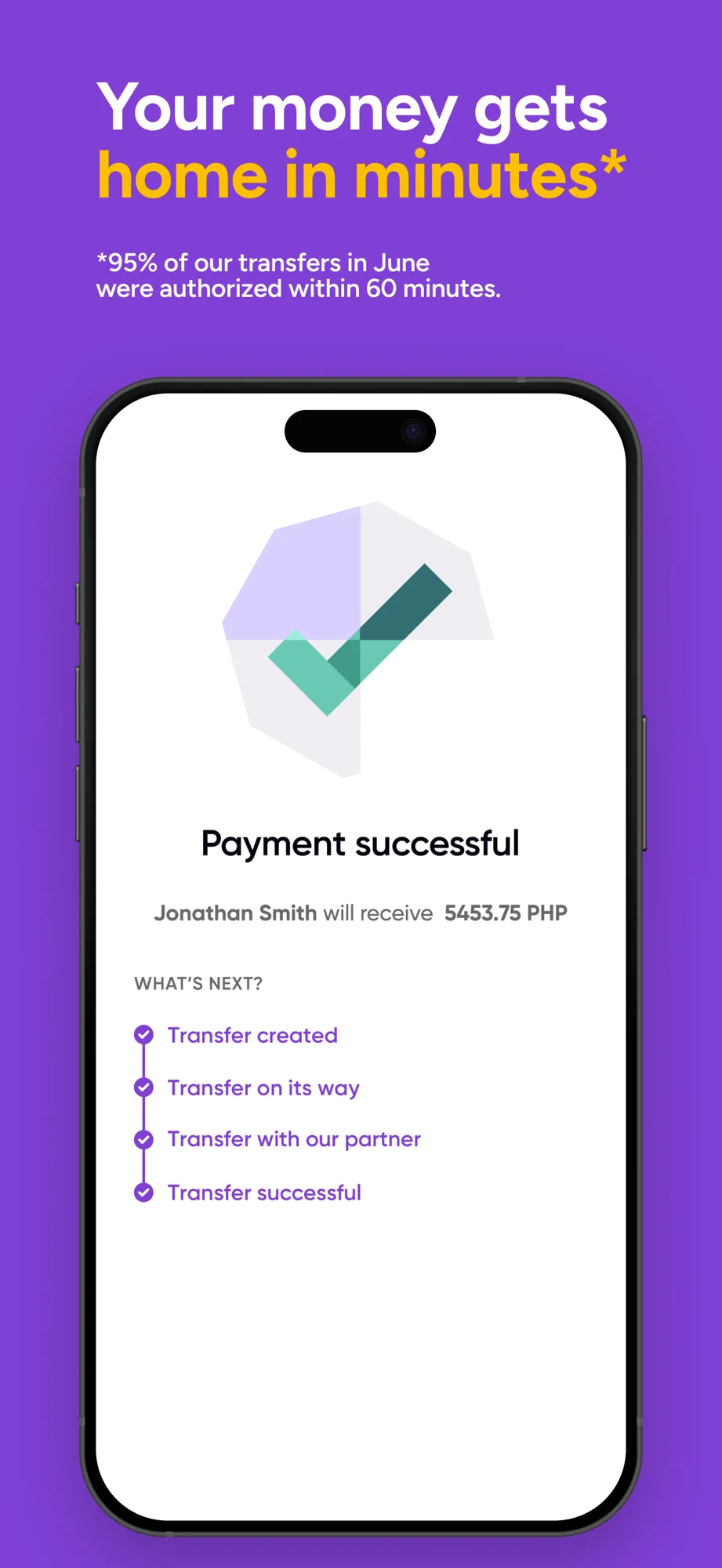
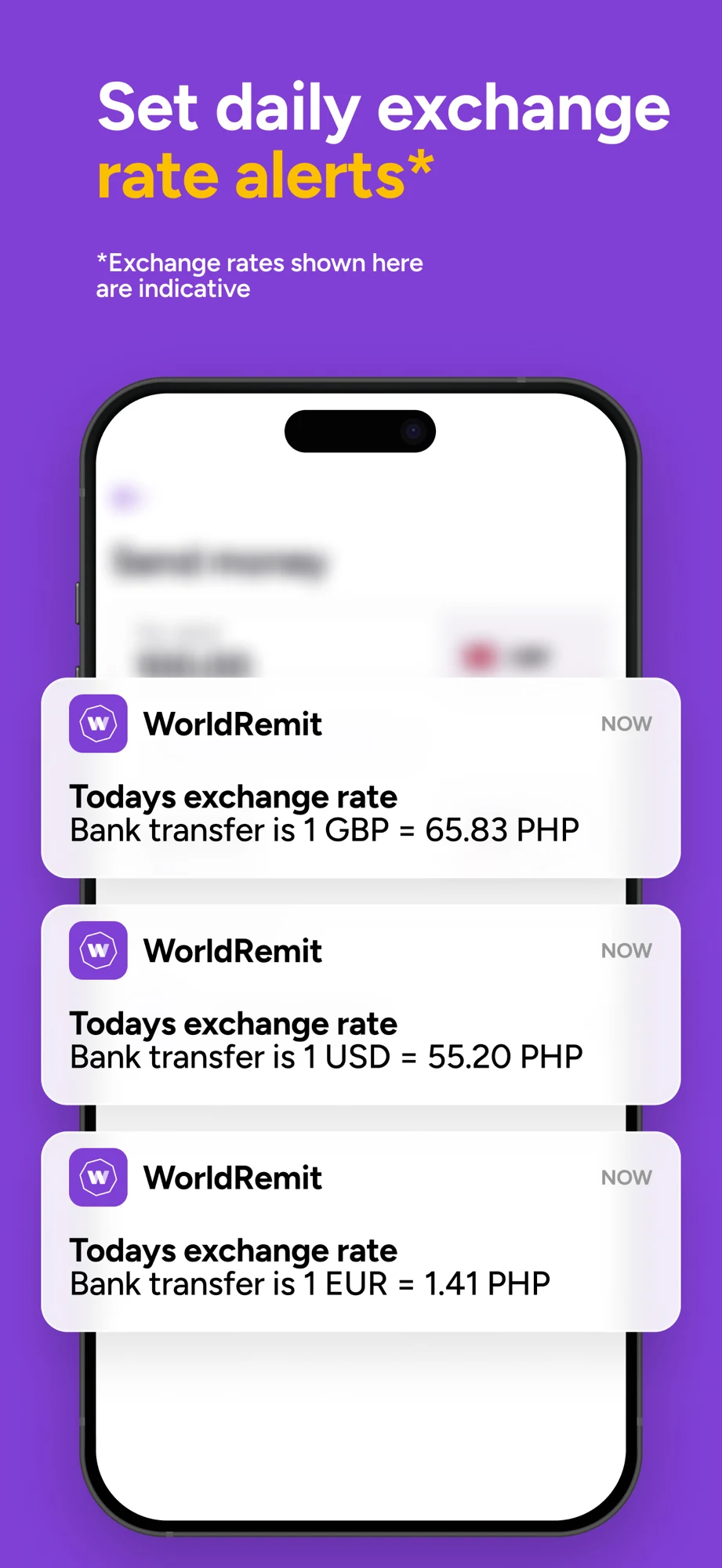
Panel 1 · A USD-to-PHP quote still has an unselected method and incomplete totals.Panel 2 · Flags and a large coverage message emphasize geographic reach.Panel 3 · A success message shares space with delivery stages and a speed footnote.Panel 4 · Rate-alert examples enlarge currency information over a blurred background.
The unfinished quote is a useful reminder: missing fees are not zero fees. The speed panel invites a distinction between payment authorization and recipient delivery. Test a completed quote and one unambiguous status. Treat the pictured rates and performance claims as publisher examples, not current verified facts.
Western Union: Broad reach, an offer and a specific funding choice
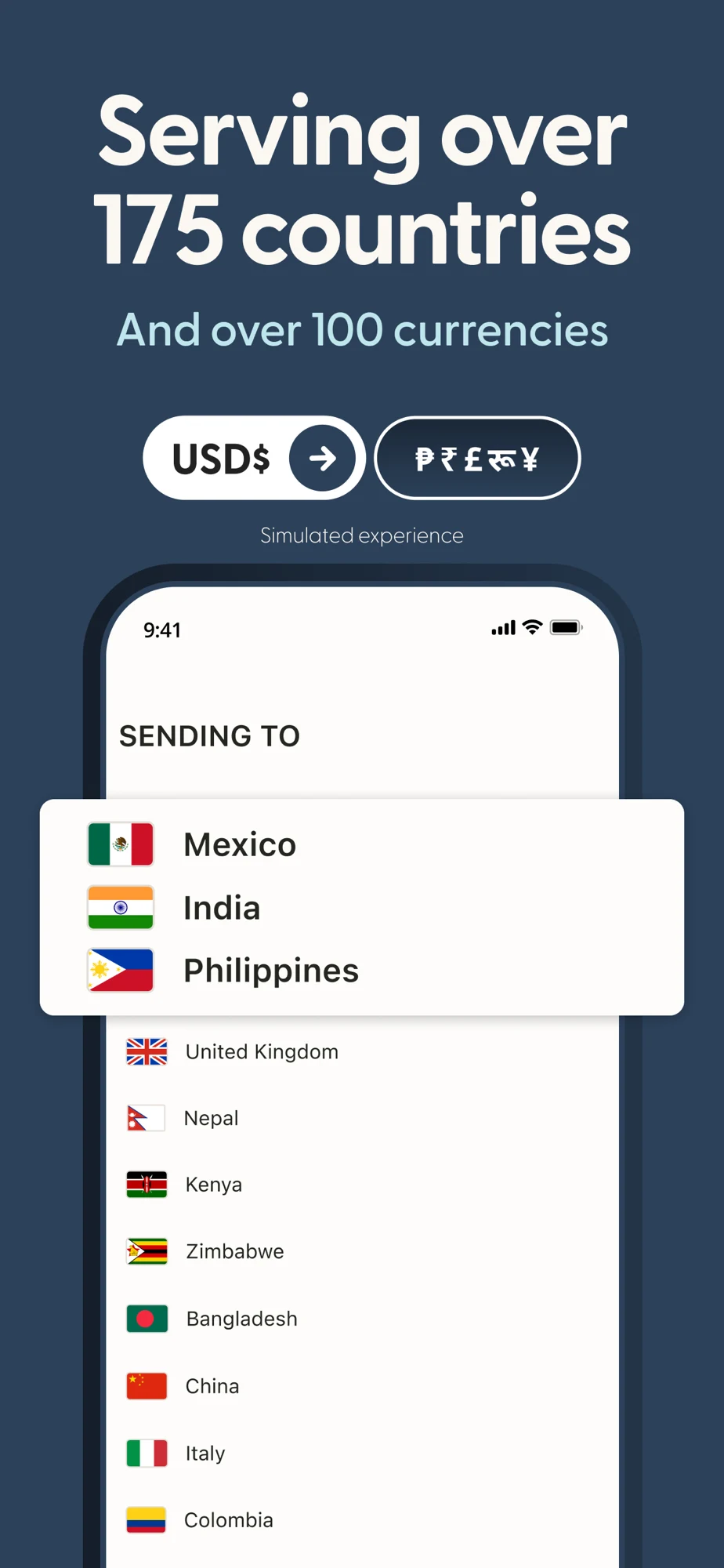
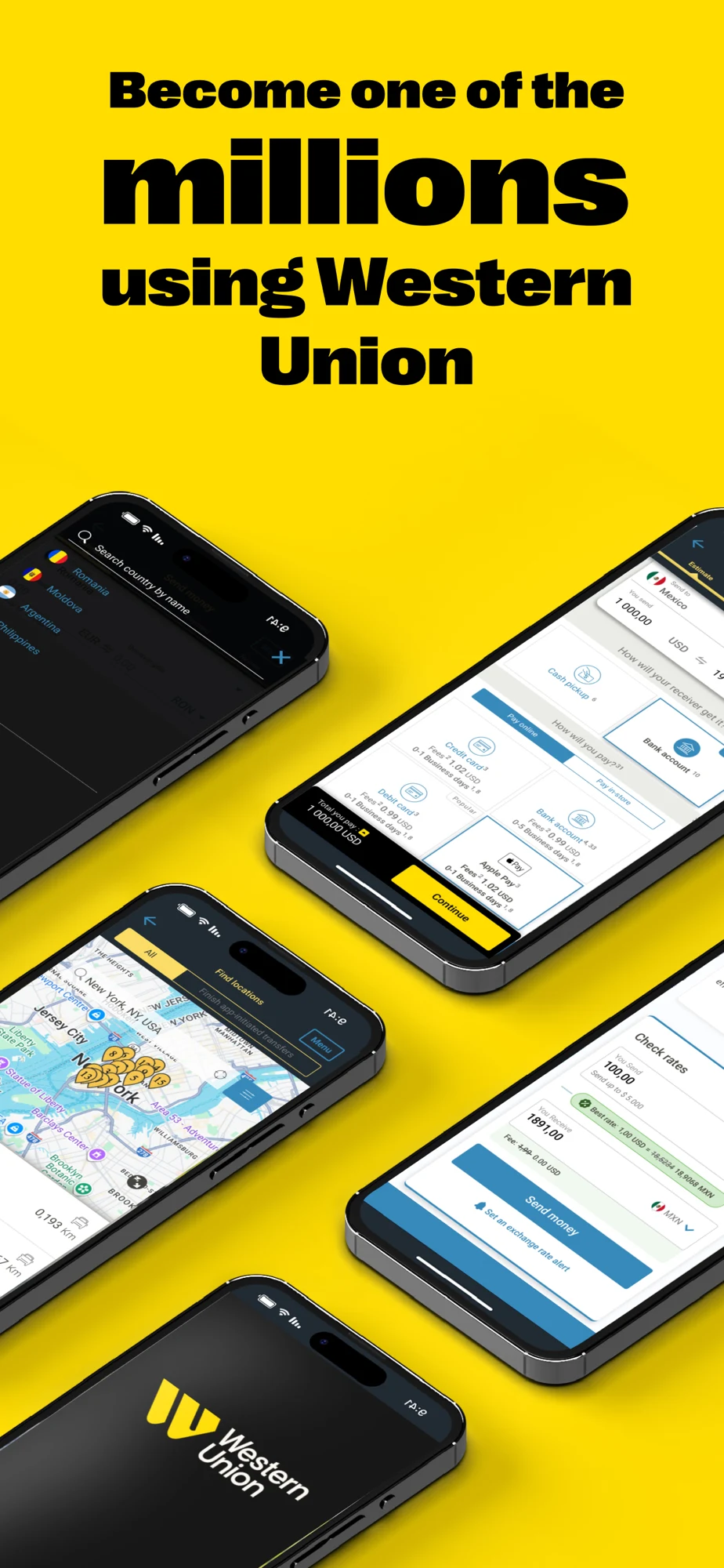
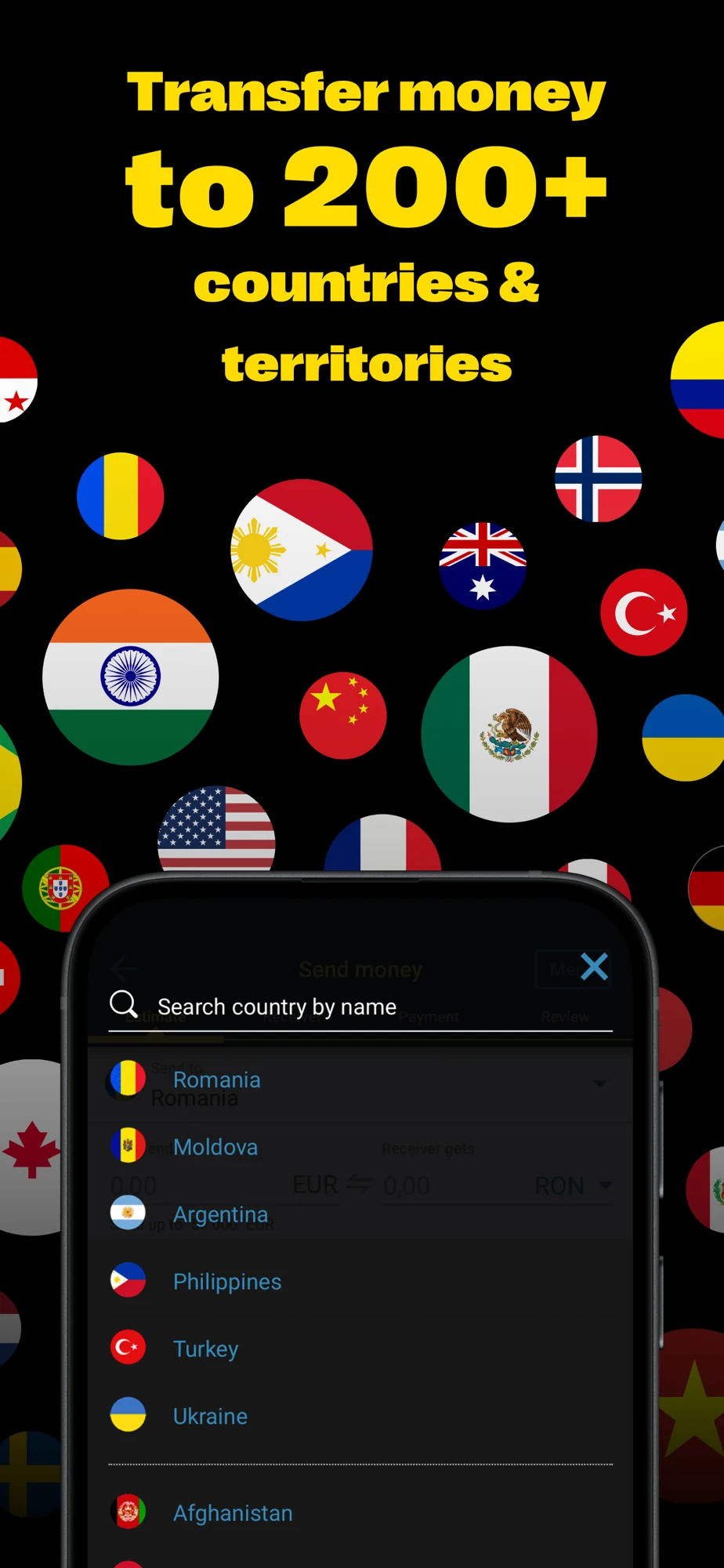
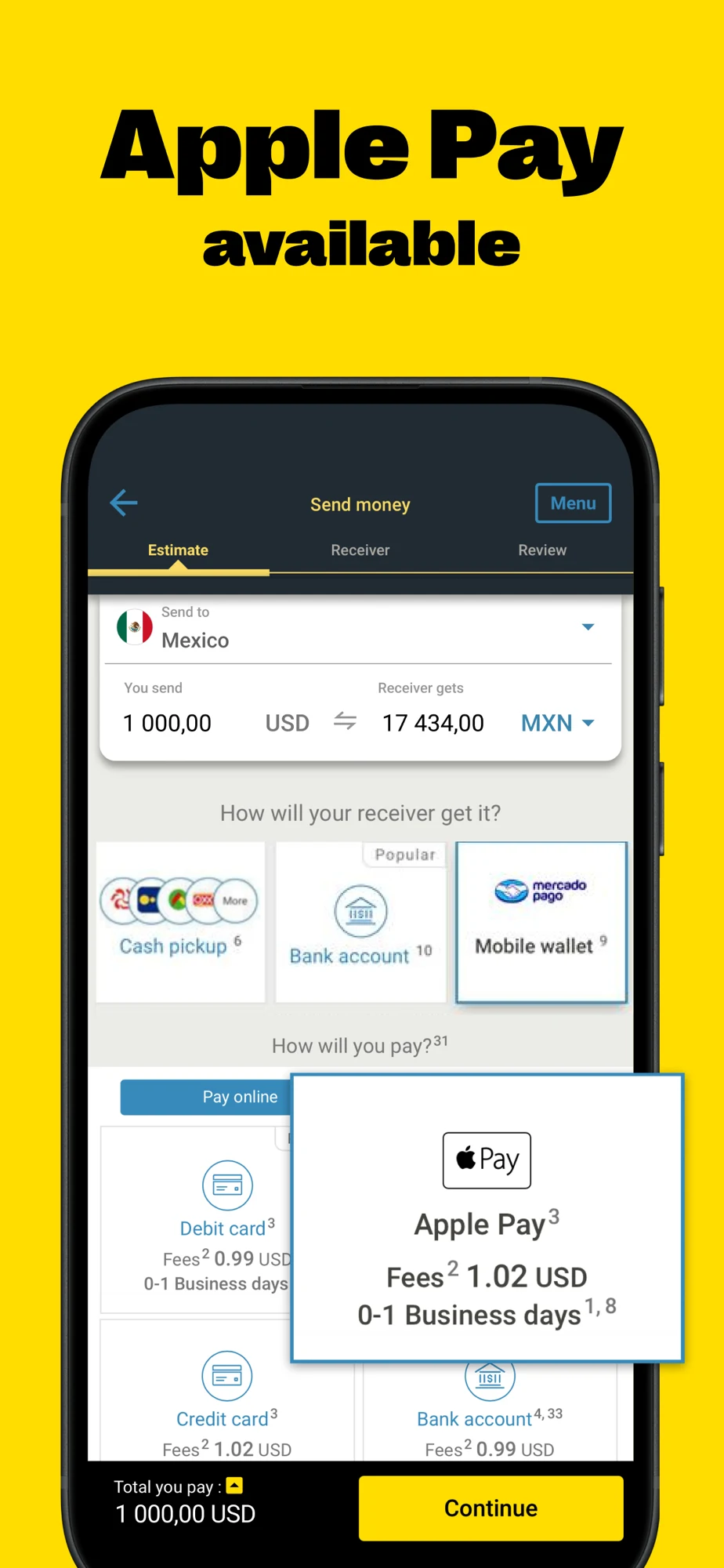
Panel 1 · A yellow-and-black opening layers several angled screens beneath social proof.Panel 2 · Flags and a country selector reinforce global coverage.Panel 3 · A first-online-transfer fee promotion includes exchange-rate context in smaller copy.Panel 4 · An Apple Pay funding panel overlays a quote and method choices.
The funding example is concrete; the opening montage makes individual details harder to read. Test one frontal review screen for a matched sending intent. Preserve the distinction between payment instrument and recipient delivery, and between a waived transfer fee and overall cost.
Ria: A promotion, transfer history, reassurance and location finding
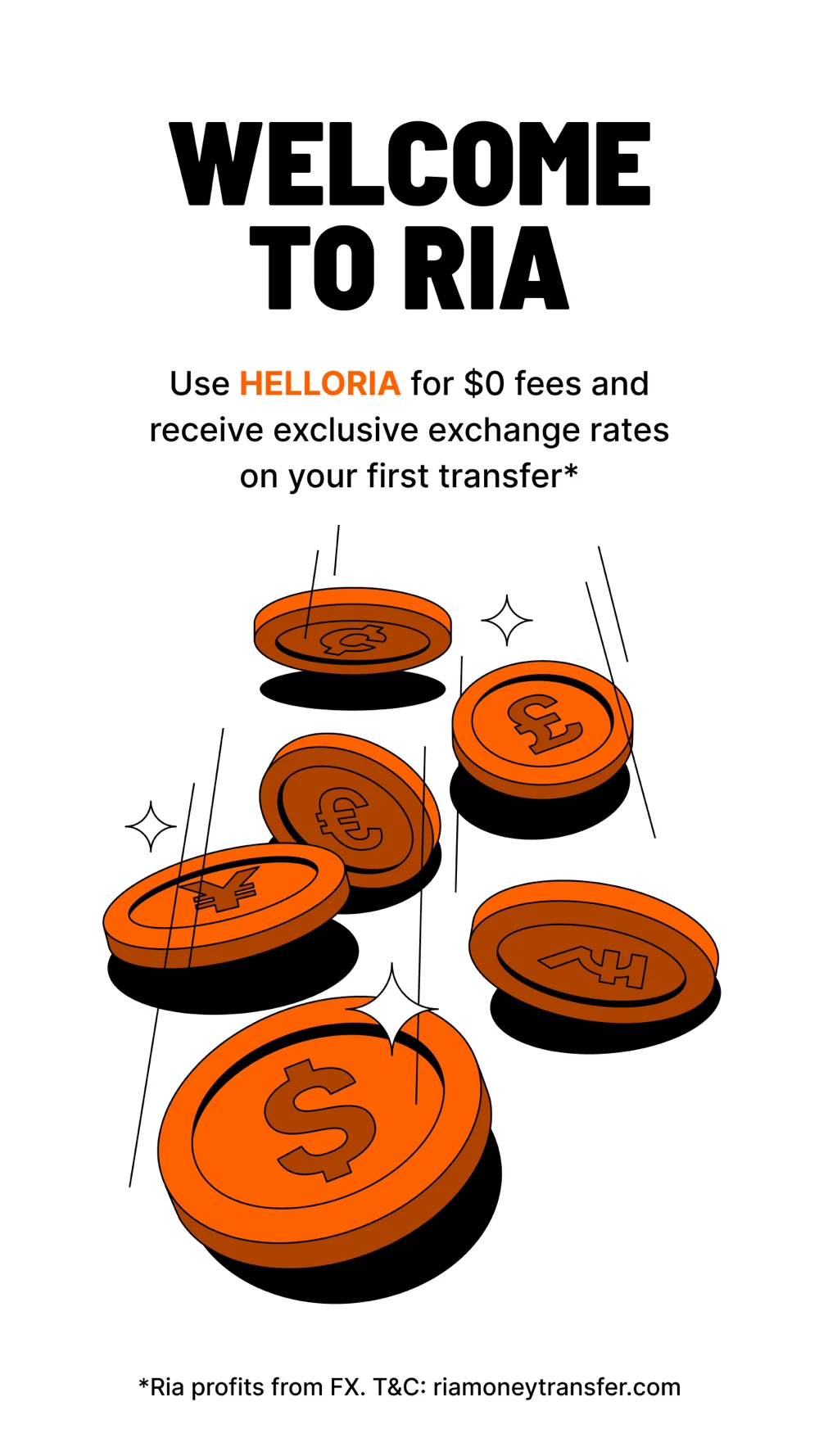
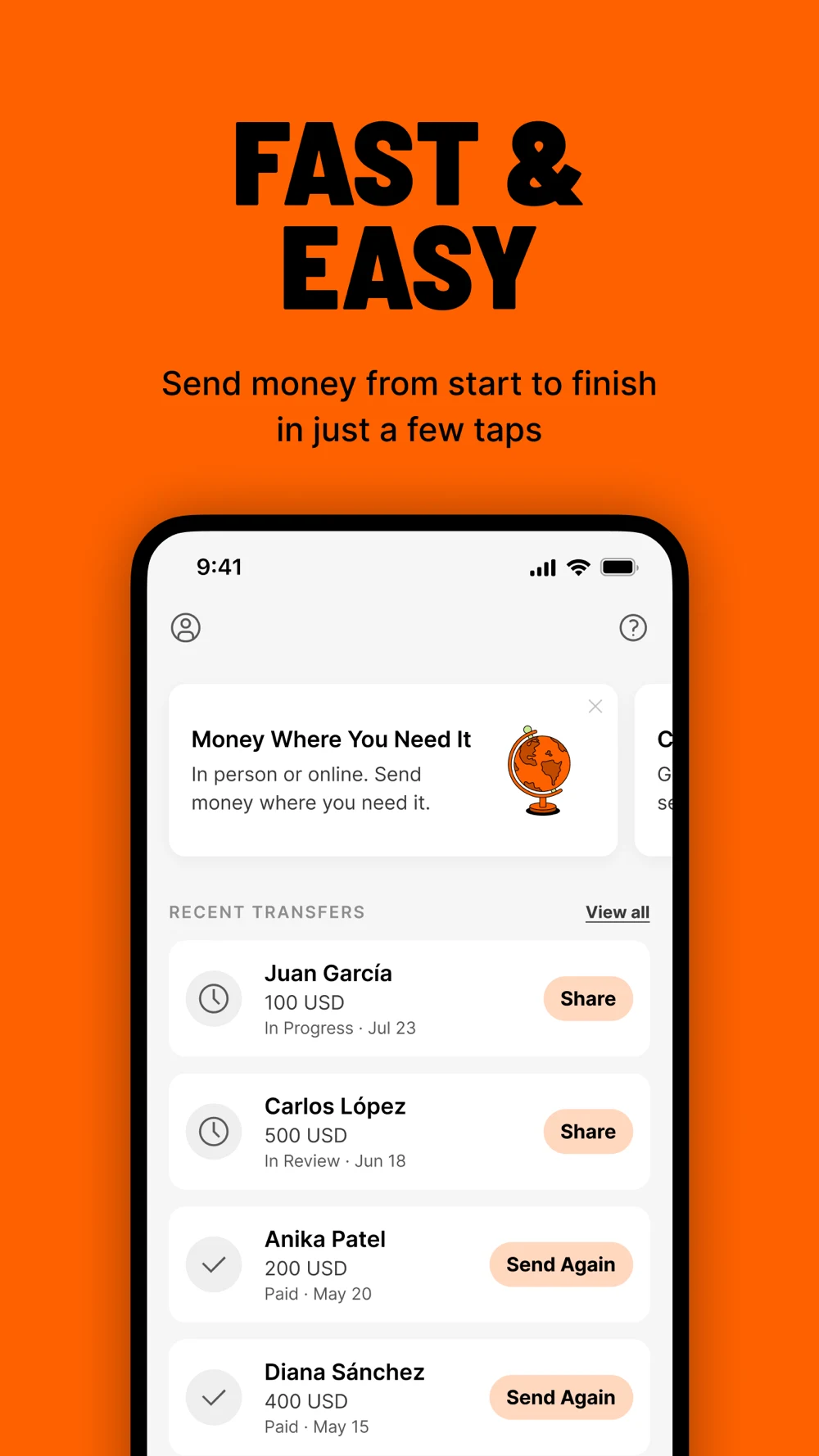
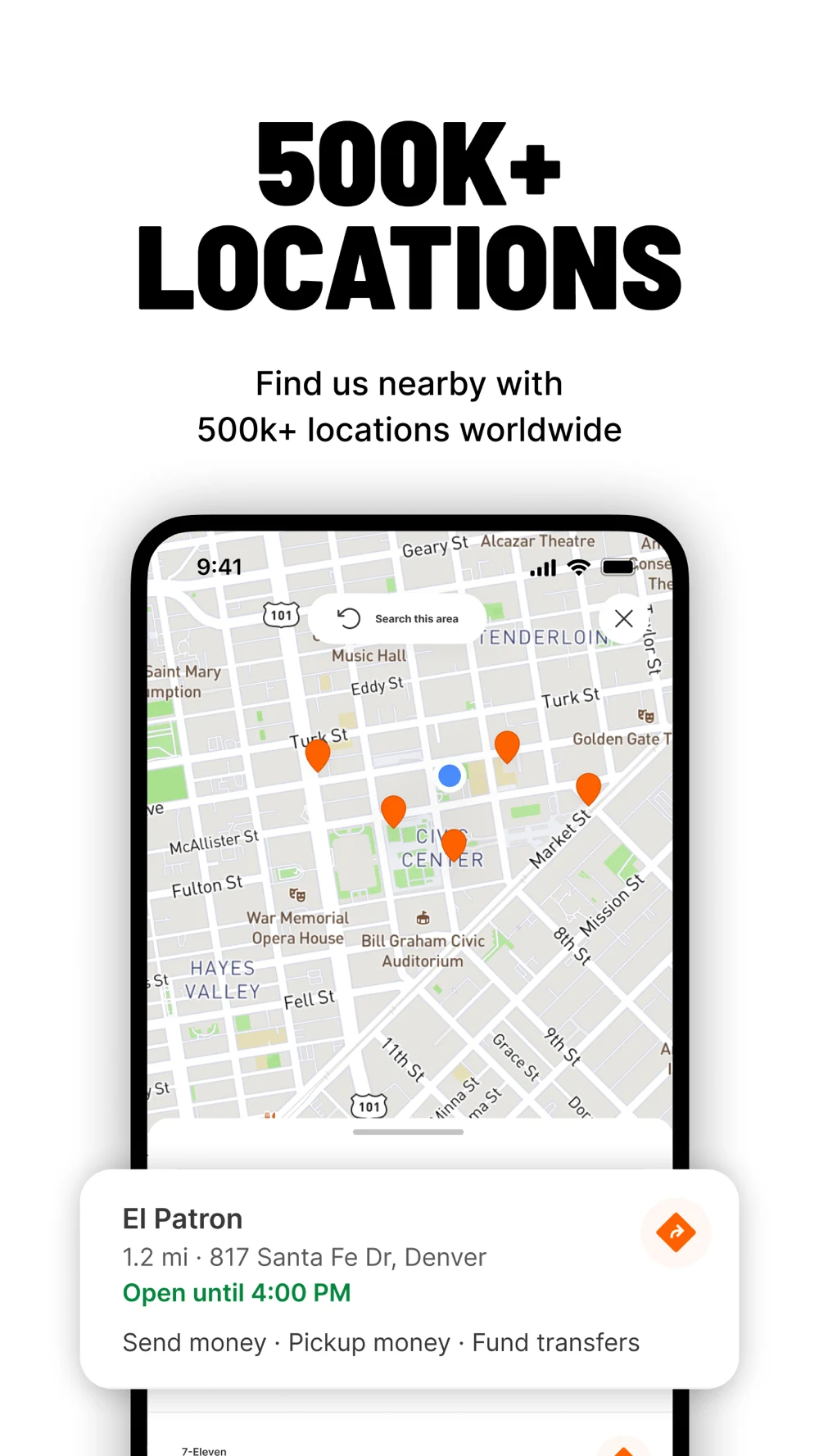
Panel 1 · A welcome offer leads with coins and a smaller exchange-rate caveat.Panel 2 · Transfer history distinguishes review, progress and paid entries.Panel 3 · A shield and rating claim provide reassurance without transaction UI.Panel 4 · A location card adds hours and services over a map.
The history frame makes repeat sending tangible. The location frame is worth a consistency check: its visible map and address appear to refer to different cities. That is an artwork QA question, not evidence of a live routing defect. Test accurate local pickup details and explicit collection status.
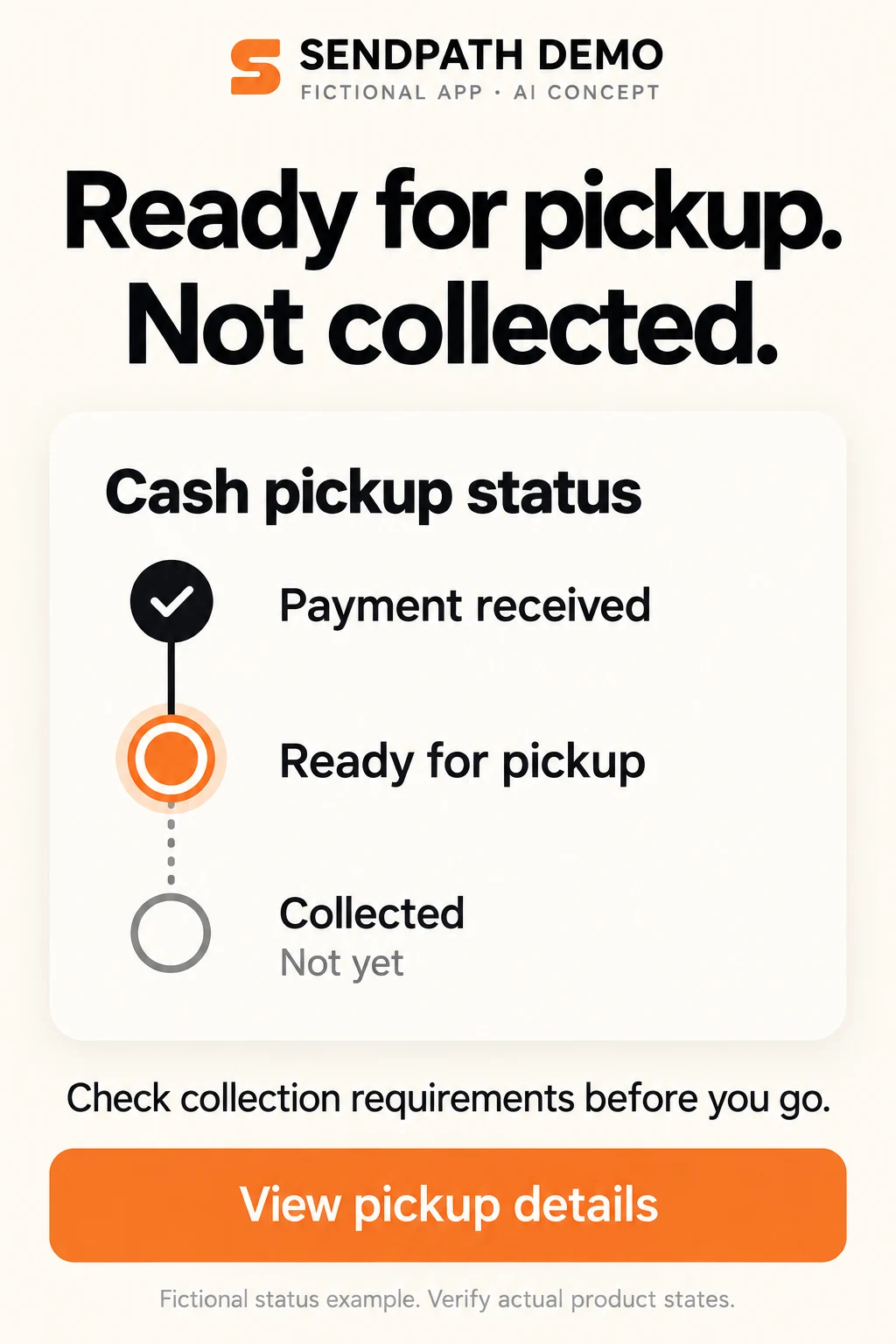
ReadyCash is ready for collection, if that is the method.
CollectedUse only after confirmed recipient collection.
The diagram is an illustrative cash-pickup path, not a universal transfer state machine. Bank deposit and wallet delivery need their own final-state labels. A failed, returned or cancelled transfer also needs a truthful path; a linear marketing timeline should not imply that every instruction succeeds. Use actual product states in screenshots and avoid a celebratory checkmark on unfinished steps.
For a low-cost diagnostic, show one status frame to a handful of relevant users and ask them to explain who has the money now, what remains unfinished and what they would do next. Record answers without leading them. Fix repeated misunderstandings before testing decorative alternatives. Then use screenshot copy and sequence planning to make the full story coherent.
MONEY TRANSFER APP ASO
Make the title clear, then let the quote prove the value.
Sendpath Demo is a fictional teaching product. These examples assume a supported personal-transfer service with quotes, bank deposit and cash pickup on defined routes, saved recipients and tracking. They do not claim universal coverage, guaranteed speed, lowest pricing or a particular verification outcome. Replace the identity and validate every feature before using any wording.
The title should identify money transfer. Supporting copy can explain why someone should inspect the app. A slogan such as “Bring the world closer” may express a brand idea, but it leaves the category and task unstated. The worked alternative below gives a recognizable product descriptor and a concrete supporting job.
4. Identify the product in the title. Prove the value in the screen.
TitleSendpath Demo: Money Transfer
Supporting copyReview fees. Track delivery.
ScreenshotKnow the full amount.
ProofSender total, fee, rate and recipient amount together.
Review transfer costs, choose supported delivery and follow your payment.
73 / 80
The ASCII keyword-field example avoids repeating the main title terms. It is not a demand-tested recommendation. Select the final field by locale, supported route and live intent; use keyword-field guidance rather than copying a research list wholesale. On Google Play, explain the product naturally in the full description; repeated country lists are not a substitute for useful information.
A worked description opening
Fictional copy: Send money on supported international routes with Sendpath Demo. Choose where your recipient will receive it, review the transfer fee and exchange rate, and check the recipient amount before you confirm.
Select an available bank-deposit or cash-pickup option for your route. Review the details required for that method and check the delivery estimate shown for your transfer. Funding choices, recipient options and timing depend on the sending country, destination and transfer details.
Follow your transfer’s actual status in the app. A payment received by the service is not the same as money received by your recipient. For cash pickup, check collection details and requirements before the recipient travels. When sending again, review the new quote even if the recipient is saved.
Eligibility, verification and supported-route requirements apply. Add your real help channel, current feature scope and product-approved terms here. Do not use this fictional text to imply that a live service supports any particular country or delivery partner.
This opening explains decisions in their actual order: route, method, quote, confirmation, tracking. A production description can then cover the precise supported funding choices, recipient information, language options and help resources. Keep essential limitations near the claim they qualify instead of hiding all the context in a final dense paragraph.
Swipe horizontally to compare all columns →
Proposed screenshot sequence — adapt it to the supported route and intent
Frame
Headline candidate
Actual UI to show
Why it belongs here
One: route fit
Send on the route you need
Eligible origin, destination and supported method
Qualifies the visitor before a broad benefit
Two: quote
Know the full amount
Sender total, fee, rate and recipient amount
Answers the cost question with visible proof
Three: recipient
Check who receives it
Redacted recipient and destination details
Makes careful review part of the story
Four: confirmation
Review before you send
Final review with accurate next-action label
Separates an estimate from a confirmed instruction
Five: tracking
Know what happens next
Current state and relevant next step
Does not imply processing equals delivery
Six: pickup alternative
Check collection details
Only the actual eligible pickup journey
Use for cash intent; replace for bank-deposit intent
Seven: repeat use
Same recipient. Fresh quote.
Saved recipient followed by updated pricing
Shows convenience without a fixed-rate implication
For a cash-pickup page, bring method and collection requirements earlier. For quote-comparison intent, lead with both sender total and recipient net. For a default listing, choose the most justified broad audience and avoid mixing mutually incompatible methods into one fictional journey. The first-screenshots guide and screenshot strategy explain how to focus the opening.
A CTA should describe the next action. “Review transfer” fits a pre-confirmation screen; “Track transfer” fits an existing instruction; “View pickup details” fits a collection-information step. “Money delivered” is a state, not a sensible label for a button that starts a transfer. Store download controls belong to the platform. Any button pictured inside artwork is part of the demonstrated app screen, not an interactive store control.
For an app preview, capture a short real journey with test data: choose an eligible route, select a method, inspect the quote, review recipient details and show the actual next state. If processing takes time, do not edit it into a false instant-delivery story. Use readable captions without requiring audio and preserve currency labels. Follow visual storytelling principles while making the temporal gap explicit.
MONEY TRANSFER APP ASO
Fix the misunderstandings that attractive artwork can hide.
These are common audit risks and proposed improvements, not measured failures attributed to named competitors. The screenshot observations above concern visible creative only. Review product behavior before deciding whether an artwork detail reflects a real issue.
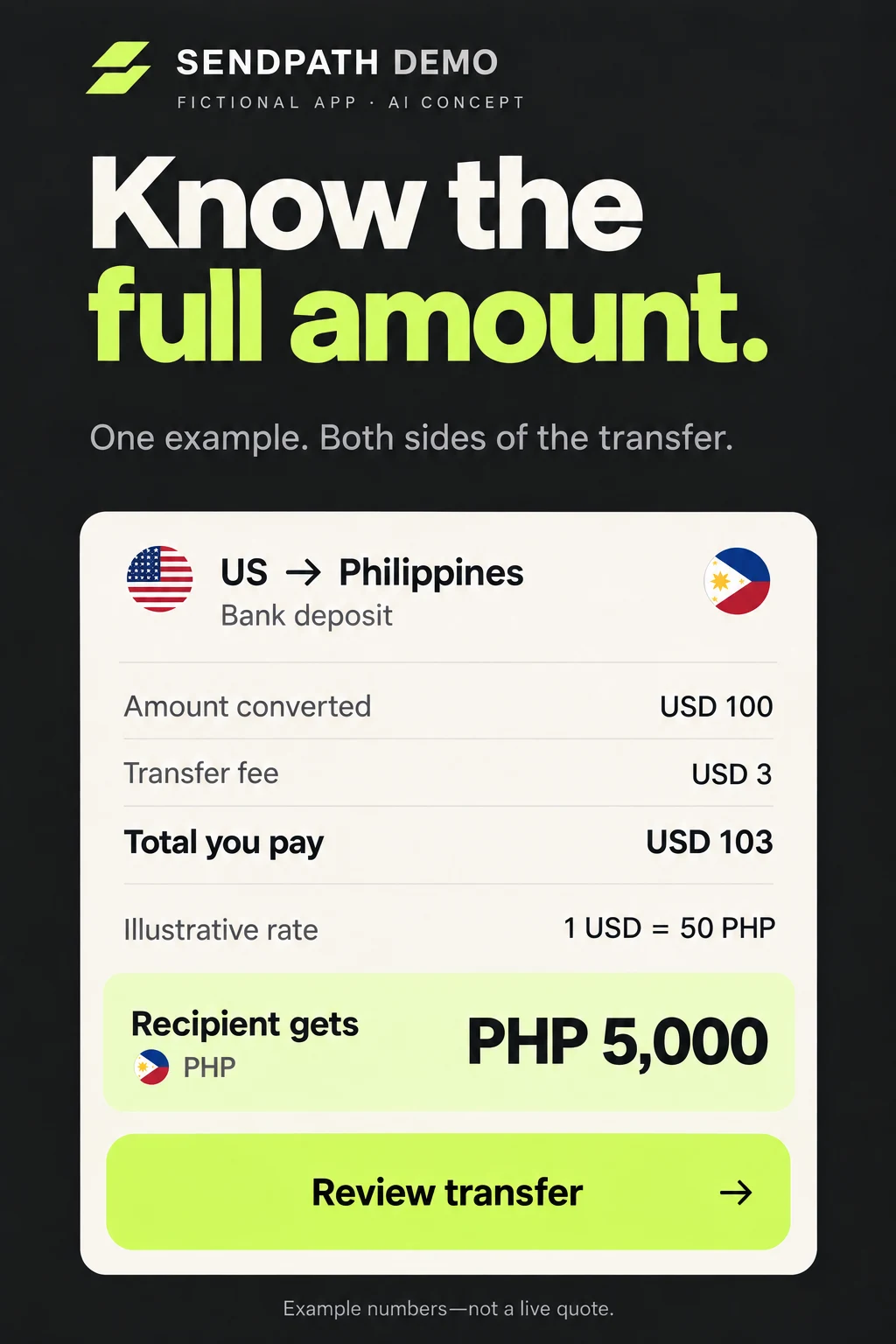
5. Show both sides of the quote.
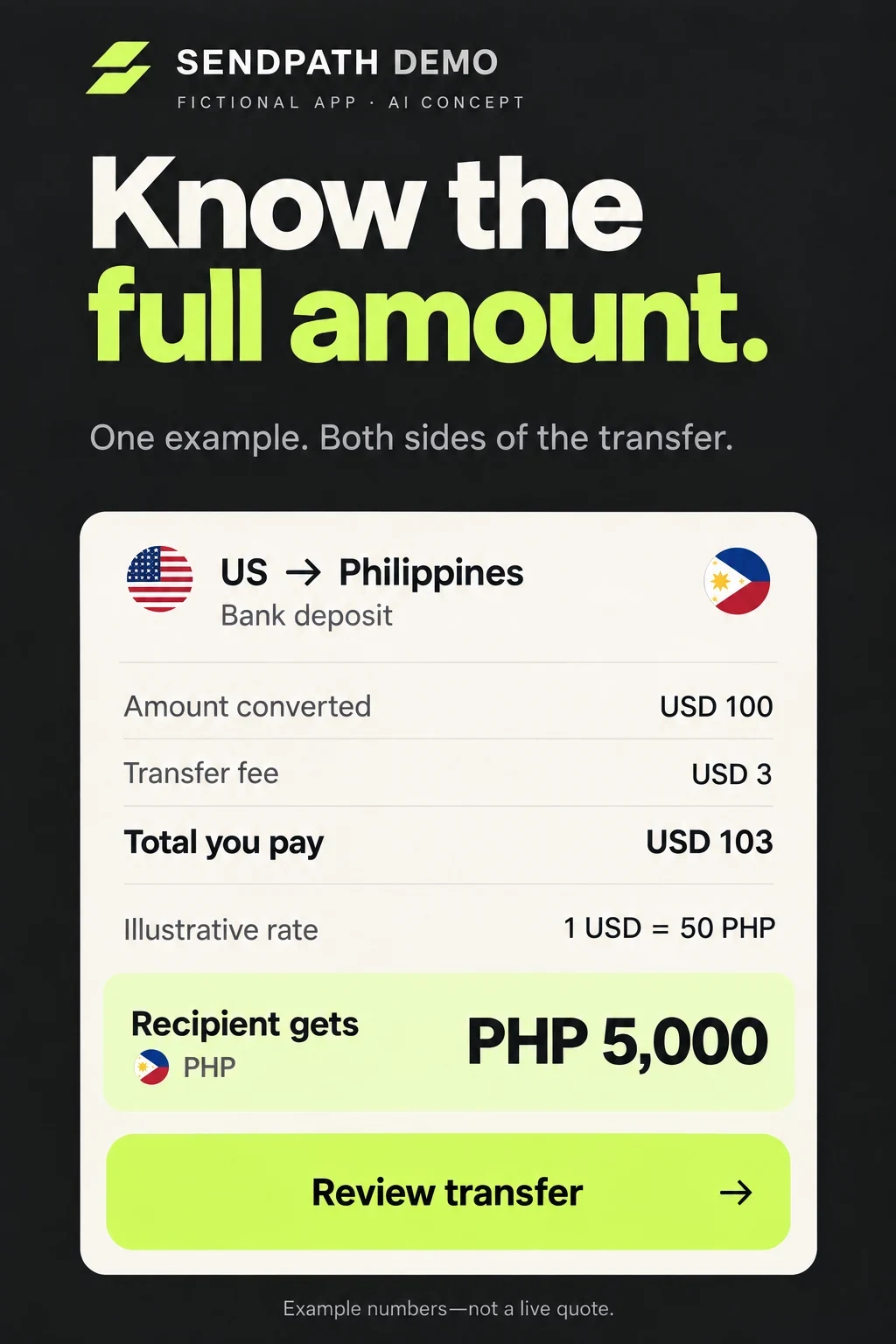
ConvertIllustrative USD 100 × 50 PHP/USD
ChargeUSD 100 + USD 3 fee = USD 103
ReceiveIllustrative recipient amount: PHP 5,000
QualifyExample only; actual route, fees and rates vary.
Swipe horizontally to compare all columns →
Money-transfer creative audit: clarity before decoration
Mistake to look for
Why it confuses people
More useful direction
Verification
Calling a waived fee a free transfer
Exchange-rate differences or other charges can still matter
Show sender total and recipient net with applicable context
Compare the complete approved quote, not one fee line
Treating a destination list as universal availability
Sending origins and recipient methods can differ
Name the supported route and method
Check the route matrix for the target audience
Mixing payment and delivery methods
A debit card may fund a bank deposit or pickup
Label how you pay separately from how they receive
Ask users to identify both sides
Using a partly completed quote as final pricing
Blank fees or totals can be mistaken for zero
Complete the method selection or label the screen as an estimate
Match every visible field to the depicted stage
Turning a timing estimate into a guarantee
Reviews and partner processing can change the outcome
Keep estimate language and actual state separate
Verify current route-specific wording
Marking every timeline step complete
Ready for pickup is not collected
Use unfinished styling and actual status terms
Ask who has received funds now
Letting a promotion swallow the product story
First-transfer terms do not explain repeat use
Show offer scope plus an ordinary transfer journey
Check expiry, eligibility and repeat-customer creative
Reusing old prices with a saved recipient
Same destination does not imply the same quote
Put a fresh review before confirmation
Check the product flow and comprehension
Using map decoration as location evidence
A map and address can contradict each other
Use consistent verified sample geography and services
Check city, address, hours, pin and service list together
Using one enormous number without currency labels
Sender and recipient amounts may use different currencies
Keep currency codes and row meanings attached
Read the frame without flags or surrounding prose
Counting installs as completed remittances
Many visitors are returning users or ineligible senders
Separate acquisition, funding and recipient payout
Use explicit cohort and transaction-state definitions
Translating words but not recipient instructions
Local method names, hours and documents may differ
Review the whole supported journey with native-language expertise
Test the final screen and help path, not only a spreadsheet
In the fictional quote diagram, USD 100 is converted at an invented illustrative rate of 50 PHP per USD. The recipient example is PHP 5,000; a separate USD 3 fee makes the sender total USD 103. These numbers are not current market prices. They teach the distinction between principal, fee and total charged. If a real product deducts a fee from the sent amount, the arithmetic and labels must change together.
Compare two providers only with equivalent sender totals, delivery methods, funding methods and timing assumptions. A smaller advertised transfer fee does not alone establish a better recipient amount. For ASO, the practical lesson is to make the quote understandable, not to claim a pricing winner without an appropriate comparison.
Prioritize errors that change the perceived product promise before polishing colors. Use test prioritization and trust-signal guidance to distinguish actual product evidence from generic shields, flags and badges. A state label that prevents a wrong expectation may matter more than another reassurance slogan.
MONEY TRANSFER APP ASO
Turn ASO research into a focused, measurable Search Ads plan.
Use ASO research to design an Apple Ads search-results pilot, then return the learning to metadata and creative. Start with one eligible sender market, one supported route family and a clear definition of a new activated sender. Nothing in this plan launches a campaign or authorizes spending. It is a worked setup for review.
The App Store country or region selected for a campaign is not a substitute for verifying the person’s actual transfer eligibility. Keep corridor availability in the product flow. Separate first-time senders from returning app users and from people merely checking an existing transfer. A cheap install can still be a poor acquisition.
6. Carry one intent from the search to the transfer.
SearchA supported corridor and delivery need
PageMatching route, quote and method proof
ActivationFirst eligible transfer reaches the defined paid-out state.
LearningUse query fit and outcomes to refine ASO.
Swipe horizontally to compare all columns →
Proposed campaign structure — adapt after eligibility and account review
Campaign / group
Research inputs
Initial matching approach
Creative and guardrail
Brand
Official brand and approved spelling variants
Exact; Search Match off in this focused group
Recognizable official identity; report returning users separately
Category: general transfer
money transfer app; international remittance
Exact starter terms; inspect actual matched queries
Supported transfer journey and clear quote
Category: route and method
A verified corridor plus bank deposit or pickup terms
Exact, grouped by coherent method
Matching CPP where available; no unsupported route promise
Competitor exploration
Relevant brands from verified research
Separate exact group only if justified and permitted
Own identity and product proof; never impersonate another app
Discovery: broader intent
Relevant supported seed terms
Broad match in a bounded discovery group
Review route fit and actual search terms before promotion
Discovery: Search Match
App and listing relevance
Separate Search Match group
Find language you missed; retain independent budget and exclusions
The separation follows Apple’s campaign-structure guidance. Search terms are more informative than keyword labels alone. Apple’s current match-type documentation explains that exact matching can include close variants, and broad matching can reach related searches beyond the literal phrase. Inspect what actually matched rather than assuming exact means identical text.
Use negative keywords for demonstrated mismatch, with the appropriate campaign or group scope; negative keywords default to exact. Examples to investigate include domestic-only payment intent, unsupported business payouts or a destination the product cannot serve. Do not blanket-exclude a country word without checking whether it appears in a supported route. Keep a reason and review date for every exclusion.
A concrete corridor research-to-ad example
Suppose a fictional product supports US senders paying eligible bank accounts in the Philippines. The research cluster includes “send money us to philippines” and “send money philippines bank deposit.” Check current search results and customer language first. If the intent fits, place the validated phrases in one focused group, match it to a bank-deposit creative page, and keep cash pickup out of that page unless it is separately supported and clearly presented.
The opening frame names the route and bank delivery. The second shows the full quote. The third demonstrates recipient review. The app destination should preserve the route when technically supported, but it must still check eligibility, authentication and required details. A deep link must not imply it can bypass verification. Read Apple’s CPP guidance and test the actual new-install and returning-user paths before use.
Swipe horizontally to compare all columns →
Measurement ladder — distinguish sender funding from recipient delivery
Stage
Event definition to agree
What the result can teach
Store visit / install
Use the platform’s defined denominator and attribution window
Whether the listing attracts installs from the intended source
Route selected
An eligible route and method are selected
Whether creative and product scope match
Quote reviewed
A complete quote is displayed and reviewed
Whether users reach the cost decision
Transfer funded
Sender funding is confirmed under the product definition
Whether installation becomes a funded instruction
First transfer paid out
First eligible new-sender transaction reaches its method-specific recipient state
Acquisition quality; do not count cancelled or duplicate transactions
Repeat completed transfer
A defined later transaction in a declared cohort window
Repeat use without blending new and existing senders
Bound the pilot with economics, not an arbitrary bid
Illustrative planning numbers only: if 20% of attributed new installs become first eligible paid-out transfers and the allowable acquisition cost per such sender is USD 15, the implied maximum cost per install is USD 3 (0.20 × 15). If 40% of taps become installs, the corresponding planning cost per tap is USD 1.20 (0.40 × 3). These are assumptions for a worksheet, not observed rates, recommended bids or a performance forecast.
Define the allowable acquisition cost from contribution economics, not transfer principal. Sending USD 500 does not create USD 500 of revenue. Model the relevant fees and exchange revenue, subtract payment processing, partner payout costs, promotions, support and expected reversals over a declared period, and use finance-approved assumptions. The purpose here is to connect acquisition measurement to a defensible limit, not to recommend a financial product.
Before a pilot, write the market, route, test period, maximum spend, daily limit, event maturity window and stop conditions. If conversion tracking breaks or the route becomes unavailable, pause that test. If spending reaches its cap without enough mature outcomes, classify it as inconclusive; do not raise the cap automatically. Review search relevance early, but allow the declared completion window before judging downstream performance.
Separate first-transfer promotions from ordinary pricing, and tag major exchange-rate movements, holidays, payout outages and campaign changes as context. A creative change made during a promotional surge does not alone explain the resulting install movement. Use conversion definitions, ASO KPIs and reporting discipline.
Attribution cannot automatically tell you the exact keyword behind every completed transfer. Privacy limits, aggregation, returning users, multi-device journeys and delayed outcomes can restrict that connection. Use available authorized reports and explicit cohort definitions; do not infer a person’s nationality or personal circumstances from a query. Paid campaign results are also not proof that the same wording improved organic ranking.
Feed learning back to ASO in a decision log: query, route fit, observed matched intent, creative, mature activation evidence and action. Relevant queries with coherent outcomes can become metadata candidates after further validation; mismatch can become an exclusion; repeated quote confusion can become a screenshot test. Connect this loop to ASO and user acquisition and record releases in the change log.
MONEY TRANSFER APP ASO
Watch the transfer decisions behind the visual trends.
These are patterns in this dated eight-app sample, not a market-growth report. They suggest where to investigate creative differences. They do not establish demand, conversion uplift or the best design for every route.
Swipe horizontally to compare all columns →
Editorial research patterns — reviewed 27 October 2026
Pattern in the reviewed material
What to investigate
What remains unknown
Broad reach competes with route-specific questions
Whether a destination-and-method opener clarifies fit
Demand and conversion for each corridor
Offers appear alongside ordinary transfer functions
Whether first-time and repeat visitors need different openings
Promotion incrementality and long-term retention
Quotes compete with emotion and reassurance
Whether legible amounts answer the visitor’s main concern earlier
Which sequence performs better for each audience
Digital and physical recipient journeys coexist
Whether cash collection deserves distinct proof and status language
Actual availability and recipient friction by location
Transfer states are compressed into short creative stories
Whether users understand processing, readiness and delivery
Comprehension in the target population
Search matching extends beyond literal phrases
Whether actual matched searches reveal useful local vocabulary
Which variants will appear in a particular account
The verified listings and original panels are the source for the creative patterns. Match behavior comes from Apple’s current documentation. Recheck these observations before a future campaign; an old screenshot can continue circulating after an offer or method changes.
Maintain a small evidence register: claim, route, method, source, owner, capture date and next review trigger. Changes to delivery partners, funding costs, supported languages or transaction states should trigger a creative review even if the app icon has not changed. Avoid publishing a trend chart from invented percentages. A useful graphic here explains a decision or process; measured charts require real data and a stated denominator.
MONEY TRANSFER APP ASO
Use AI to make the quote and the status easier to understand.
These two original AI-generated concepts use the fictional Sendpath Demo identity. One explains a complete illustrative quote; the other distinguishes readiness from collection. They are teaching proposals, not competitor screenshots, real product evidence or tested performance claims.
AI CONCEPT · Quote clarity: sender total and recipient amount · Open full size.AI CONCEPT · Pickup clarity: ready is not collected · Open full size.
7. Ask AI to clarify a decision, then audit its answer.
InputsApproved route, UI, states and fictional numbers
ConceptOne quote or one delivery state
ReviewArithmetic, implied claims and unfinished steps
RebuildActual UI, readable details and consistent branding
Swipe horizontally to compare all columns →
AI critique — polished layouts still need product and accessibility review
Concept
What it explains
What needs a production rebuild
Test question
Both sides of a quote
The converted amount, fee, charged total and recipient amount have distinct labels
Use actual UI and a validated route; include real funding context, timing and applicable charges
How much is charged and how much does the recipient receive?
Pickup state
The collected step is visibly unfinished
Match the actual state machine and collection rules; improve secondary-text and button contrast; standardize the brand mark
Has the recipient collected anything yet, and what is the next step?
The quote arithmetic is internally coherent, but the rate is invented for teaching. During generation, the model added an unrequested real-rate claim; that line was removed in a targeted edit. This is exactly why generated copy must be inspected, even when the main numbers look correct. A model can add a plausible sentence that changes the promise.
The pickup concept uses a useful active-versus-unfinished hierarchy. Its gray supporting text and white-on-orange button need contrast review in the production design. The two concepts also use different brand symbols; a real screenshot set should use one approved identity. Neither concept covers failed, returned or cancelled transfers. Those limitations belong in the creative brief, not in an assumption that a polished mockup is a finished app.
A prompt that produces useful improvement options
“Using the approved transfer quote screen and route notes, propose three readable compositions for a sender comparing costs. Preserve the sender total, fee, exchange rate, recipient amount, currency codes and actual next action. Use the supplied fictional test data. Do not add claims about price leadership, safety, speed or availability. Flag missing fields rather than inventing them. Explain which customer question each composition answers.”
For status creative: “Use the approved cash-pickup states. Make completed, current and unfinished steps distinct in words as well as color. Preserve the real collection instructions and next action. Do not turn ready for pickup into collected.” These prompts constrain the meaning before asking for visual polish.
A production workflow is straightforward: agree one hypothesis, provide approved inputs, inspect generated wording and math, rebuild in the design system with real UI, check accessibility and local language, then run a comprehension exercise. Only after that should a focused store experiment be considered. Use the creative-brief guide to keep source screens and concepts clearly separated.
Publish a clear promise for a route the product supports.
8. Localize the whole transfer journey.
LanguageUse the sender’s and recipient’s actual terms.
RouteVerify origin, destination and delivery eligibility.
DetailsCheck amounts, dates, names and collection instructions.
ReleaseApprove the final assets against the current product.
Swipe horizontally to compare all columns →
Release checklist for corridor-aware money-transfer ASO
Release check
Money-transfer detail
Evidence to retain
Route eligibility
Sender origin, recipient destination, currencies and method
Current route matrix and responsible product owner
Quote integrity
Converted amount, fees, total charged and recipient net agree
Reviewed sample-data sheet with arithmetic
Funding versus delivery
Sender instrument and recipient method are separately labeled
Actual journey capture
Timing and states
Estimate, processing, readiness and receipt mean what the product says
Approved state definitions and UI match
Pickup details
Consistent map, address, hours, supported service and requirements
Verified fictional example or approved current location data
Promotion scope
Eligibility, expiry, method and exchange-rate context
Current approved offer record
Language continuity
Local transfer terminology, quote, tracking and help
Native-language review of the entire promised journey
Accessibility
Currency labels survive cropping; states use words; text and controls are readable
Small-screen and assistive-technology checks
Metadata and creative
Relevant terms, correct limits, actual product UI and valid support links
Final localized export and screenshot sources
Measurement
New sender, funding, payout and repeat transaction remain distinct
Event definitions, cohort windows and attribution caveats
Localize the route meaning as well as the words. Currency symbols can be ambiguous; use the correct code where it matters. Date order, decimal separators, recipient naming conventions and pickup terminology need local review. A translated headline does not prove that the app or help team supports the same language. Use local keyword research, market prioritization, screenshot adaptation and localization QA.
Review the final export, not only the design file. Confirm that all frames show the same recipient and route when they tell one journey, that a sample quote does not silently change between review and confirmation, and that the final state matches the recipient method. Recheck essential labels after cropping and compression. A source asset can be large while its important text is still too small in the store.
After release, compare like-for-like storefronts, routes, source traffic and customer cohorts. Record promotions, holidays, currency movements and operational incidents as possible confounders. A result that does not reach a reliable conclusion should stay inconclusive. A useful first improvement may be fewer mistaken expectations in comprehension research, rather than an immediate claim of higher installs.
Start with one route: document eligibility, choose one intent cluster, audit the first three frames, and use a worked test brief. An ASO audit can connect the evidence and ASO services can coordinate keyword research, copy, creative and measurement.
Research scope: eight public US iOS listings, five sets of original screenshots, and official Apple and Google Play guidance. No Android competitor audit, private transaction testing, measured keyword demand or competitor conversion results. Audience segments, niche opportunities, fictional copy and AI creative are proposals to validate. This is an app-marketing guide, not a recommendation of financial services.