By Gabriel Machuret · US iOS competitor research · reviewed 27 October 2026 · iOS and Google Play guidance
AI CONCEPT · KEEP THE CONTEXT WITH THE SCORE.
CREDIT MANAGEMENT APP ASO
Separate checking credit from building credit.
Someone searching “check credit score” wants information. Someone searching “credit builder” may be looking for a financial product with payments, fees and reporting obligations. Someone searching “credit report errors” needs a way to inspect a record and understand a process. These searches share a category word, but they should not share an undifferentiated promise.
Start the ASO brief by naming the service. Score monitoring, report access, credit-building accounts, payment reporting, dispute assistance and offer marketplaces are different jobs. An app can combine them, but an opening screenshot should still make the featured journey recognizable. A visitor should not have to install the app to discover that the advertised service requires a different plan or a separate account.
The finance category guide maps the broader market. The banking guide covers account controls, while budgeting and expense tracking address spending records. This report concentrates on credit information and credit-management acquisition, not general debt advice.
1. Identify the service before promising progress.
MonitorShow supported scores, reports and alerts.
BuildExplain the actual credit or reporting product.
ReviewHelp inspect entries and follow a defined process.
MatchGive each search intent the right product story.
Swipe horizontally to compare all columns →
Six credit jobs that need different ASO stories
Service
Customer question
Evidence the page needs
Boundary to preserve
Score monitoring
Which score am I looking at?
Model, source, date and available history
A score is not an approval decision
Report access
What is actually in my file?
Available bureau, report or summary and update scope
One report does not imply every bureau
Credit-building product
What am I signing up for?
Mechanism, commitment, costs and eligibility
Monitoring alone is not a credit-building account
Rent or bill reporting
Which payments can be reported?
Eligible payment types, source and reporting status
Payment made does not prove reporting is complete
Report review
What can I do about this entry?
Entry detail, supported assistance and actual stages
A submitted request does not guarantee removal
Offer marketplace
What does this match mean?
Offer scope, relevant terms and approval explanation
A match is not guaranteed lender approval
Create a capability sheet before drafting metadata: market, eligibility, available score models, bureau coverage, refresh cadence, subscription boundaries, account obligations, reporting process, permissions and help channels. Pair each claim with actual product evidence and an owner. This turns ASO strategy into a concrete decision about which searches the app can honestly serve.
The CFPB distinguishes reports from scores and explains that scores can vary with the data source, model, lending purpose and calculation date. That distinction matters to creative: enlarging one number while removing its context can make the product harder to understand.
This is a dated review of eight public US iOS listings and twenty original Apple-served panels. It is not a ranking of financial providers or an account-level product test. Android guidance is included, but Android competitor assets have not been audited. Public screenshots reveal communication choices; they do not reveal conversion rates, customer outcomes or the accuracy of every publisher claim.
CREDIT MANAGEMENT APP ASO
Research the credit task without stereotyping the person.
Treat these audiences as research hypotheses. Relevant demographic dimensions include adult age bands, local credit-system experience, language, accessibility, device use and household responsibilities. None establishes a person’s score, income, financial literacy or likely behavior. A young adult may understand credit products well; an older newcomer to a country may have limited local history.
Recruit around the task and the product’s actual eligibility. Ask what someone wants to inspect, whether they have used another service, and which terms they find unclear. Use fictional records rather than requesting personal credit reports or sensitive identifiers. The purpose is to understand the store message, not to diagnose a participant’s financial position.
Swipe horizontally to compare all columns →
Audience hypotheses — not measured demographic segments
Potential audience
Job
Recruitment dimensions
Research question
Useful proof
First-time report reader
Understand what a score and report mean
Adult age bands, language, prior exposure to credit systems
Which number or label needs explaining first?
Model, source, date and report details
Person with limited recorded history
Understand whether the product can serve them
Local credit-file experience, account eligibility, recent relocation
Does the product require an existing score or file?
What appears on the lock screen and what data is linked?
Actual permissions and notification controls
Reader using accessibility features
Interpret scores, tables and status consistently
Large text, screen reader, color perception, device size
Can meaning survive without color or a small gauge?
Text labels, readable dates and clear navigation
Run a short comprehension exercise with three separate openings: monitoring, a credit-building account and report review. Ask participants what each product does and whether it requires borrowing, payments or a subscription. Record the words that caused confusion. Do not count a positive emotional response as proof that someone understood the commitment.
Then show a score card. Ask which model and bureau it uses, when it was updated and whether it promises approval for a loan. A person who can read the number but cannot explain its context may need a different hierarchy. For a review workflow, ask whether a request has been sent and whether anything has been changed on the report.
Use search intent to connect these questions to acquisition, value propositions to frame the benefit and test hypotheses to turn a finding into a specific comparison. Avoid stigmatizing labels or creative that assumes a visitor has poor credit merely because they searched the category.
CREDIT MANAGEMENT APP ASO
Build keyword clusters around the service people actually need.
The following 100 distinct candidates are starting points, not measured search demand or easy-ranking opportunities. Each cluster includes a product gate. Some educational and support phrases will fit a helpful web page better than app metadata. A large list is useful only when irrelevant terms are rejected.
Product check: Research intent may belong in educational content rather than acquisition metadata.
credit education appcredit history for beginnersunderstand credit inquiriescredit report before mortgagecredit score before car loanlearn credit terminologyunderstand reported balancescredit report checklistcredit monitoring for beginnerscredit building basics
Narrow tasks and accessibility
Product check: Validate combinations against the actual journey and local language; no measured demand implied.
credit app with report datescredit score app with model namecredit alerts without loan offerscredit report app in spanishaccessible credit monitoring appcredit app with large texttrack rent reporting progresscompare score sources in one appcredit app for thin filescredit report review without borrowing
For each phrase, record store, country, language, search date, returned product types and the customer’s likely job. “Credit builder” may lead to a loan, a restricted credit line or a reporting service. “Credit report” may imply a complete file rather than a factor summary. Use the research process and relevance checks to resolve those differences before scoring potential.
Keep your brand, competitor names and unsupported features separate. A competitor’s use of a bureau name does not grant permission to imply a data relationship or offer that score model. Terms such as guaranteed approval, instant repair or a promised point increase should not be manufactured into keyword opportunities. The product and its substantiation determine the language, not the other way around.
Expand by actual capability: alert → new account alert → inspect the changed account; report → account detail → review the reported payment status. Use customer language and authorized search-term reports to test those branches. Keep volume estimates and difficulty estimates separate from verified feature support. The CSV keeps the gate, locale and decision visible for prioritization.
CREDIT MANAGEMENT APP ASO
Find the narrow question your product can answer clearly.
Narrow opportunities become useful when the app can demonstrate something the broad category hides. A report date, a clear subscription boundary or an inspectable reporting status can be more distinctive than another large score gauge. These angles remain hypotheses until current search results and product evidence support them.
Swipe horizontally to compare all columns →
Long-tail hypotheses with evidence requirements
Niche
Candidate language
Opening proof
Validation question
Score context
credit score app with model name; compare score sources in one app
Score with readable model, bureau and date
Can the app expose that context accurately for each score?
Monitoring without an offer-first journey
credit alerts without loan offers; credit report review without borrowing
Actual report or alert task
Does the real experience match the absence implied by the phrase?
Thin-file understanding
credit app for thin files; credit history for beginners
Honest eligibility and no-score explanation
What happens when the person has no supported score?
Rent-reporting progress
track rent reporting progress; rent reporting status
Eligible payment and current reporting stage
Is this a reported payment or merely a logged payment?
Clear report freshness
credit app with report dates; credit report update
Report date and refresh scope
Does the displayed date describe the report, score or last app visit?
Accessible explanations
credit app with large text; accessible credit monitoring app
Real large-text labels and non-color status
Has the product been tested with the relevant access needs?
Localized report reading
credit report app in spanish; learn credit terminology
Actual localized report explanations
Do the supported journey and help match the listing language?
Review before a major application
credit report before mortgage; credit score before car loan
Relevant model and report information with accurate limits
Is the app providing information rather than promising approval?
A niche page should change the evidence, not just insert a longer phrase into a headline. A rent-reporting page needs the payment’s source and destination bureau. A report-review page needs entry detail and process states. A score-context page needs model and dates. Use long-tail research and gap analysis to decide whether that difference is meaningful.
Avoid presenting “no borrowing” as a property of a product that opens a credit account, or “free” as a description of a paid feature. Verify the whole journey, including the point at which an account or subscription is required. A precise niche can reduce irrelevant acquisition, but this guide has no demand or conversion data proving that it will.
CREDIT MANAGEMENT APP ASO
Compare the mechanisms behind eight credit-app promises.
Titles, subtitles, listed sellers and descriptions were checked against primary Apple listings on 27 October 2026. This sample spans monitoring and credit-building models so the differences are visible. Inclusion is not an endorsement, a ranking or a claim that the services are interchangeable.
Swipe horizontally to compare all columns →
Eight verified US iOS listings for credit-management research
Build Credit & Money: Dovly AI Subtitle: Fast fix: credit score boost
Combines report and score access, dispute assistance, building products and money insights.
Show the supported process without implying that AI guarantees a correction or score result.
The listed seller is shown separately from the short brand name. Some products include financial services delivered through other entities; the table does not turn the app seller into a bank or credit bureau. Follow the primary listing for current product descriptions, terms and eligibility.
Several descriptions contain point-gain averages, speed claims, audience counts or comparative language. We have not independently validated those outcomes and do not recommend borrowing them. A dated publisher statement is evidence of positioning, not evidence that your app can make the same claim. Use competitor research to identify questions worth testing, not to inherit someone else’s promises.
The most useful comparison is often between mechanisms: a score viewer explains information; a payment-reporting service explains what it reports; a credit-building account explains an obligation; a review tool explains a process. That is a stronger basis for the first screenshot than deciding which competitor uses the boldest number.
CREDIT MANAGEMENT APP ASO
Use store tools to test clarity while preserving product scope.
Swipe horizontally to compare all columns →
Platform guidance reviewed 27 October 2026
Surface
Current capability or limit
Credit-app use
iOS name / subtitle
30 characters each
Identify the credit task without promising a result
iOS keywords
100 characters
Add relevant supported concepts without repetition or competitor stuffing
iOS product page optimization
Tests icons, screenshots and previews
Compare a contextual score view with another clear product hypothesis
iOS custom product pages
Tailored assets, supported keyword assignment and deep links
Separate monitoring, reporting and builder journeys when genuinely available
Google Play text
Title 30; short description 80; full description 4,000 characters
Explain service scope, plan and permissions in natural language
Google Play experiments
Graphic and localized-text testing
Test a specific message with comparable traffic and meaningful downstream measures
Product page optimization is not a test of every metadata field. Custom product pages support tailored creative and current discovery features, but the page still has to reflect the real product. A deep link cannot make an unsupported bureau, plan or account available.
Apple’s screenshot guidance calls for actual app-use evidence. The fictional AI images later in this report are teaching concepts. A production version needs real UI, accurate scope and the required context. These platform notes are an editorial checklist, not a complete review of financial-app submission requirements; assess the actual service and target market before submission.
CREDIT MANAGEMENT APP ASO
Look beyond the score gauge and inspect the product evidence.
Each set contains four original Apple-served iPhone panels, inspected individually. Select a panel for the full-size file. These are publisher assets, not AI reconstructions or browser thumbnails. The sequence follows the retrieved feed and may differ from a live storefront, device or campaign page.
Read the headline first, then check whether the visible UI proves it. Is this a score, a report, a financial-health measure, a credit product or an offer? Which conditions sit in small text? Which important labels would disappear in a tighter crop? Use the readability guide to assess the meaning as well as the font size.
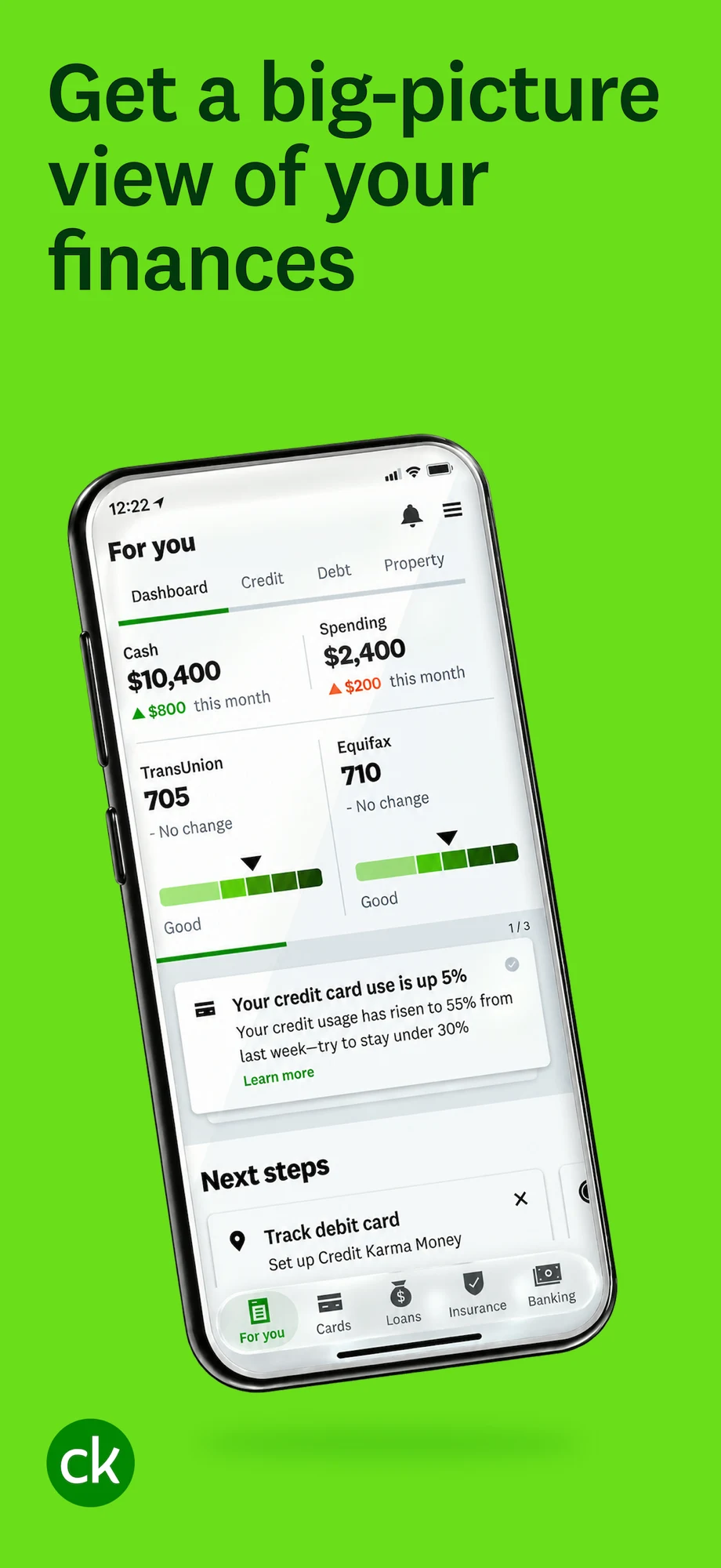
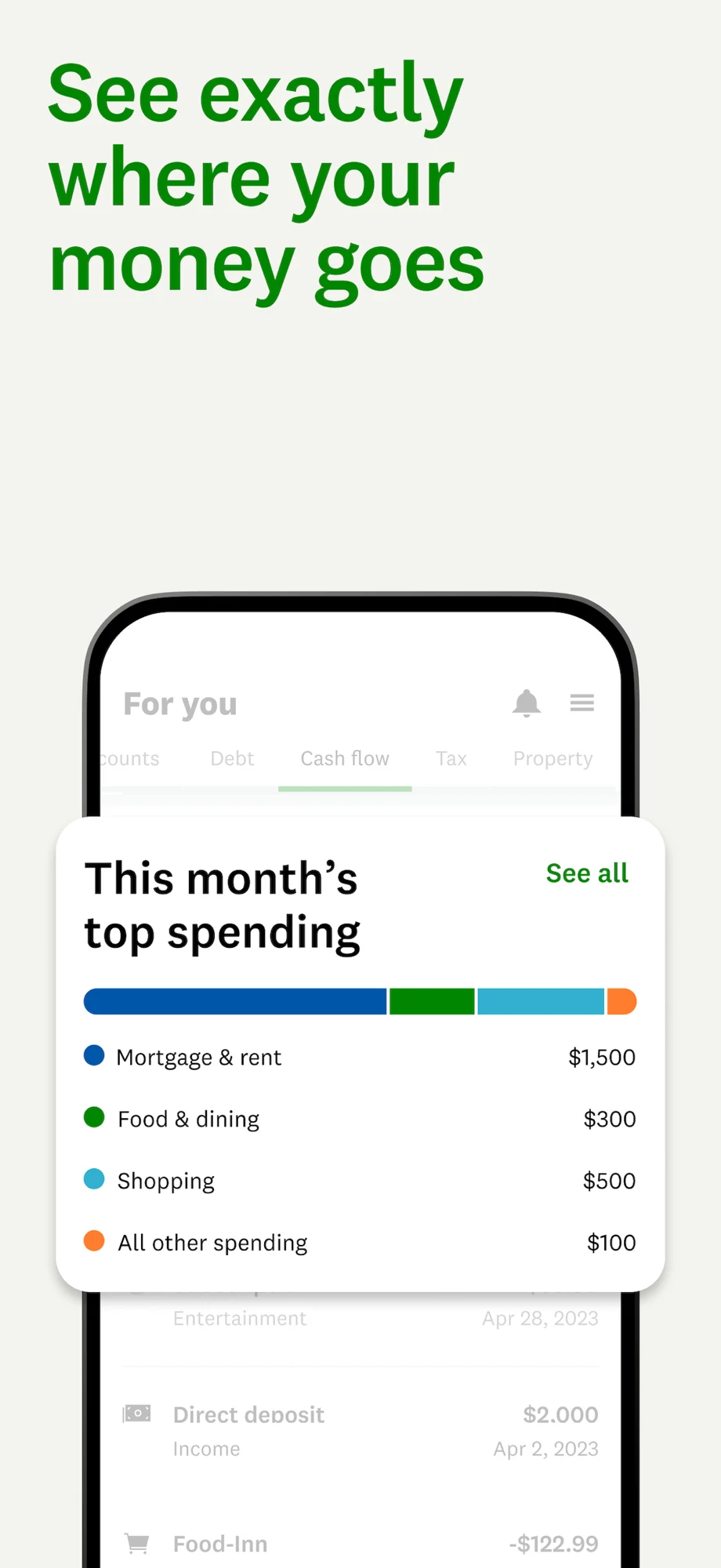
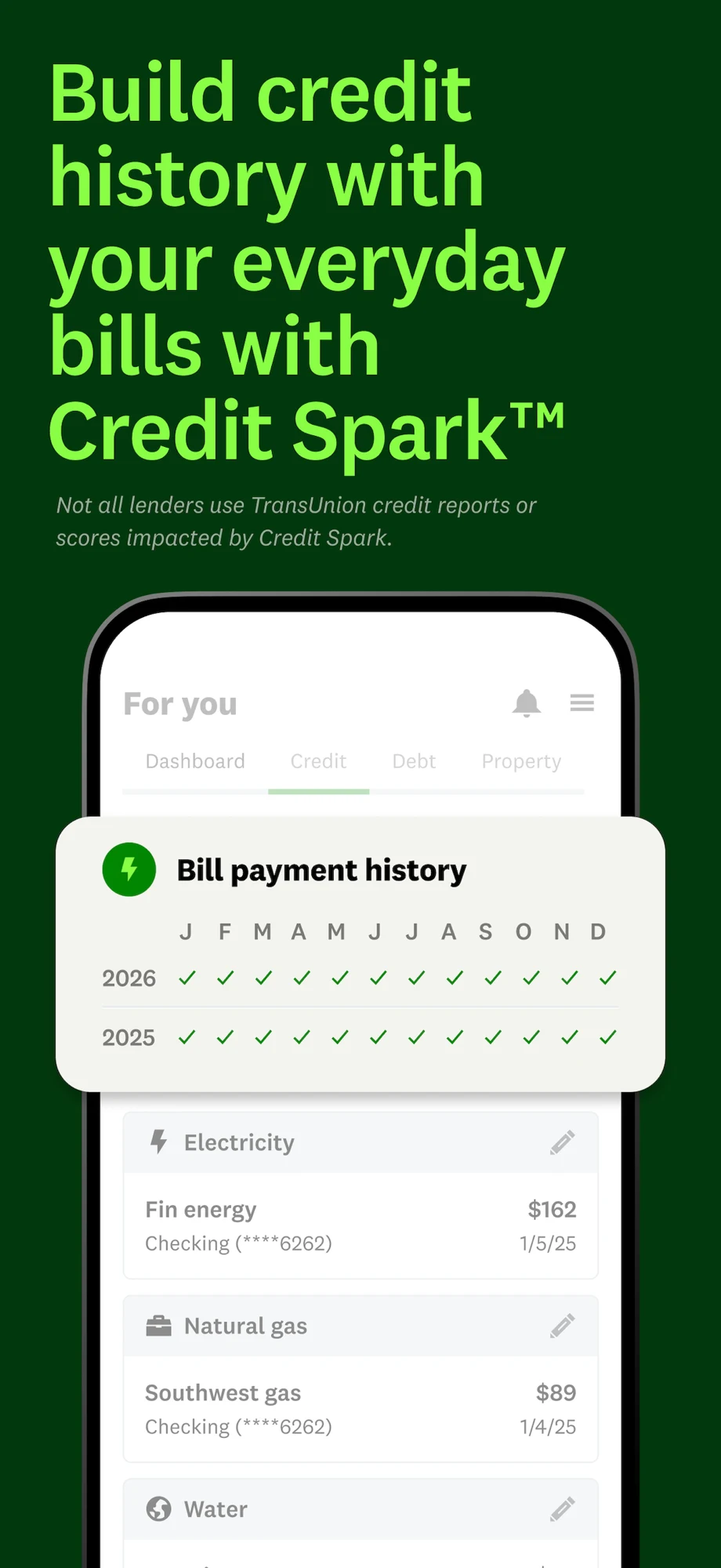
Credit Karma: A broad financial view alongside credit and banking
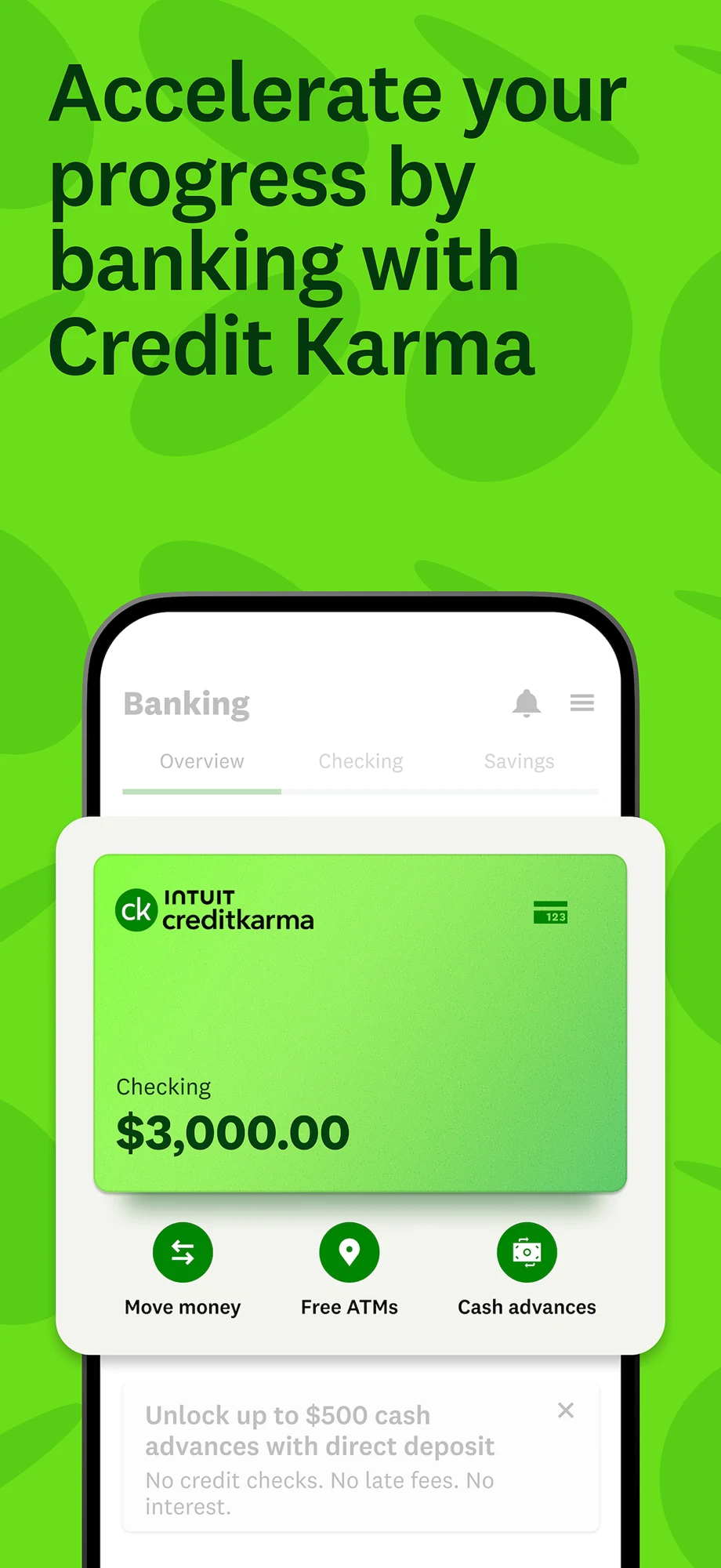
Panel 1 · An angled dashboard shows two bureau scores alongside cash and spending.Panel 2 · An enlarged spending breakdown shifts attention from credit to monthly expenses.Panel 3 · A bill-history overlay presents payment reporting with a lender-use qualification.Panel 4 · A banking frame introduces a checking balance and money-movement features.
The bold hierarchy makes the product areas recognizable. For credit-monitoring searches, test a focused score-and-report frame before adjacent spending or banking. Preserve the source context and payment-reporting qualification. A comparison of two scores needs more than equally sized numbers.
Experian: Brand welcome, score access, enhancement and card offers
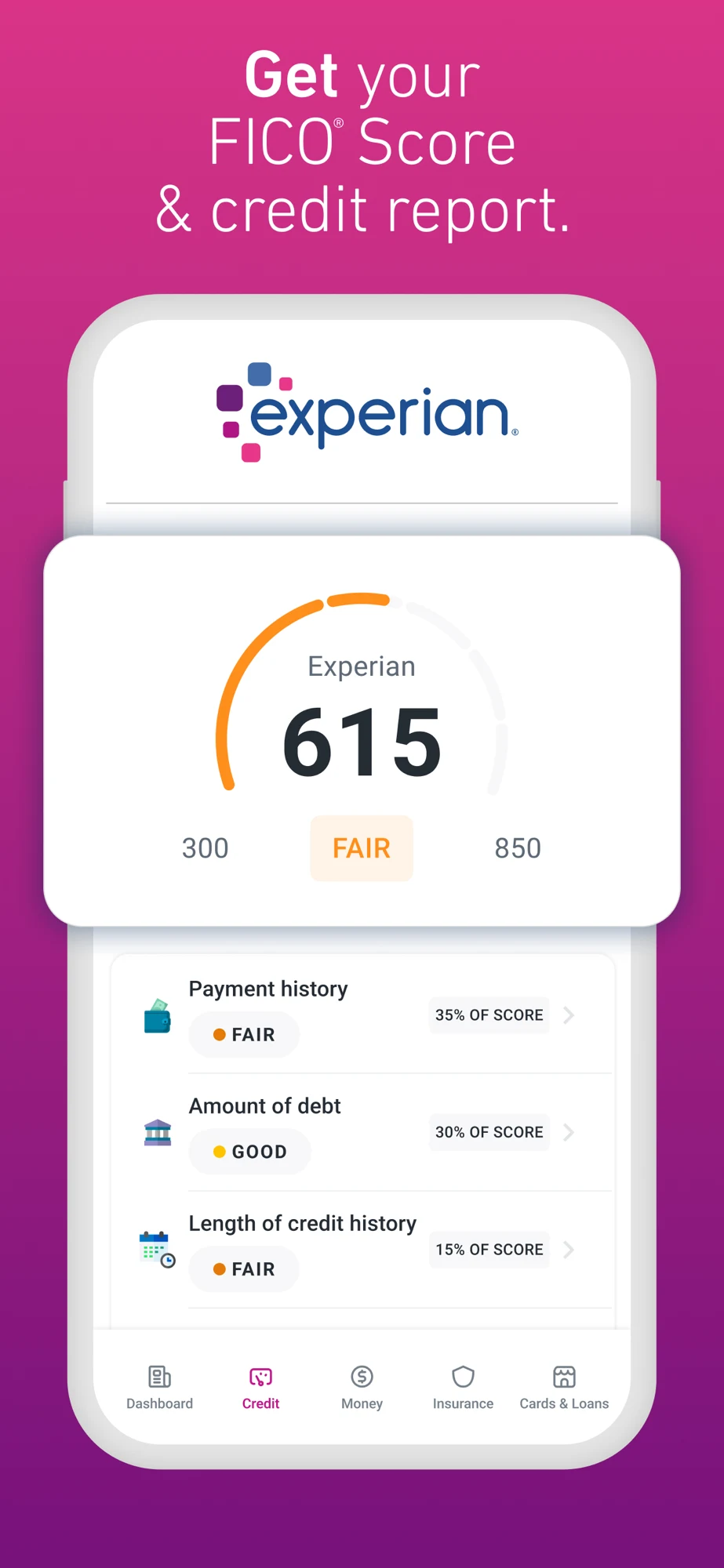
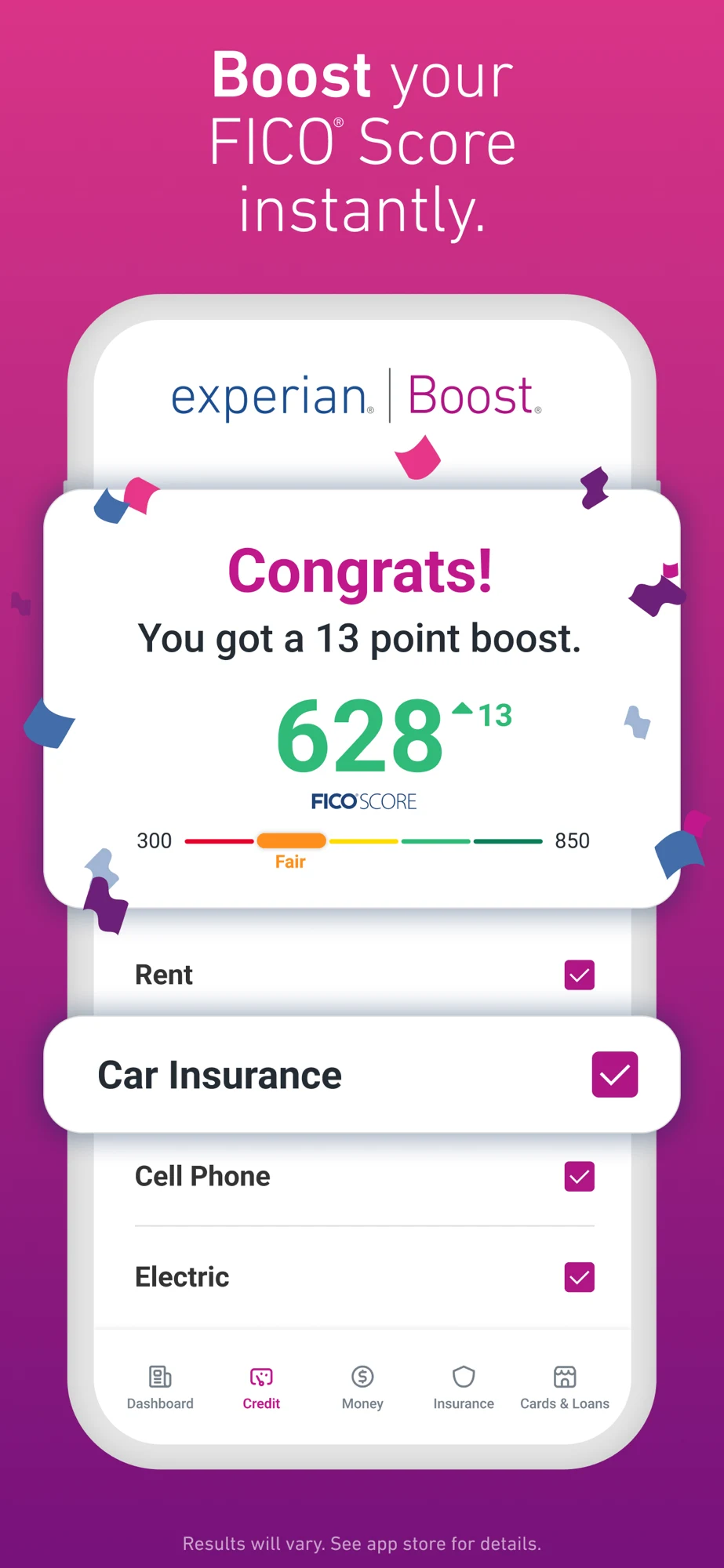
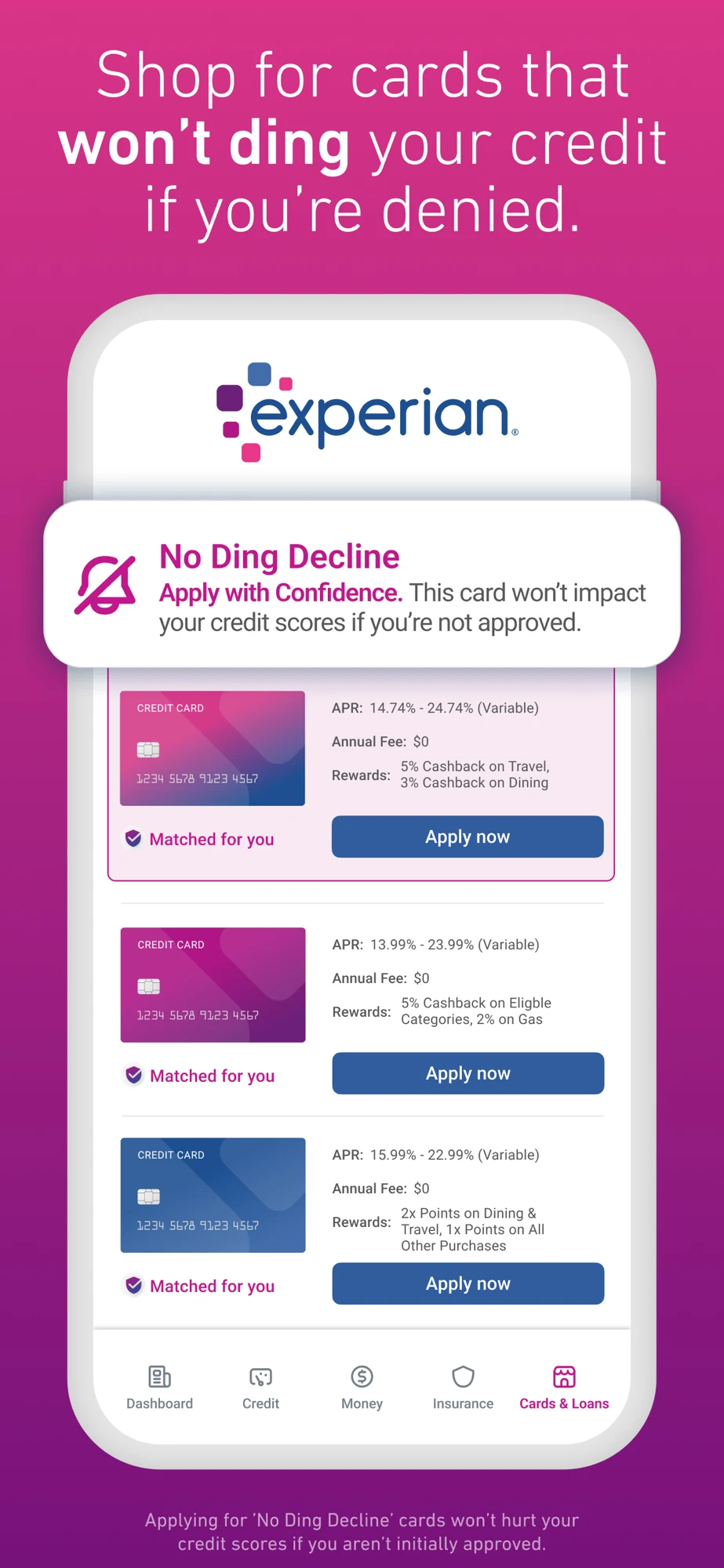
Panel 1 · A branded welcome screen uses a friendly financial-companion message.Panel 2 · A large score card appears above factor explanations.Panel 3 · A celebratory score-change example is paired with eligible-bill imagery and a results-vary note.Panel 4 · A card-offer frame emphasizes a conditional application feature.
The score frame provides more direct task evidence than the welcome illustration. Test that evidence earlier for score-checking intent. Keep model, update context and feature conditions readable. The enhancement and application messages should not be generalized into universal score improvement or approval claims.
myFICO: Model and bureau context followed by factors, alerts and reports
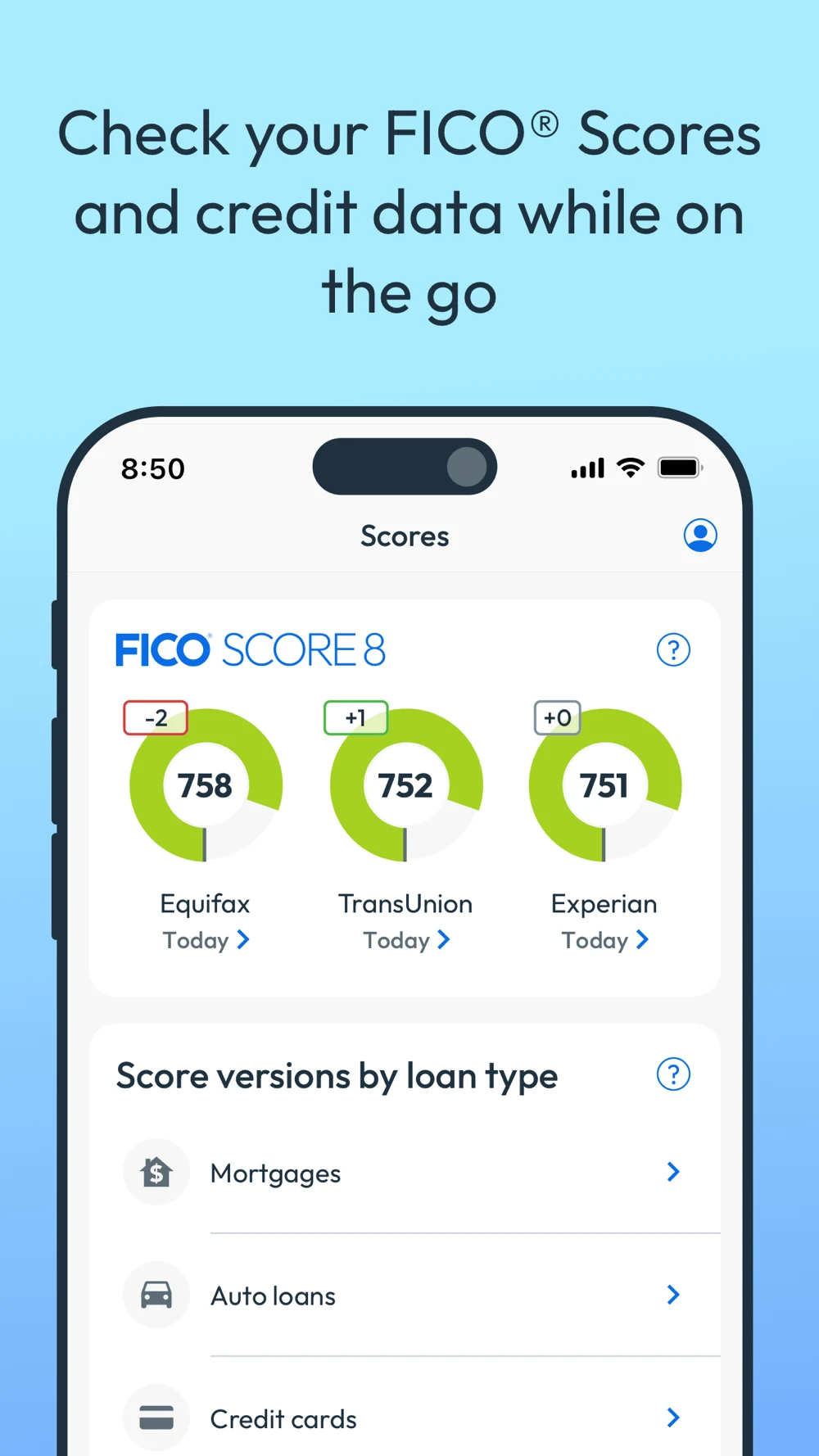
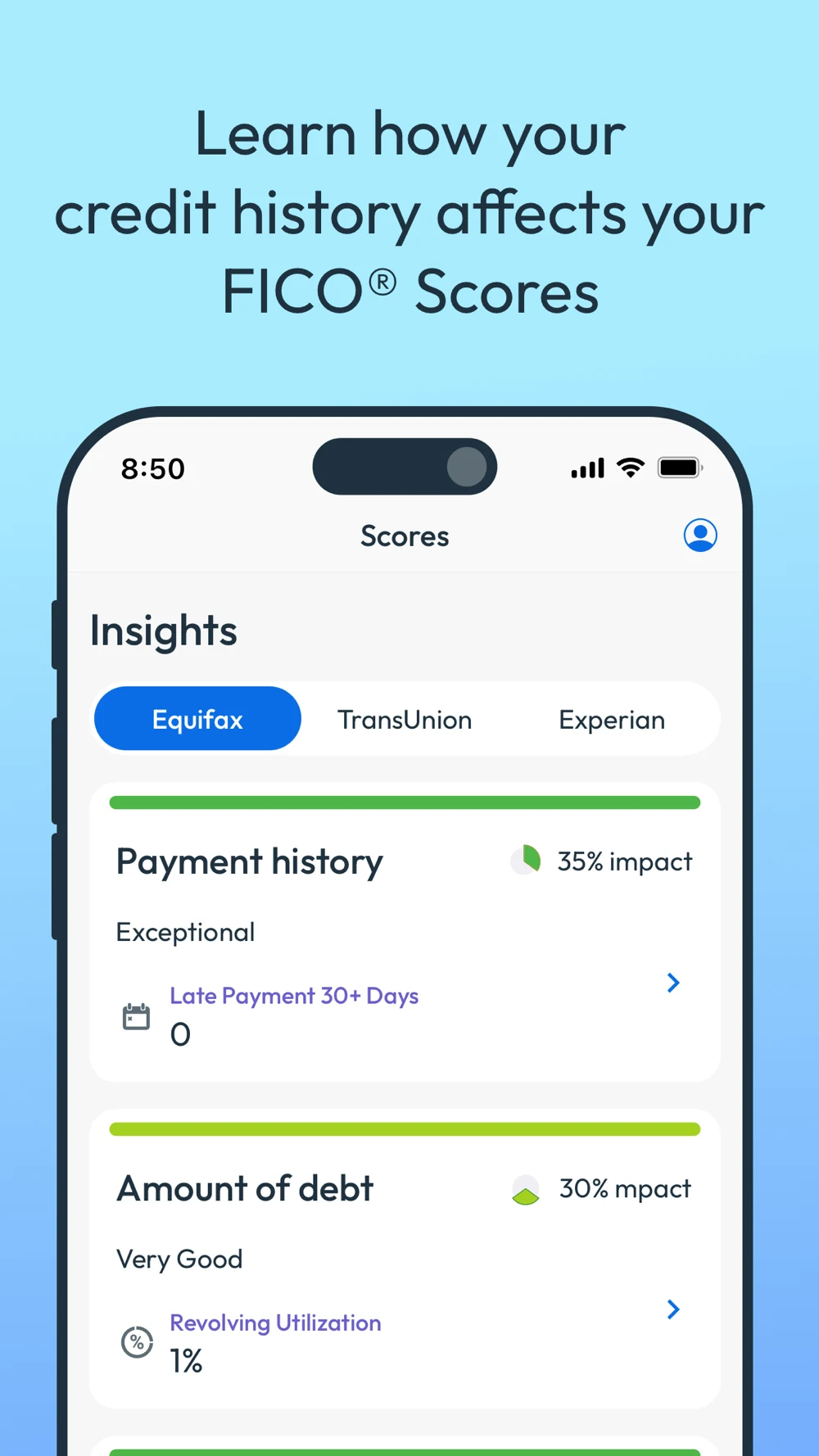
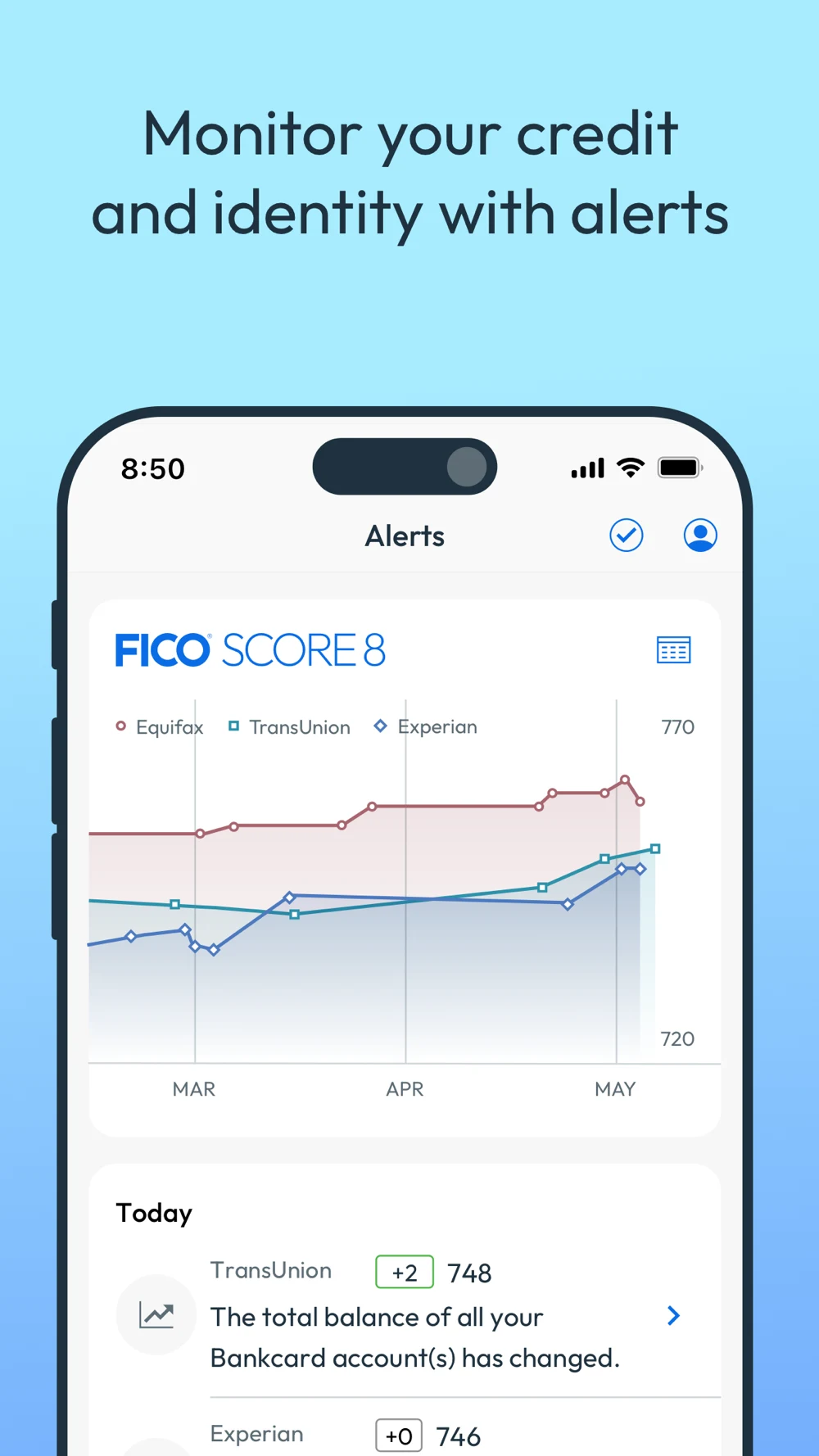
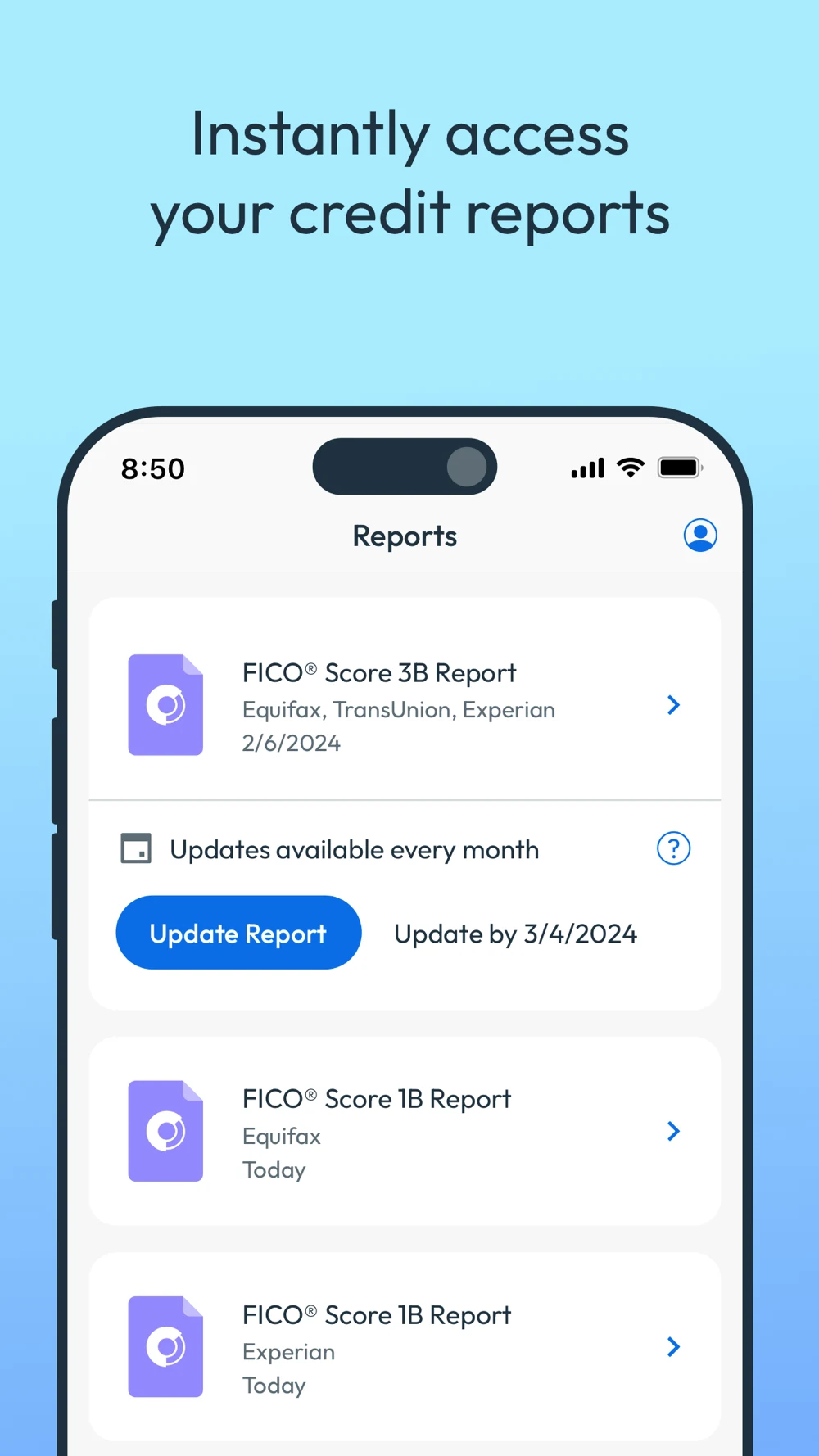
Panel 1 · Three bureau scores share a visible model label and links to score versions by loan type.Panel 2 · A factor view separates bureau tabs and payment-history details.Panel 3 · A multi-source score-history chart sits above a specific change alert.Panel 4 · A report list distinguishes bureau coverage, report dates and update availability.
This set makes data scope unusually explicit. The report frame is useful evidence that availability and refresh cadence are separate questions. Test a closer alert-detail view if the goal is to explain what changed; the chart should not overpower the next action. Confirm subscription eligibility when adapting this approach.
Self: A credit-building product family and an inspectable account
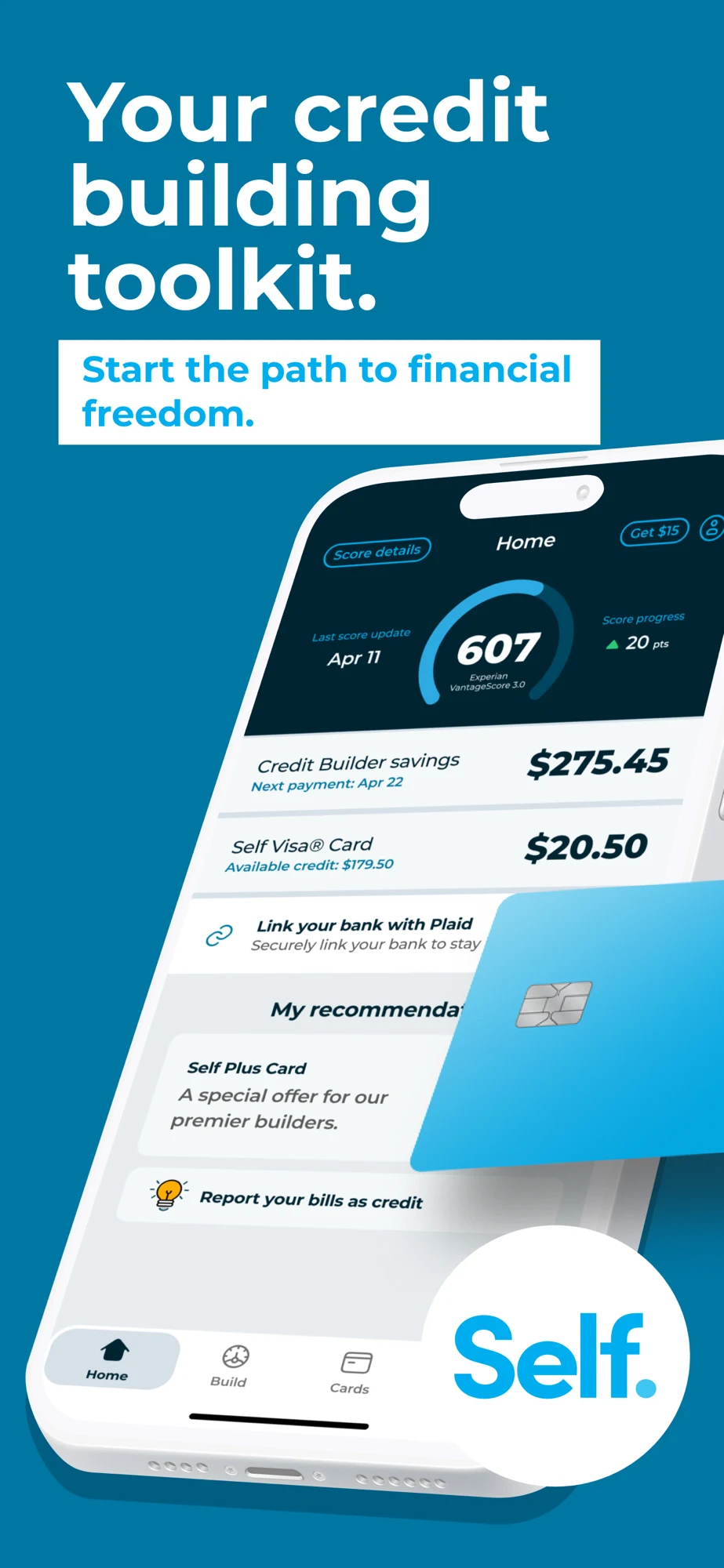
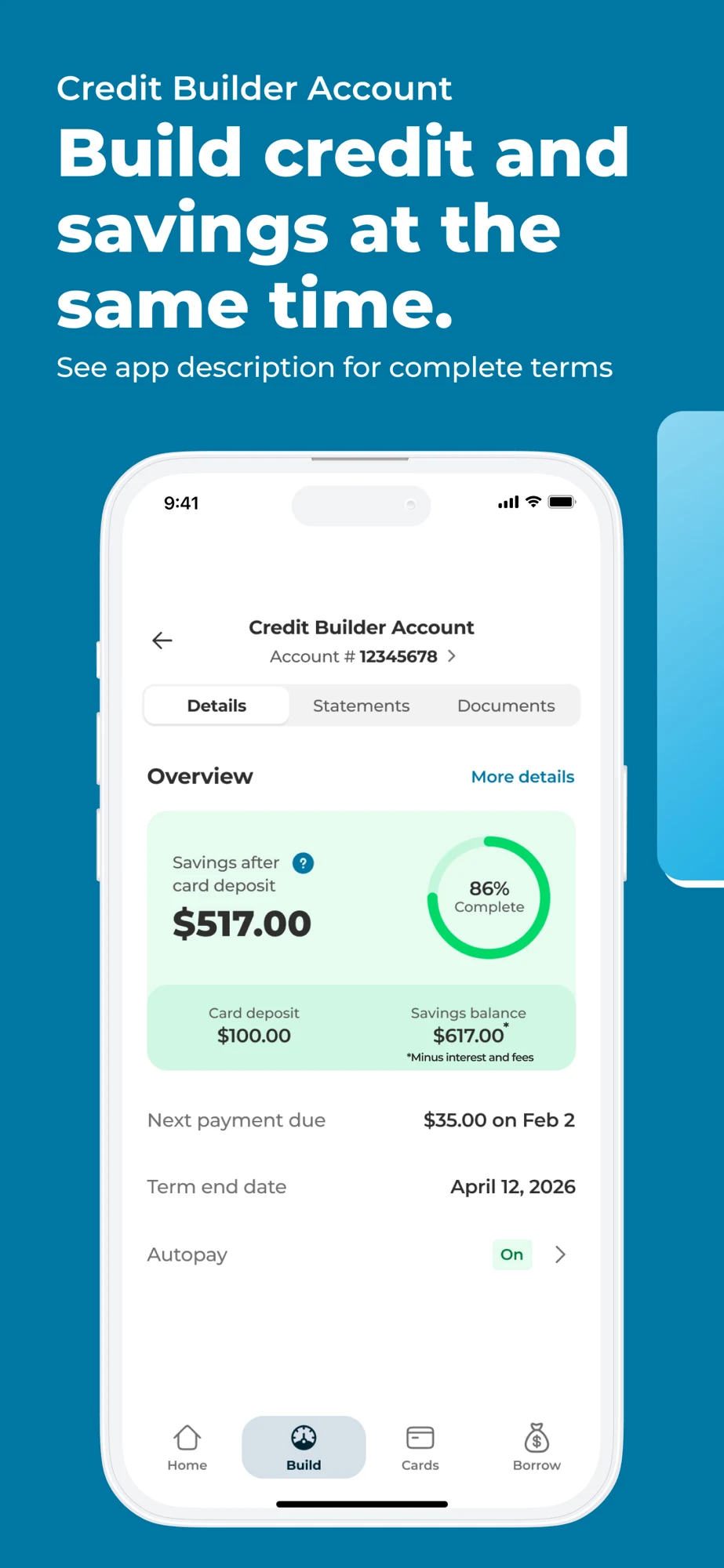
Panel 1 · An angled overview combines score context, builder savings and card information.Panel 2 · A benefit list and media mentions explain the broader toolkit.Panel 3 · A builder-account view shows payment due, term end, savings and interest/fee context.Panel 4 · A secured-card image uses lifestyle photography and directs readers to terms.
The account-detail frame explains the mechanism more concretely than the toolkit slogan. Test it earlier for builder-account intent, preserving payment, term and cost labels. A secured card, savings released after a term and score monitoring are distinct services; the opening should identify the chosen one.
Kikoff: Outcome-led headlines followed by tradeline and process details
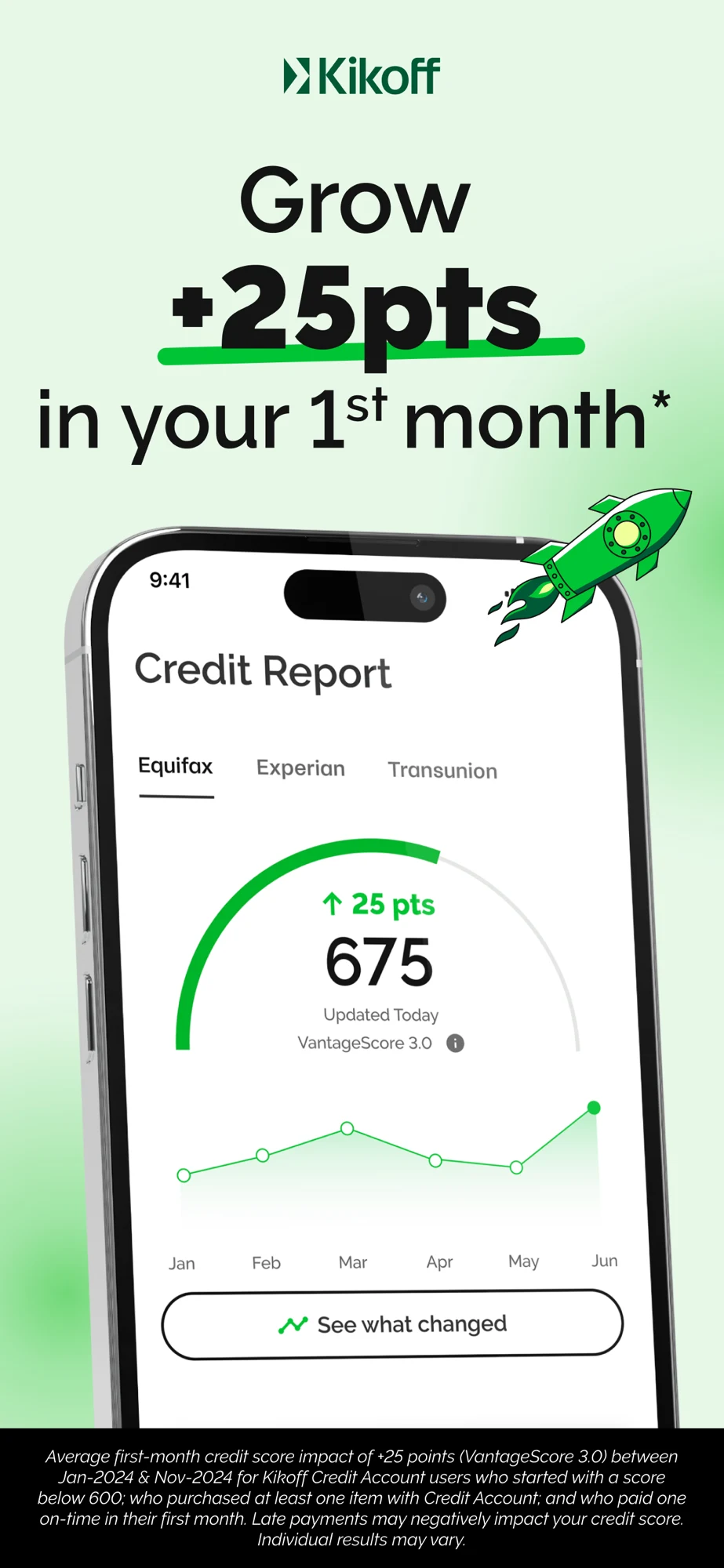
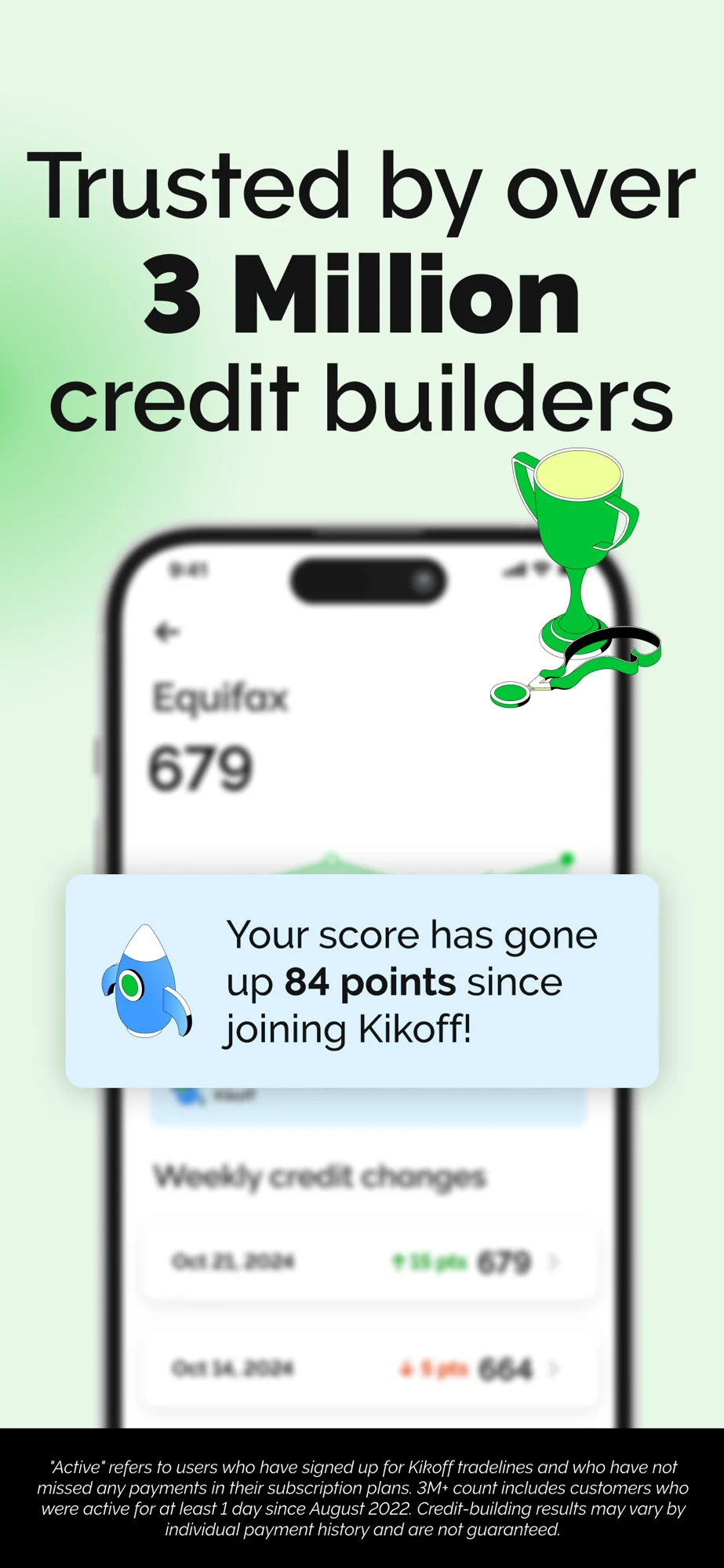
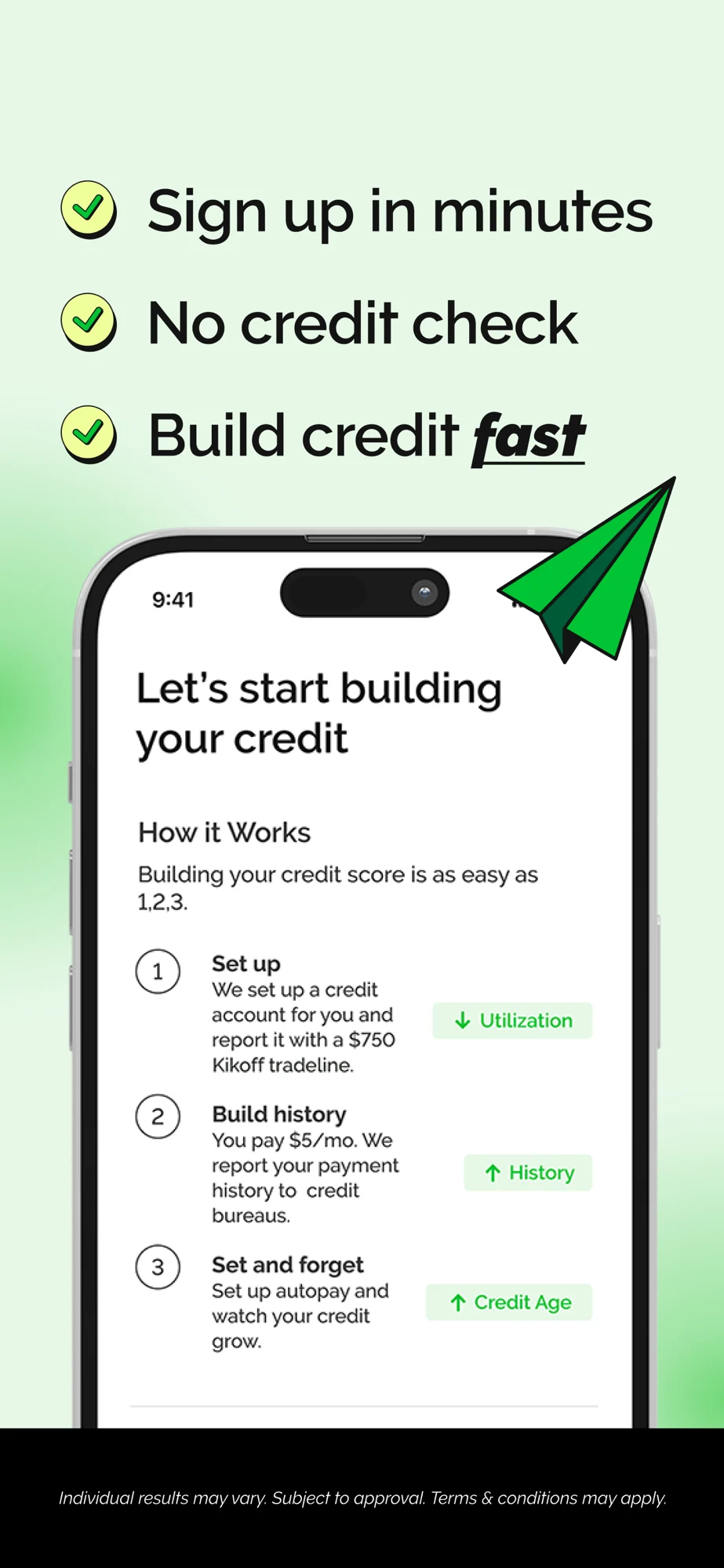
Panel 1 · A large first-month point-change claim sits above a score screen and cohort qualification.Panel 2 · A tradeline amount and bureau logos are paired with a restricted-use qualification.Panel 3 · A social-proof claim and score-change overlay dominate a deliberately blurred interface.Panel 4 · A setup explanation describes the account and payment-reporting process.
The hierarchy makes headline claims dominant while their conditions are smaller. Test the product mechanism earlier: what the account can finance, what the customer pays and what gets reported. Preserve cohort and eligibility context. The publisher’s historical claims are not predictions for a new user or proof of conversion uplift.
DateWhen was this information calculated or refreshed?
MeaningA displayed score is not a lender approval.
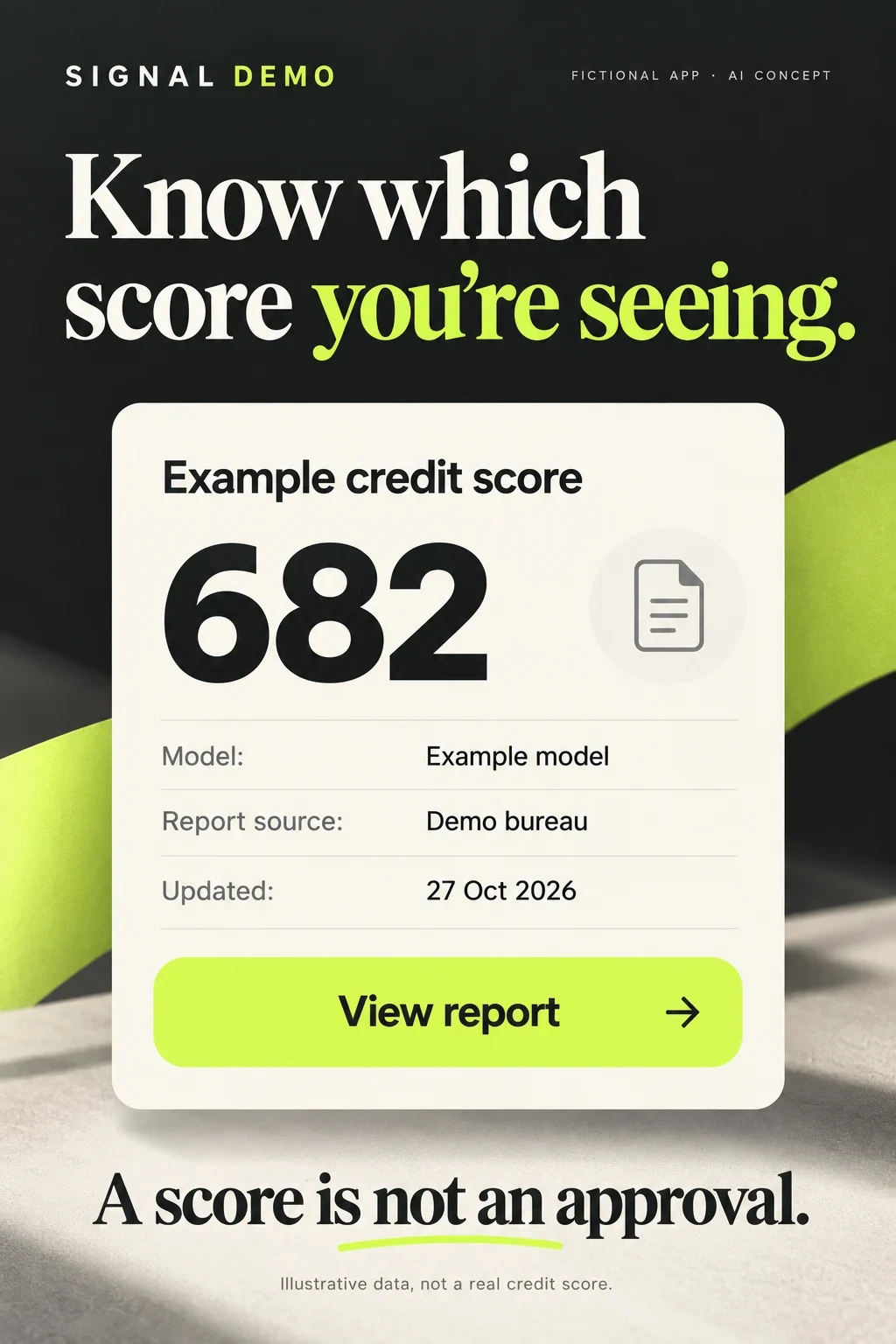
The score-context graphic is a reading checklist, not a scoring formula. A source, model and date help explain what a number represents. They do not establish that a particular lender will use it. Ask whether the date means a report refresh, a score calculation or merely the last time the app opened; those are different events.
A practical redesign exercise is to take a score-first frame and reserve visible space for those labels. Keep the headline short enough that the context can remain legible. Use screenshot copy to explain the task and sequence planning to introduce the next action. Do not remove a qualification just because it weakens the visual simplicity.
For a credit-building frame, replace the score-gain headline in a test with the actual mechanism and a readable product view. For a report-review frame, show an entry and the next supported step. These are proposed comparisons, not claims that restrained creative always wins. Measure understanding and appropriate activation before making a performance conclusion.
CREDIT MANAGEMENT APP ASO
Make the copy describe information and actions people can actually access.
Signal Demo is a fictional monitoring app for this exercise. Assume it has legitimate access to one supported score and report source, offers a readable report view and sends defined change alerts. It does not open credit-building accounts, lend money, guarantee corrections or promise score increases. A real product would need its exact source, model, plan and eligibility language.
4. Let the title identify credit. Let the screen explain the task.
TitleSignal Demo: Credit
SupportReports, scores & alerts
FrameKnow which score you are seeing
EvidenceModel, report source and meaningful date
Swipe horizontally to compare all columns →
Illustrative metadata — validated character limits
See score context, review report details and follow credit changes.
67 / 80
The name identifies credit; the subtitle names the visible services. The keyword field adds relevant concepts rather than repeating the title or inserting competitor names. This is a coherent starting hypothesis, not a claim that the words have search demand. Verify licensed terminology and actual feature support with the keyword-field guide before release.
A description that explains access and action
Illustrative opening: “Know what you are looking at. Signal Demo brings supported credit information into a clear view, with the score model, report source and update context alongside the number. Open the available report details to understand the information behind it.”
“Follow changes without losing the context. Review supported alerts, inspect the affected entry and choose the next available step. Manage notification settings so the information you receive matches the service you use.”
“Check the coverage before joining. Available information, update timing and features depend on the actual service and membership. A displayed score is not a promise of lender approval or a guaranteed improvement.”
The final paragraph is a drafting reminder, not an adequate replacement for specific product terms. A real description should state the supported source, plan, costs, eligibility, permission requirements and update behavior. If a feature is paid, make that boundary clear. If the app offers only a summary, do not quietly describe it as a complete report.
Swipe horizontally to compare all columns →
A monitoring-first screenshot sequence for the fictional app
Frame
Headline hypothesis
Evidence required
Question it answers
Opening
Know which score you are seeing
Actual score, model, source and date
What does this number represent?
Report
Read the detail behind your credit
Real available report or clearly labeled summary
What can I inspect?
Change
See what changed and when
An actual alert with source and time
Why did I receive this notification?
Review
Check an entry before choosing the next step
Entry details and supported assistance
What can I do here?
Control
Choose how you hear from us
Real notification and permission controls
How do I manage the experience?
Coverage
Understand what your plan includes
Accurate source, update and feature boundaries
What is included before I commit?
Use calls to action that describe the real next step: “View report,” “Review entry,” “Read alert” or “Manage notifications.” Reserve “Submit request” for a screen that actually sends a request after appropriate review. “Fix my score” would promise a result that this fictional monitoring product does not provide. “Get approved” would confuse information access with a lender’s decision.
For a preview, show one alert opening into the relevant entry, then demonstrate the available next action. Keep source and time visible long enough to read. Do not cut from a review draft to a removed entry or a higher score. The viewer should understand the tool’s role without needing a dramatic success story.
For a real credit-building product, write a separate brief. Explain whether it is a loan, secured card, restricted credit line or reporting service; show the commitment and costs; distinguish payment from reporting. Do not reuse the monitoring copy merely because both products display a score. The short description, full description and first screenshots should agree on the service.
CREDIT MANAGEMENT APP ASO
Prevent the small wording changes that turn a tool into a promise.
These are review questions for your own listing, not claims that every competitor makes each mistake. Public creative can suggest a potential misunderstanding, but it cannot prove customer harm or conversion loss. Keep the critique precise: identify the frame, the possible interpretation and the change to test.
5. Show the review stage without inventing a result.
DraftThe customer is checking an entry.
SubmittedA request has actually been sent.
ResponseA response has been received.
OutcomeDescribe only the outcome supported by the record.
Swipe horizontally to compare all columns →
Credit-app mistakes to investigate and specific remedies
Potential mistake
Why it creates confusion
A better brief
Showing a score without context
Readers may compare different models, sources or dates
Keep the relevant labels with the number
Calling a summary a full report
The promised access may exceed the actual feature
Name the document or view accurately
Treating every financial-health measure as a credit score
Different measures answer different questions
Use distinct names and explanations
Equating an alert with fraud prevention
Detection and prevention are different services
Explain the supported event and available action
Promising a universal point gain
A historical sample or example does not describe every user
Use substantiated scoped claims or a task-led alternative
Hiding the credit-building mechanism
Customers may not understand a loan or restricted line
Show product type, costs, obligations and allowed use
Treating paid as reported
A completed payment may precede reporting
Preserve actual processing and reporting states
Making a draft look like a successful correction
Review, submission and outcome are distinct
Show unfinished states without success icons
Presenting an offer match as approval
A marketplace match is not a final decision
Explain the actual stage and conditions
Using no-check language too broadly
Different checks or stages may have different consequences
Use product-approved wording for the exact action
Using free as a blanket promise
Some coverage or features may require payment
State the free scope and paid boundary
Importing bureau assumptions into another country
Credit systems and coverage differ
Validate the local product before translating
Using urgency or shame to drive action
The message can pressure an uninformed choice
Use a clear task and understandable next step
The FTC’s credit-repair guidance states that accurate, current negative information cannot simply be removed by a credit-repair promise. For an ASO team, the practical lesson is to describe supported review or correction assistance without implying guaranteed deletion. Do not write a creative brief that asks AI to erase legitimate history or manufacture a successful dispute.
Ask participants what has happened at each stage of a review. A draft means the customer is still preparing or checking. Submitted means a request was sent through the actual supported process. A response is not automatically a favorable outcome. Use the product’s exact state definitions; the four-step graphic is explanatory, not a universal dispute procedure.
A similar exercise applies to reporting. Show a logged payment, a processed payment and a reporting status separately. Ask whether the information has reached the named bureau or whether the screen only confirms a payment. The correct answer must come from the product, not a marketing assumption.
Track the wording, source screen and hypothesis in a change log. Use test prioritization to choose a meaningful variable. Improving trust signals means making evidence understandable, not adding more badges or promises.
CREDIT MANAGEMENT APP ASO
Turn credit research into a service-specific Apple Ads plan.
Organize Apple Ads around the service in the search, then match the product page to it. Monitoring intent, report-review intent and credit-builder intent can require different onboarding and economics. Do not send all three to a generic score-growth page and count every installation as a relevant customer.
6. Optimize for an understood service, not a promised score increase.
SearchA supported credit task
PageMatching evidence, coverage and plan
ActivationA defined successful use of that service
QualityAccurate expectations and retained value
Swipe horizontally to compare all columns →
Campaign blueprint — hypothetical planning, not live advertising
Campaign role
Research input
Starting structure
Page evidence
Own brand
Your verified brand and product names
Separate brand reporting and inspect matched terms
Official identity and correct access or acquisition route
Category: monitoring
credit score tracker; credit monitoring app
Focused exact group with Search Match off
Model, source, available report and alert scope
Category: report review
credit report details; review credit report entry
Separate only where the actual review feature supports it
Report detail and honest process states
Category: builder
credit builder app; credit building account
Separate product-specific group if the service exists
Mechanism, commitment, costs and reporting
Category: rent reporting
rent reporting status; rent reporting app
Separate supported payment and market scope
Eligibility, source, destination and reporting progress
Competitor exploration
Relevant verified competitor brands
Controlled separate budget and reporting
Your own product without implied affiliation
Discovery
Supported seed terms and current category language
Separate broad-match and Search Match exploration
Accurate general page and frequent term review
The fictional Signal Demo example would start with monitoring only. It should not target builder-account terms just because those phrases appear in the research bank. Apple’s campaign-structure guidance supports separate brand, category, competitor and discovery purposes. Add the service boundary so each group has a clear reason to exist.
Exact match still includes supported close variants, reordered terms and translations. Broad match can extend to related searches. The actual search-term report matters more than the label on the ad group. Review Apple’s match-type documentation and keep Search Match off in focused exact groups when the test needs that targeting boundary.
A monitoring custom product page should lead with the report or score context and explain alerts and access. A genuine builder page should explain the product mechanism and commitment. Follow current custom product page guidance for supported assets, keyword assignments and links. The creative cannot imply that a visitor has a particular score or that eligibility has already been determined.
Work an example from search term to decision
Suppose discovery returns “check credit report,” “instant cash loan” and “remove all bad credit.” These are illustrative examples, not real account observations. The first may fit Signal Demo if the promised report is available. Inspect the result set, feature fit and qualified activation before testing it in a focused group. The loan query does not fit the fictional monitoring product. The removal query implies an outcome the product cannot promise.
Use appropriate negatives for irrelevant searches. Avoid excluding the entire word “credit” because one query was unsuitable. Apple’s negative-keyword guidance describes exact negatives as the default and distinguishes broader exclusions. Record why each term was excluded, and review what a broad negative would remove before applying it.
If a useful query moves from discovery into a controlled exact group, plan exclusions and routing to keep the experiment interpretable. Then feed the language back into ASO: do visitors expect a full report? Are they confusing monitoring with repair? Does a particular source or update question deserve clearer copy? A paid query is evidence to investigate, not automatic permission to add its promise to a title.
Choose an activation that matches the service
For monitoring, a useful funnel might be new install → eligible account setup → authorized data access → first successful report view → useful return visit. Define the events with the product team and separate existing members responding to an alert. For a builder product, the relevant milestones differ and may take longer. Do not count a score increase as the automatic consequence of acquisition, or use more borrowing as the only measure of quality.
Set an approved acquisition ceiling from actual contribution economics. Loan principal, a credit limit and the amount of a reported bill are not revenue. Include the costs of the actual service, retention assumptions, refunds or cancellations where relevant, and uncertainty. A free monitoring service with a marketplace has different economics from a paid membership; do not transfer a bid model between them without evidence.
Illustrative arithmetic: if a business independently approves $30 per qualified activated monitoring customer, and 20% of new installs reach that defined milestone, the implied install ceiling is $6. If 30% of taps become those new installs, the implied tap ceiling is $1.80. These invented inputs explain a calculation. They are not benchmarks, recommended bids or a spending instruction.
Swipe horizontally to compare all columns →
A bounded monitoring pilot with predefined decisions
Pilot choice
Rule to agree before launch
Reason
Scope
One supported service, one storefront and a matching page
Avoids mixing product models and local credit systems
Budget
Bounded approved cap and explicit stop conditions
Keeps discovery limited and reviewable
Cohort window
Wait for actual data-access and activation delays
Early installs can overstate completed service use
Primary measure
Cost per defined qualified activation
Separates useful acquisition from generic traffic
Quality checks
Coverage comprehension, plan understanding and retained use
Cheap installs can still come from mistaken expectations
Confounders
Record plan changes, offers, outages and traffic shifts
Acquisition changes may have causes beyond creative
Decision
Expand, revise, stop or retain an inconclusive finding
Prevents a small apparent difference becoming a false winner
Respect attribution and privacy limits. An aggregate search report does not establish that every query can be tied to an individual credit event. Use only authorized measurement and report the observable level honestly. Avoid importing sensitive financial records into a marketing worksheet. Align denominators with conversion definitions, distinguish search from browse, and review ASO KPIs.
A paid creative result does not prove an organic ranking gain or a financial outcome. Use the finding to create a separate metadata or screenshot hypothesis and record the evidence. This is the useful connection between ASO and acquisition: shared customer language, supported product proof and careful measurement.
CREDIT MANAGEMENT APP ASO
Watch how credit products explain scope, mechanisms and outcomes.
These patterns come from the eight reviewed US iOS listings and their dated creative. They are not market-size estimates or evidence that one approach converts better. The comparison shows where a product team should ask sharper questions.
Swipe horizontally to compare all columns →
Editorial patterns — reviewed 27 October 2026
Pattern in the sample
Question for the ASO team
Unknown until researched
Credit information sits beside budgeting, banking and offers
Should a credit-specific opening precede broader finance features?
The preferred opening for each search audience
Large outcome numbers compete with product mechanisms
Can the service be understood without relying on a point-gain headline?
Comprehension and qualified activation
Model and bureau labels receive very different emphasis
Which context must remain visible in a tighter crop?
Whether the intended audience can interpret the score
Free and paid features coexist
Does the page make the chosen feature’s access clear?
How visitors interpret the plan boundary
Reporting and review processes are compressed into short stories
Are payment, submission and outcome being kept distinct?
Whether people understand the actual stage
AI language appears in product positioning
What is the tool doing, and what still requires review?
Its accuracy and effect on real customer outcomes
The source listings support the product-model comparison; the original panels support the hierarchy and sequence observations. AI positioning is visible in Dovly’s listing, but the label itself does not establish accuracy or successful disputes. No numerical industry trend has been inferred from this small sample.
Maintain a claim register with source, date, owner, market, product tier and review trigger. A new bureau integration, changed membership, altered reporting process or revised offer should trigger a creative review. A screenshot can remain visually polished while its access promise becomes outdated.
If the team wants a trend chart, collect a consistent time series first: the same storefronts, defined sample, capture method and classification rules. Until then, use process graphics to teach the distinctions rather than inventing percentages for adoption, demand or conversion.
CREDIT MANAGEMENT APP ASO
Use AI to make the information and the unfinished steps clearer.
The two original Signal Demo images below are fictional teaching concepts. One keeps the score with its context; the other makes an unfinished review process visible. They are proposals for clearer communication, not real competitor screens, functioning products or tested improvements.
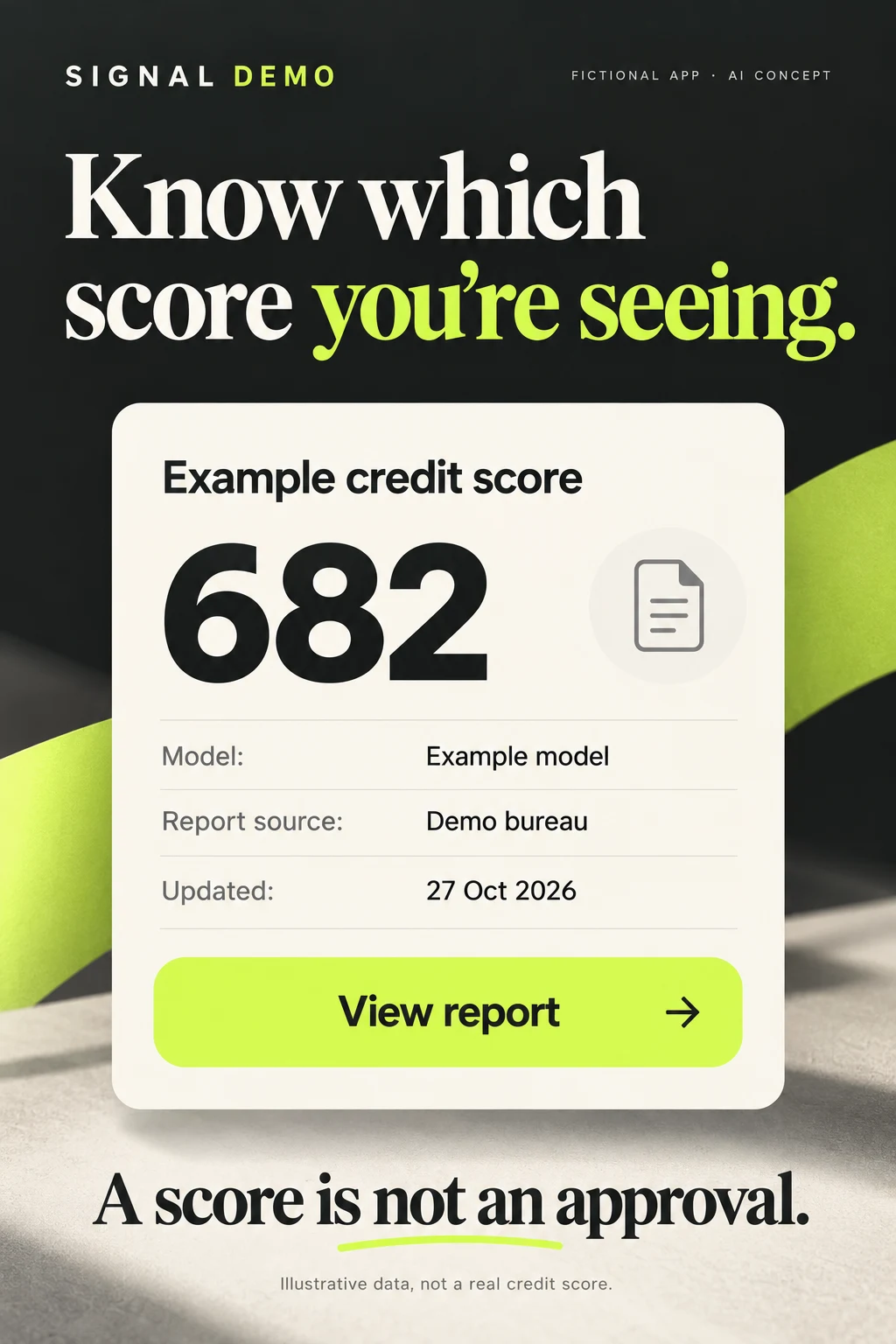
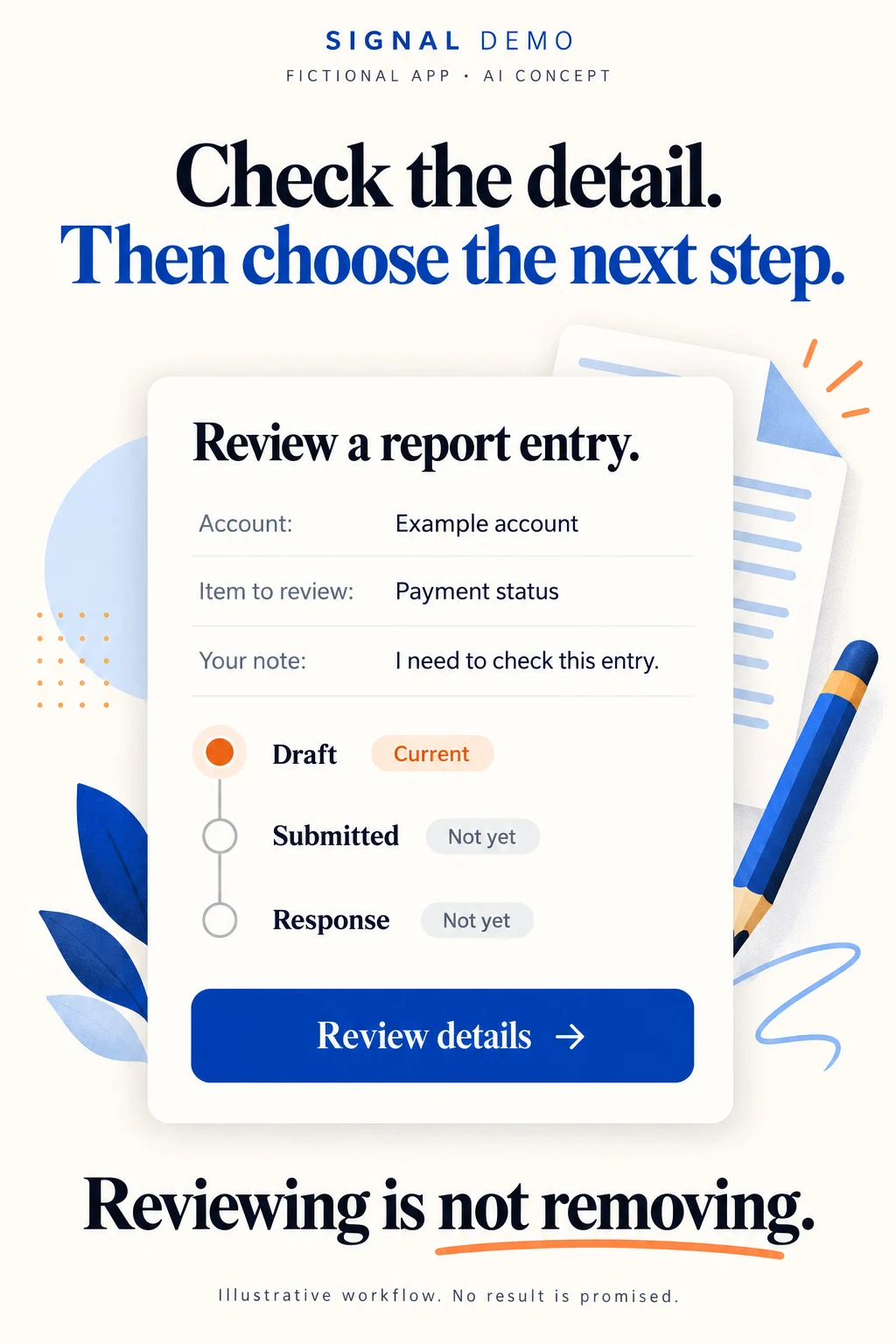
AI CONCEPT · Keep model, source and date beside the score · Open full size.AI CONCEPT · Make a draft look unfinished · Open full size.
7. Use AI to explain the evidence, not invent it.
SupplyApproved UI and fictional test data
ConstrainPreserve model, source, dates and states
InspectCheck every number, label and implied result
RebuildUse actual product assets before testing
Swipe horizontally to compare all columns →
AI critique — good hierarchy does not validate product claims
Concept
What works
What needs a real-product rebuild
Test question
Score context
The number is paired with visible model, source and date labels; approval is explicitly distinguished
Use the authorized actual model and source; define the date precisely; include real access and plan context
Which score is this, when is its data from, and does it approve anything?
Entry review
Current and unfinished stages are distinguished with words and symbols
Use the exact supported workflow, evidence requirements and next action; check secondary-label contrast
Has anything been submitted or changed on the report?
The first image follows the intended data hierarchy, but “Updated” is still too broad for some real products. It might need separate score-calculation and report-refresh dates. The source and model names are deliberately fictional; they cannot be substituted for authorized product data. The large number should also be tested against an alternative where the context occupies more space.
The second concept keeps submitted and response stages unfinished, which is important. Its review note is deliberately neutral rather than an invented allegation. A production version needs the actual process and cannot imply that every account entry can be disputed within the app. The quiet secondary labels and small footer need contrast and store-size checks. Both concepts should be rebuilt in one approved visual identity.
A prompt that keeps the model honest
“Use this approved score screen and fictional test record. Create three compositions that preserve the model version, report source, calculation date, refresh date where different, and available next action. Do not invent a bureau relationship, score increase, approval or security claim. Keep the context readable at store size and identify missing information before drafting.”
For a review flow: “Use the approved entry-review states and supplied fictional data. Distinguish draft, submitted, response and outcome. Never place a success checkmark on an unfinished step. Do not invent a removed account, favorable result or automatic submission. Explain the customer question each composition answers.”
The workflow is hypothesis → approved inputs → generated options → line-by-line review → real-UI rebuild → accessibility and local-language review → comprehension exercise → focused store test. The brief-writing guide helps keep source screenshots, proposals and production assets separate.
Make every claim traceable to a service the app actually provides.
8. Localize the credit system, not just the words.
CoverageSupported country, bureaus and data
ProductActual account, reporting or monitoring service
LanguageLocally understood terms and assistance
ReviewVerify the final promise and the full journey
Swipe horizontally to compare all columns →
Release checklist for credit-management ASO
Release check
Credit-specific detail
Evidence to keep
Service identity
Monitoring, reporting, credit product, review or marketplace is named correctly
Approved capability map
Data context
Model, bureau, report scope and date semantics are accurate
Source and product-data definitions
Plan access
Free and paid features, refresh cadence and eligibility are clear
Current membership and coverage matrix
Product commitment
Costs, obligations and restricted use match the actual builder product
Approved product terms and UI
Reporting status
Logged, paid, processed and reported are not conflated
Actual state definitions and journey capture
Review outcome
Draft, submitted, response and result remain distinct
Supported workflow and evidence requirements
Claims
Historical samples, averages, offers and conditions retain their scope
Substantiation record and review owner
Localization
Local credit systems, account terms and help coverage are supported
Native-language and market review
Accessibility
Numbers, dates and states remain readable without color alone
Small-screen and assistive-technology checks
Measurement
New service activation differs from returning access and financial outcomes
Event definitions, cohort windows and attribution limits
Do not translate a US bureau-based promise into another market without checking the underlying service. Names, score ranges, report availability, account terminology and assistance processes may differ. A localized store page should not imply a localized data source or help journey that does not exist. Use local keyword research, market prioritization, screenshot adaptation and localization QA.
Review the final exported sequence, including any paid variants. Check whether a qualification has been separated from the claim it explains. Ensure that sample dates and bureau labels agree across a journey, that a historical point change is not presented as a future promise, and that a payment or draft is not visually transformed into a reported or corrected entry.
After release, compare equivalent storefronts, services, plan tiers, acquisition sources and mature customer cohorts. Record outages, new features, pricing changes and promotional traffic. A small or inconsistent result should remain inconclusive. A useful early finding may be better understanding of the service rather than more installations.
Start with one task: choose a supported intent, document the information or mechanism, inspect the first three screenshots and use a worked test brief. An ASO audit can connect the findings, while ASO services can coordinate research, copy, creative and measurement.
Research scope: eight public US iOS listings, five original screenshot sets, official platform documentation and public consumer-finance sources. No Android competitor audit, private account tests, measured keyword demand or competitor conversion results. Demographics, keywords, niche angles and AI concepts are hypotheses. This is an app-marketing guide, not personal financial or legal advice.