By Gabriel Machuret · US iOS competitor research · reviewed 27 October 2026 · iOS and Google Play guidance
AI CONCEPT · SHOW THE PLAN, NOT A PROMISED RETURN.
INVESTING APP ASO
First explain what kind of investing app you are.
“Investing app” covers several different products. A person looking for a managed portfolio is not asking for an options screen. Someone researching an ETF may want information before choosing an account. An existing customer checking holdings may simply need the official app. A single acquisition story can blur these needs and make broad traffic look more useful than it is.
Start by naming the product model. In a self-directed journey, the customer chooses supported investments. In a managed journey, the service takes on defined portfolio decisions. A research or tracking product may not execute investments at all. Some apps combine these models, but the opening screenshots still need to explain which journey the visitor is seeing.
The finance overview explains the wider category. Use the banking guide for account-access tasks and the budgeting guide for allocation and spending plans. Here the focus is investing ASO: discovery, model clarity, product proof, metadata and appropriate customer activation.
ManagedThe service manages a defined portfolio journey.
ResearchThe app helps inspect information.
MatchUse the opening that reflects the actual product.
Swipe horizontally to compare all columns →
Choose the product job before writing the ASO brief
Product job
Opening question
Useful screenshot proof
Avoid implying
Self-directed investing
What can I research and choose here?
Actual research detail and order review
Every visitor receives individualized advice
Managed investing
What does the service decide for me?
Actual setup, portfolio explanation and control scope
Automation removes investment risk
Recurring investing
What action repeats, and can I inspect it?
Amount, asset, frequency and current plan state
A scheduled bank deposit is already an investment
Portfolio tracking
What changed in my account?
Holdings, contributions, period and calculation labels
All account growth came from returns
Research and education
What information can I understand here?
Real sources, explanations and data timestamps
Educational information guarantees a better result
Existing-account access
Is this the official app for my relationship?
Identity, account recognition and access route
Every installation is a new funded customer
Build a capability sheet with the product team: account types, supported markets, securities, purchase modes, minimums, fee scope, customer eligibility, advice model, data coverage and help channels. Attach a real screen to each promise. If an asset or action needs additional approval, that restriction affects both keywords and the onboarding story. This is the foundation of ASO strategy, not a final copy edit.
This report uses eight public US iOS listings and twenty Apple-served screenshot panels captured on 27 October 2026. They are a purposeful comparison sample, not a ranking of financial providers. Retrieved feed order can differ from live storefront presentation. We have not opened accounts, traded, assessed investment suitability or measured competitor conversion. Android platform guidance is included; Android competitor screenshots have not been audited.
INVESTING APP ASO
Research the decision people want to make—not an investor stereotype.
The segments below are hypotheses for research, not measured demographic findings. Consider adult age bands, account experience, preferred language, accessibility needs, review habits and the kind of decision someone wants help with. Age does not tell you whether a person wants active trading, automated investing or simple account access. A small intended contribution does not tell you their knowledge or total wealth.
Ask participants to describe a recent task without sharing account credentials or sensitive financial details. What did they want to understand? Did they want to choose an investment themselves, delegate a portfolio decision or check something already held? Which words did they search? What made a screenshot seem relevant or confusing? Use fictional or redacted account examples for comprehension exercises.
Swipe horizontally to compare all columns →
Audience research hypotheses for investing-app ASO
Potential audience
Job
Recruitment dimensions
Research question
Product proof
First-time account researcher
Understand what kind of investing product this is
Adult age bands, prior financial experience, reading language
Who chooses the investments, and what do you still need to decide?
Product model, account requirements and a clear first task
Self-directed researcher
Inspect a security and review an order
Research habits, supported asset types, device preference
Does the screen show information or a recommendation?
Research source, timestamp and order-review controls
Person seeking managed investing
Understand the service they would delegate
Time constraints, existing experience, preference for assistance
What does the service manage and what remains your choice?
Actual goal/risk setup, portfolio explanation and fees
Recurring-plan user
Set and inspect a repeated action
Pay cycle, funding method, schedule preferences
Does this schedule deposit cash or purchase an investment?
Amount, destination, cadence and status
Existing customer on a new device
Recognize the official app and regain access
Account tenure, device changes, access needs
Is this an acquisition journey or returning access?
Recognizable identity and accurate sign-in route
Investor reviewing account changes
Separate money added from investment movement
Number of accounts, review frequency, calculation familiarity
What caused the displayed account value to change?
Contribution, gain/loss and period labels
Retirement-account researcher
Understand the account type and supported journey
Life stage without assuming age, existing accounts, locale
Are you opening, transferring or simply viewing an account?
What fees and asset restrictions apply to this action?
Actual minimum, fee scope and supported purchase mode
Customer wanting human assistance
Find what help is actually available
Preferred channel, language, service eligibility
Is this general support or an advisory service?
Real service type and eligibility
Person using accessibility features
Read data and operate controls confidently
Large text, screen reader, color perception, small devices
Can you tell a loss from a gain without color alone?
Words, signs, periods and accessible controls
A useful first exercise shows one screenshot briefly, then asks: who chooses the investment, what can the person do, and what has already happened? Follow with a portfolio view and ask whether the displayed amount is cash, account value, contributions, gain/loss or a projection. Record exact misunderstandings instead of scoring every positive reaction as trust.
For a newcomer-focused page, test plain explanations and readable controls rather than assuming bright colors or celebratory gains are helpful. For an experienced researcher, inspect whether data scope, timestamps and supported tools are visible. These are different creative briefs. Combine value proposition, intent research and test hypotheses before choosing the default opening.
INVESTING APP ASO
Build a keyword map around decisions and supported actions.
These 100 distinct candidates are grouped by product job. They are not measured demand, easy-ranking terms or recommended bids. A phrase stays in the candidate sheet until the actual feature, target market and live search intent have been checked. Several education or support queries may belong in helpful content rather than store metadata.
Product check: Use the actual supported order types and status definitions; access is not approval.
review investment orderstock order statuspending investment orderfilled stock ordercancel open stock orderlimit order appmarket order reviewinvestment buying powercash available to withdrawinvestment deposit status
Records and account service
Product check: Documents and assistance must exist for the advertised account and locale.
Product check: Validate these specific combinations; they are hypotheses, not measured demand.
investing app with recurring etfsportfolio tracker with contributionsinvestment app with clear feesinvesting app in spanishaccessible investing appinvestment app large textmanaged investing without stock pickingstock research without placing ordersseparate cash and investment balancesinvestment schedule with pause control
For every candidate, record store, country, language, date, returned product types and the job implied by the query. “Portfolio tracker” can mean aggregation without trading. “Recurring investments” can mean a scheduled purchase rather than moving cash. “Retirement” can mean planning, an account type or an existing-account task. Resolve those differences with keyword research and relevance checks.
Expand from supported features: ETF research → holdings information → a watchlist or comparison task. Do not append beginner, safe or best to every term. Validate local phrasing with real search results, authorized search-term reports and customer language. Keep tool estimates of search volume and difficulty separate from known feature fit.
Maintain separate sheets for your brand, competitors and unsupported adjacent products. A competitor may offer crypto, options or cash accounts; that does not make those terms relevant to your app. Use prioritization to record a reason for keeping, testing or rejecting each phrase. The CSV includes feature gates so the next content round cannot quietly turn a research idea into a product promise.
INVESTING APP ASO
Find a narrower product job that deserves a better explanation.
A credible niche combines a clear job with a demonstrable feature. “Managed investing without stock picking” and “stock research without placing orders” describe different levels of control. Neither is inherently a better financial choice; they are different ASO intents. The opportunities below remain unmeasured until current search evidence supports them.
Swipe horizontally to compare all columns →
Niche hypotheses with explicit feature and eligibility gates
Narrow angle
Candidate phrases
First-frame proof
Question before targeting
Recurring ETF setup
investing app with recurring etfs; recurring etf purchase
Asset, amount, cadence and review state
Can this account schedule eligible ETF purchases rather than only deposits?
Contribution-aware tracking
portfolio tracker with contributions; track investment contributions
Value and contributions shown separately
Does the calculation handle cash flows correctly and explain its period?
Delegated portfolio management
managed investing without stock picking; managed portfolio app
Actual service scope and setup journey
Who makes decisions, and what controls does the customer retain?
Research before action
stock research without placing orders; etf holdings research
Legible information, source and timestamp
Can the user access this research at the advertised stage?
Schedule control
investment schedule with pause control; edit investment schedule
Current schedule and real edit/pause control
What happens to pending instructions after a change?
Clear cost information
investment app with clear fees; investment fee details
Actual service and transaction cost explanation
Are subscription, advisory and other applicable costs distinguished?
Readable holdings
investment app large text; accessible investing app
Actual large-text holdings and signed gain/loss labels
Has the product been tested beyond a large marketing headline?
Language continuity
investing app in spanish; investment account help
Localized task and accurate assistance scope
Do account setup, disclosures and help support the promised language?
A search gap is useful only if the product can answer it. If research shows confusion about account value versus gain, a clearer performance view may improve the story even if the exact phrase has little install intent. If a query mostly seeks tax explanations or a current order’s status, support or educational content may be more appropriate. Use the long-tail method and gap analysis to preserve those distinctions.
Avoid pages that claim a financial outcome for a demographic group. A useful retirement-account page explains the supported account and journey; it does not promise a comfortable retirement. A useful small-amount page explains actual costs and controls; it does not imply that a small purchase cannot lose value. Make the niche about product fit and clarity.
INVESTING APP ASO
Compare eight investing stories without treating them as one product.
Titles, subtitles, listed sellers and descriptions were checked together against public Apple listings. These eight products are relevant comparison points for investing communication, not a recommendation to open an account. Features, pricing, eligibility and offers can change; the source links identify what was reviewed.
Swipe horizontally to compare all columns →
Eight verified US iOS investing listings — reviewed 27 October 2026
Describes a multi-asset investing service with separate product conditions.
Identify the supported asset and account journey before claiming breadth.
Several brands describe more than one product model. This makes category words useful but insufficient: the screenshot sequence still needs to show whether the user is researching, choosing investments, delegating decisions or managing cash. A competitor’s public asset can suggest a test; it cannot establish which approach converts better for your audience.
Repeat the competitor review in the intended storefront and operating system. Do not import a US account name into another country’s metadata merely because the brand is familiar. The same caution applies to claimed ratings, awards, returns and rates: we analyze their role in creative, not their financial attractiveness or independent validity.
INVESTING APP ASO
Use each store’s tools to test a specific investing story.
Swipe horizontally to compare all columns →
Platform differences checked 27 October 2026
Surface
Current capability or limit
Investing-specific use
iOS name / subtitle
30 characters each
Identify investing and the supported task; preserve official identity
iOS keyword field
100 characters
Use relevant terms that are not redundant with the title and subtitle
iOS product page optimization
Tests icons, screenshots and previews
Compare product-model clarity or a task opener with one coherent hypothesis
iOS custom product pages
Tailored assets, supported keyword assignment and deep links
Match recurring-investment or research intent with corresponding product proof
Google Play text
Title 30; short description 80; full description 4,000 characters
Explain the model, actions and eligibility in natural language
Google Play experiments
Graphics and localized text testing
Test a clear feature message and examine comparable traffic and downstream quality
Apple’s optimization tool supports controlled creative treatments; it is not a test of every metadata field. Custom product pages support tailored screenshots, previews and promotional text, with selected keyword assignments and supported deep links. Match those assignments to the page’s actual intent, and do not imply that a deep link bypasses account approval or feature eligibility.
Store creative should demonstrate the real product. Apple’s screenshot guidance emphasizes showing the app in use. Fictional AI concepts in this guide are teaching proposals; rebuild them with verified UI and approved product wording before considering submission.
INVESTING APP ASO
Read the screenshots for meaning, not just visual impact.
Open any panel for its full-size original. These five sets contain four Apple-served iPhone assets each, individually inspected before analysis. They are not AI recreations or browser-wide thumbnails. The order follows the retrieved feed, which can differ from a live storefront, device or campaign page. Each set links to its source and capture date.
Scan the headline at store size, then inspect the UI at full size. Does the screen prove the task? Is the account type visible? Can you tell cash from investments, a contribution from a return, and a scheduled action from a completed one? Use readability guidance to keep the important distinction legible, not just the slogan.
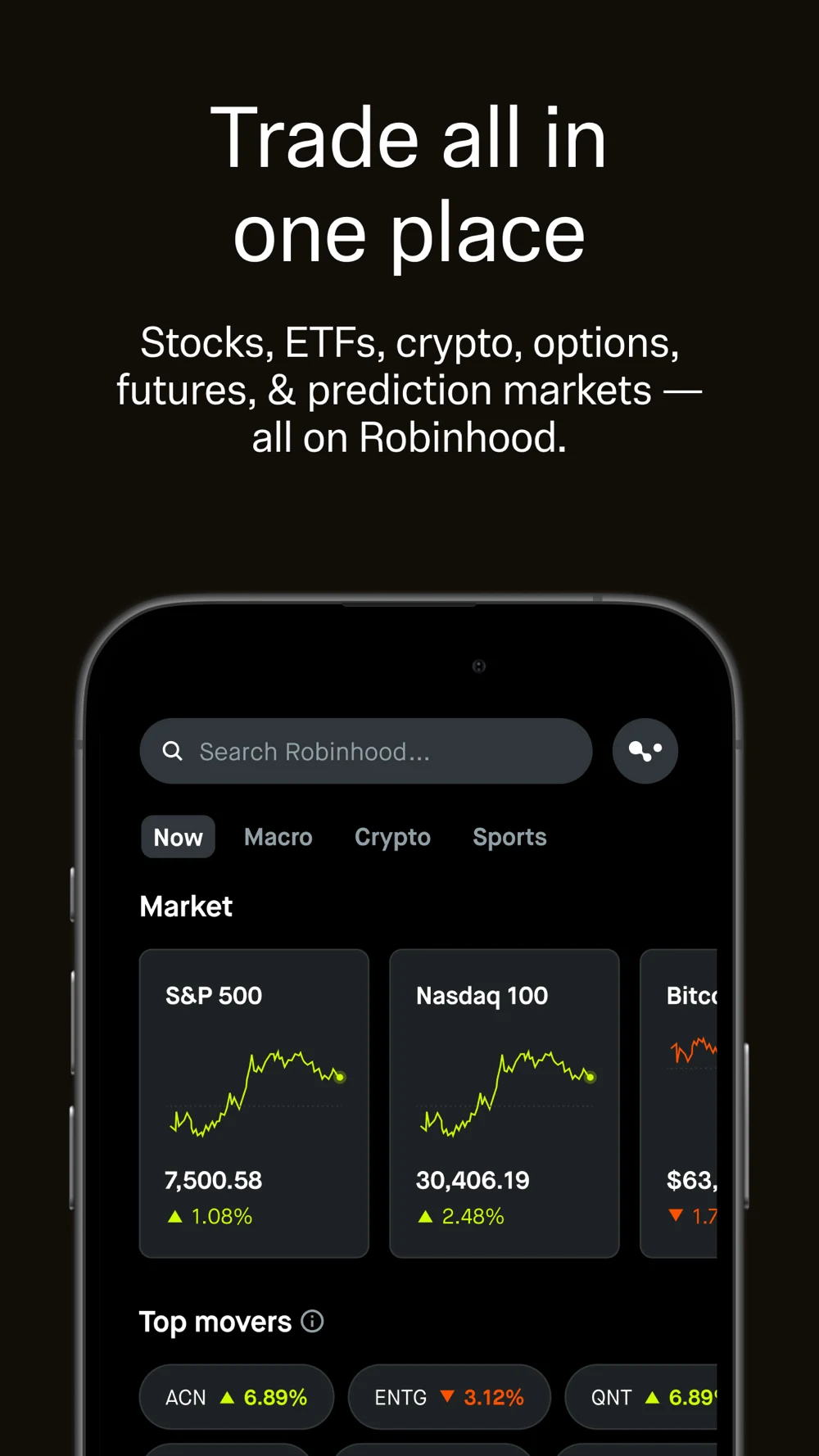
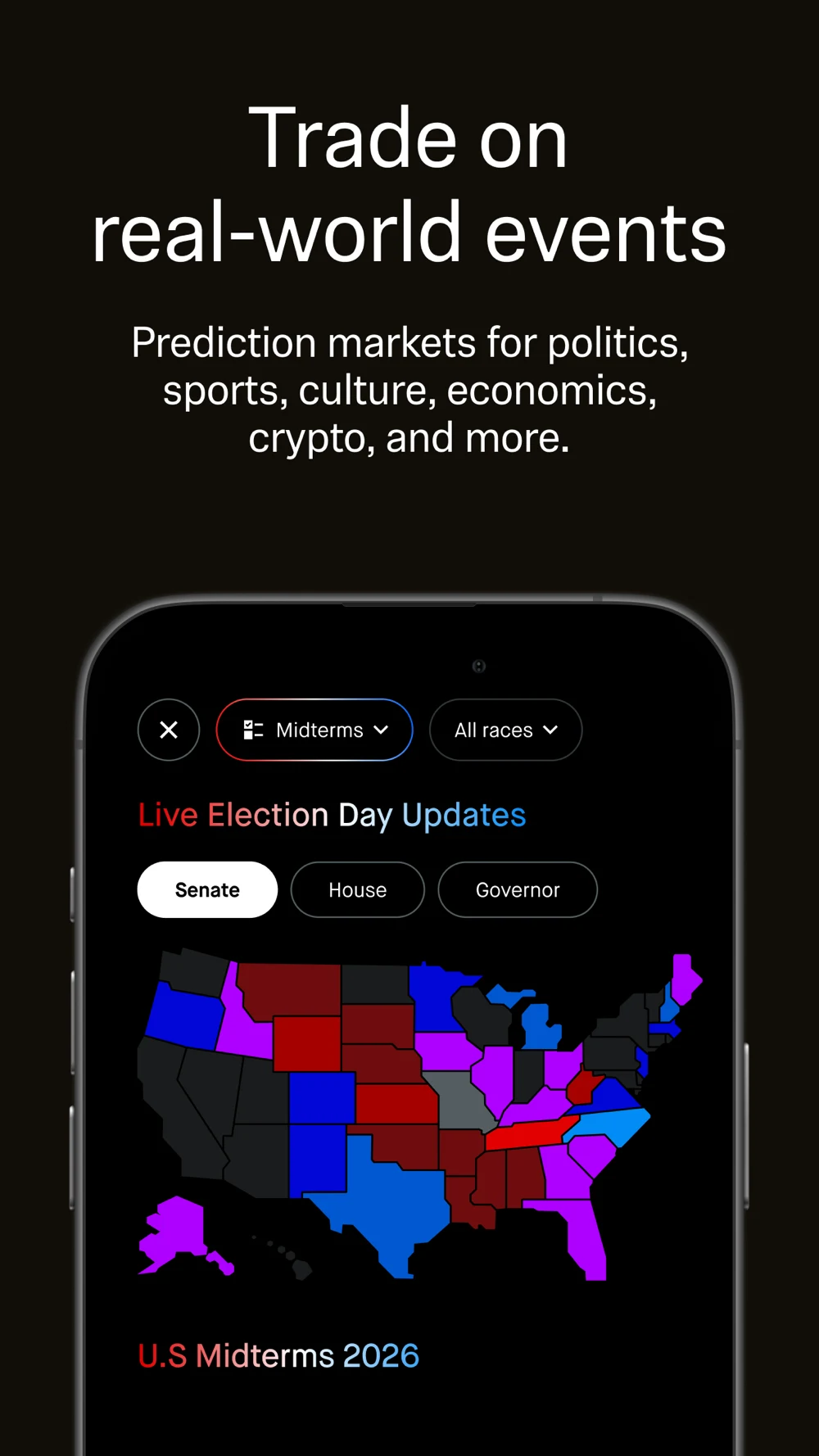
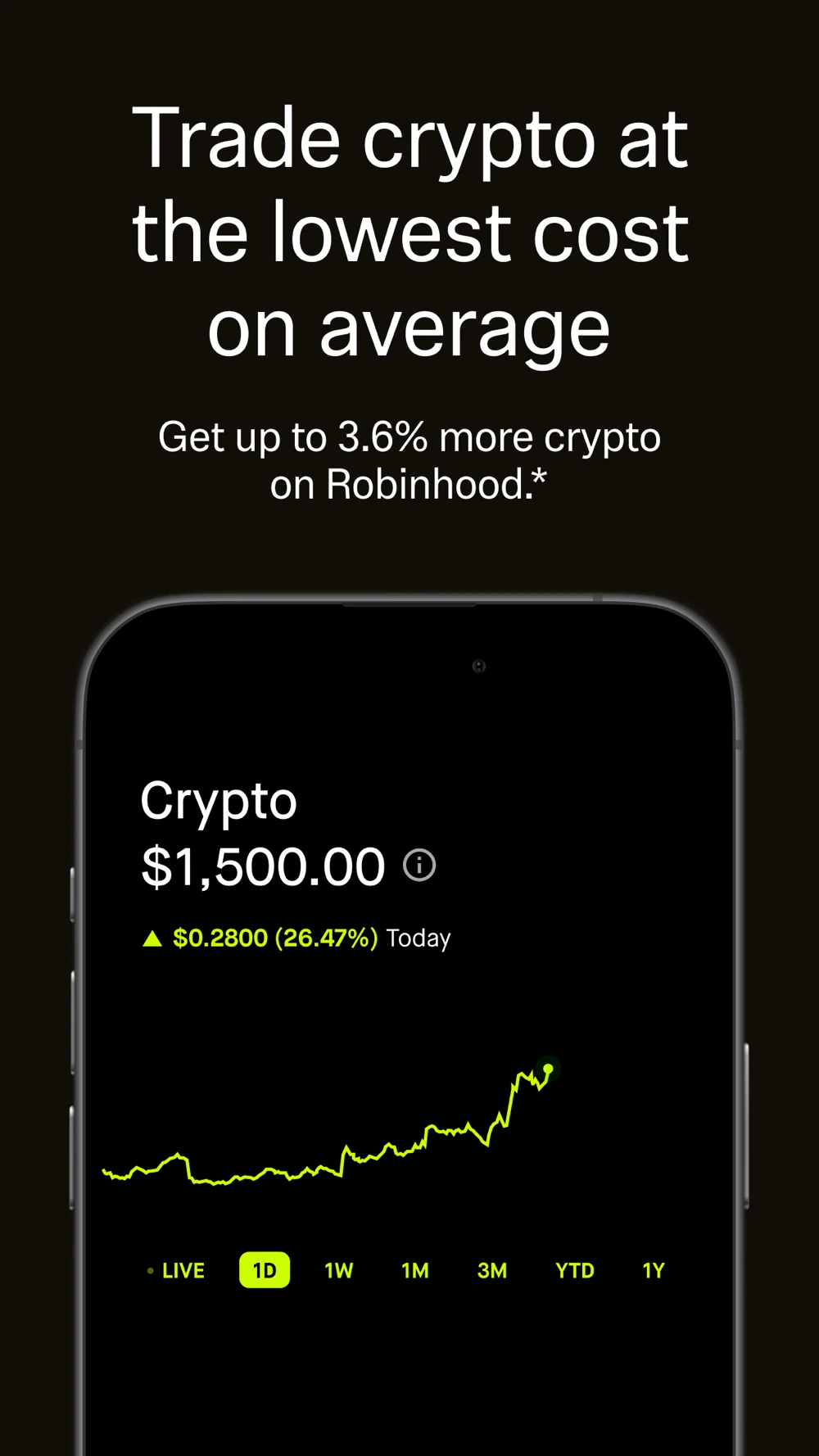
Robinhood: Broad trading, cash and adjacent product stories
Panel 1 · A dark market dashboard supports a broad multi-asset headline.Panel 2 · A cash-rate panel includes membership and variable-rate context.Panel 3 · An event-contract panel shifts the subject to prediction markets.Panel 4 · A crypto price-comparison claim appears above a chart.
Large headings and strong contrast make the topics easy to recognize. The sequence spans distinct intents. For ETF-research visitors, test focused research and review proof earlier. The charts, rates and comparative claims are publisher creative, not independently verified outcomes or current offers.
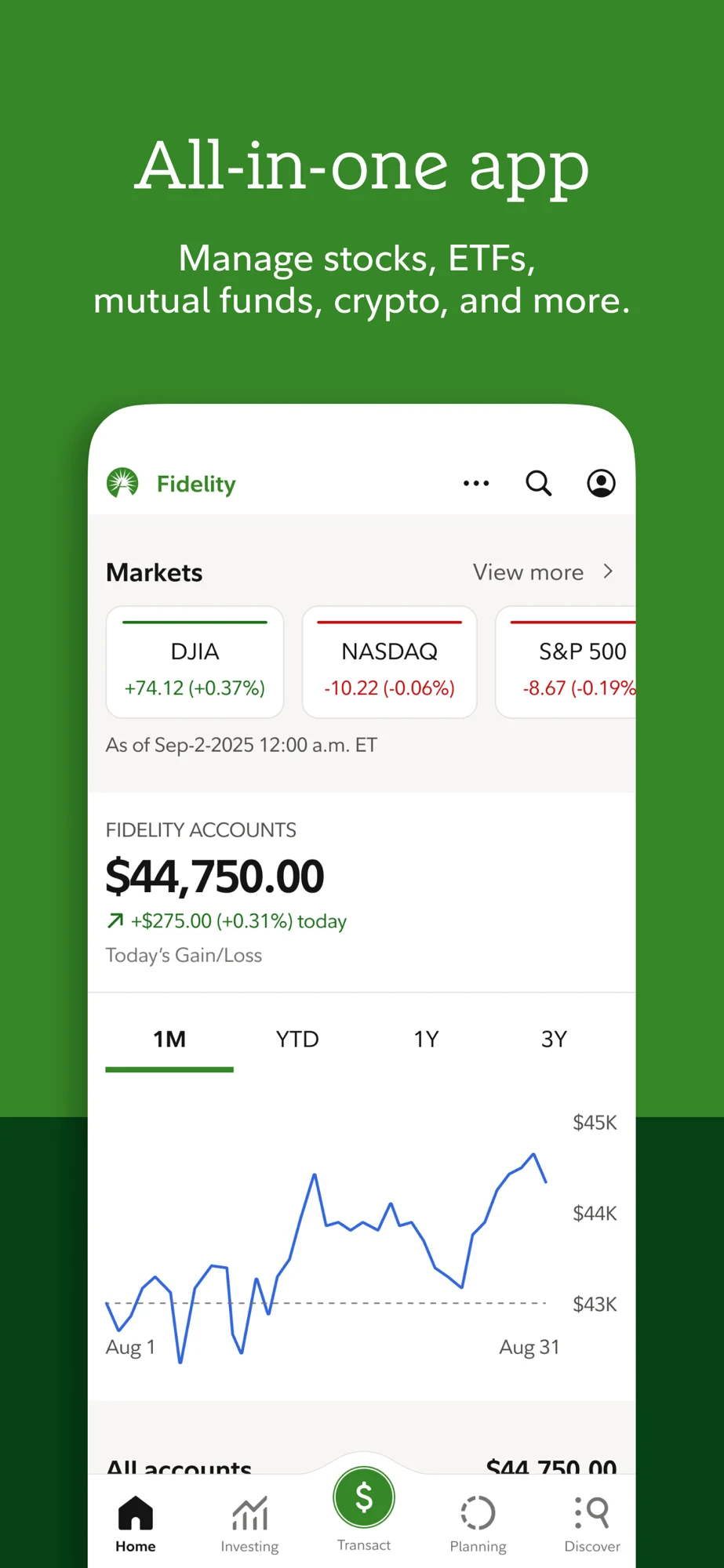
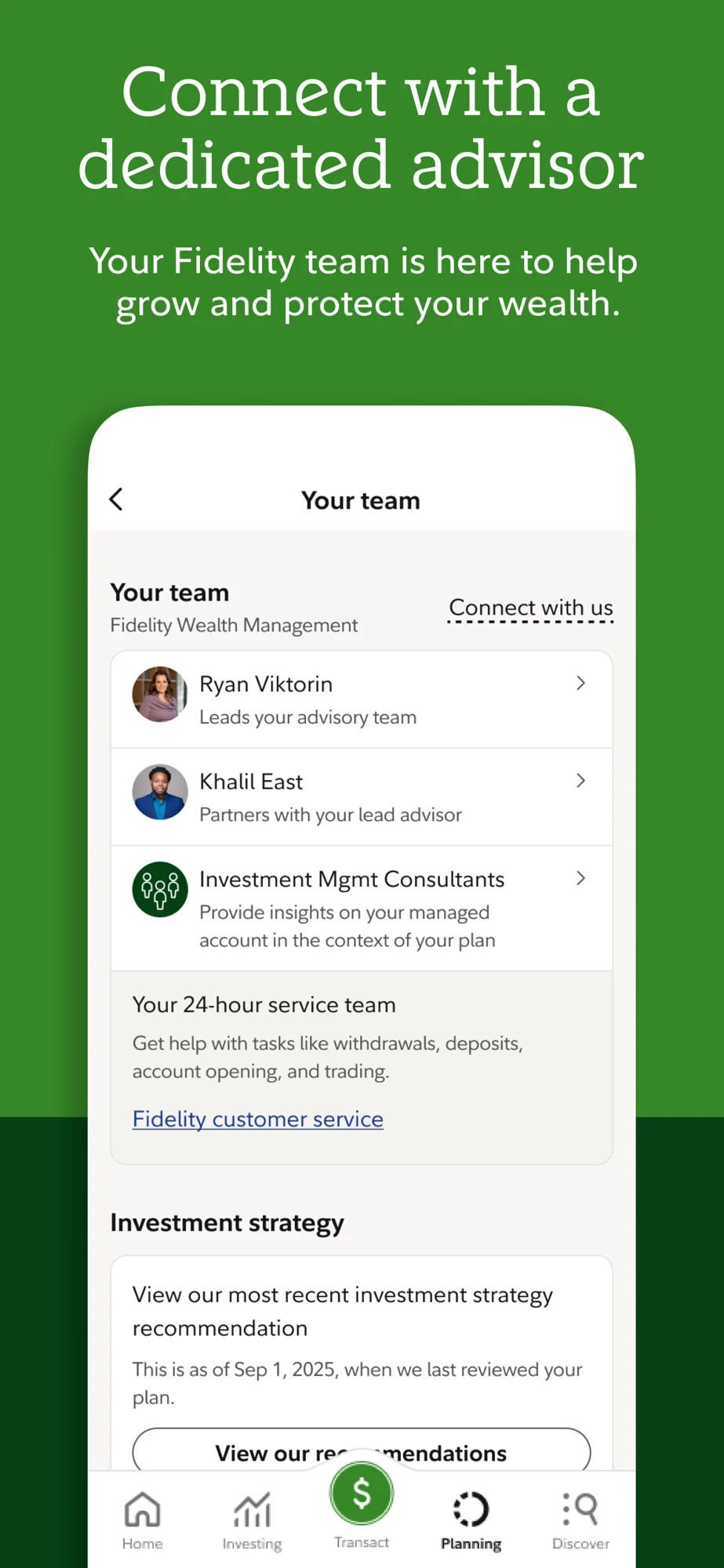
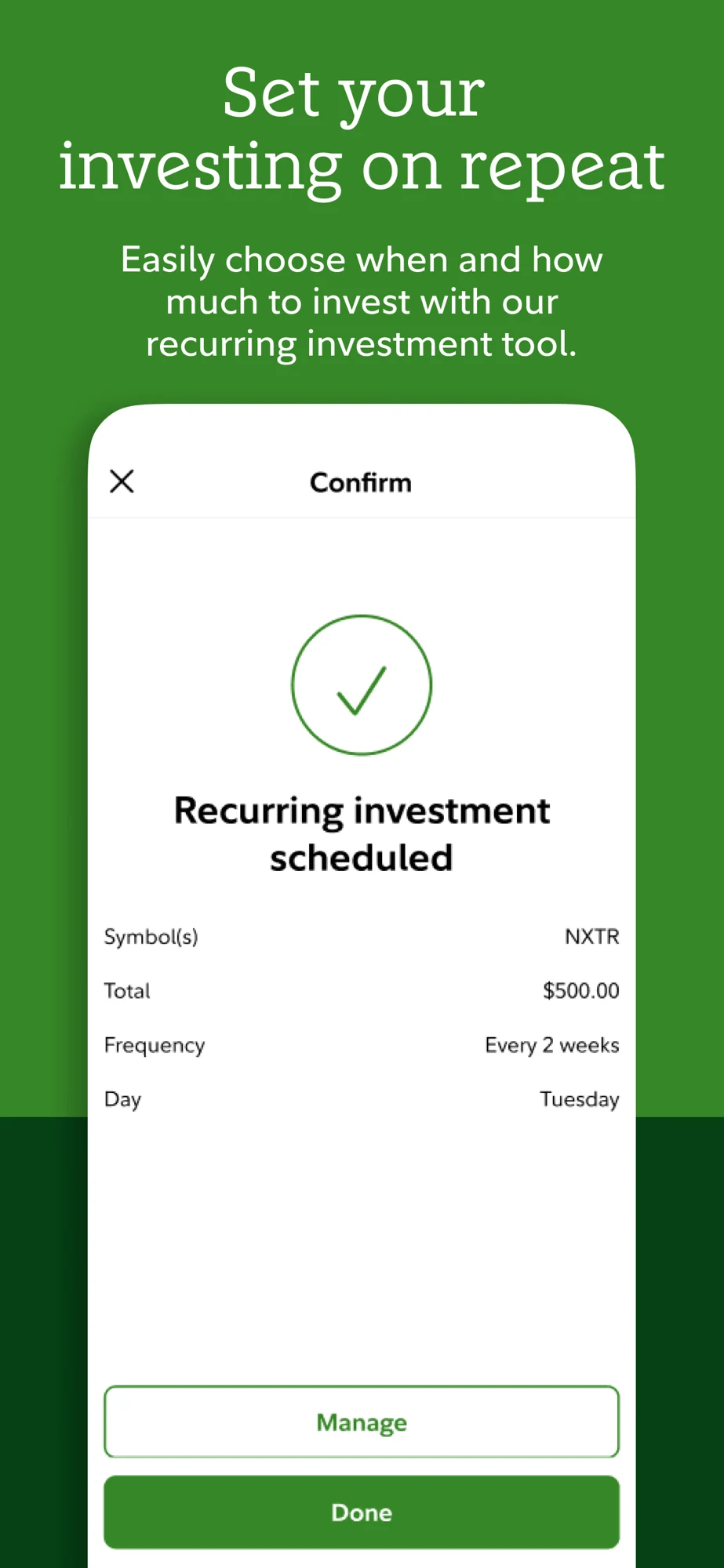
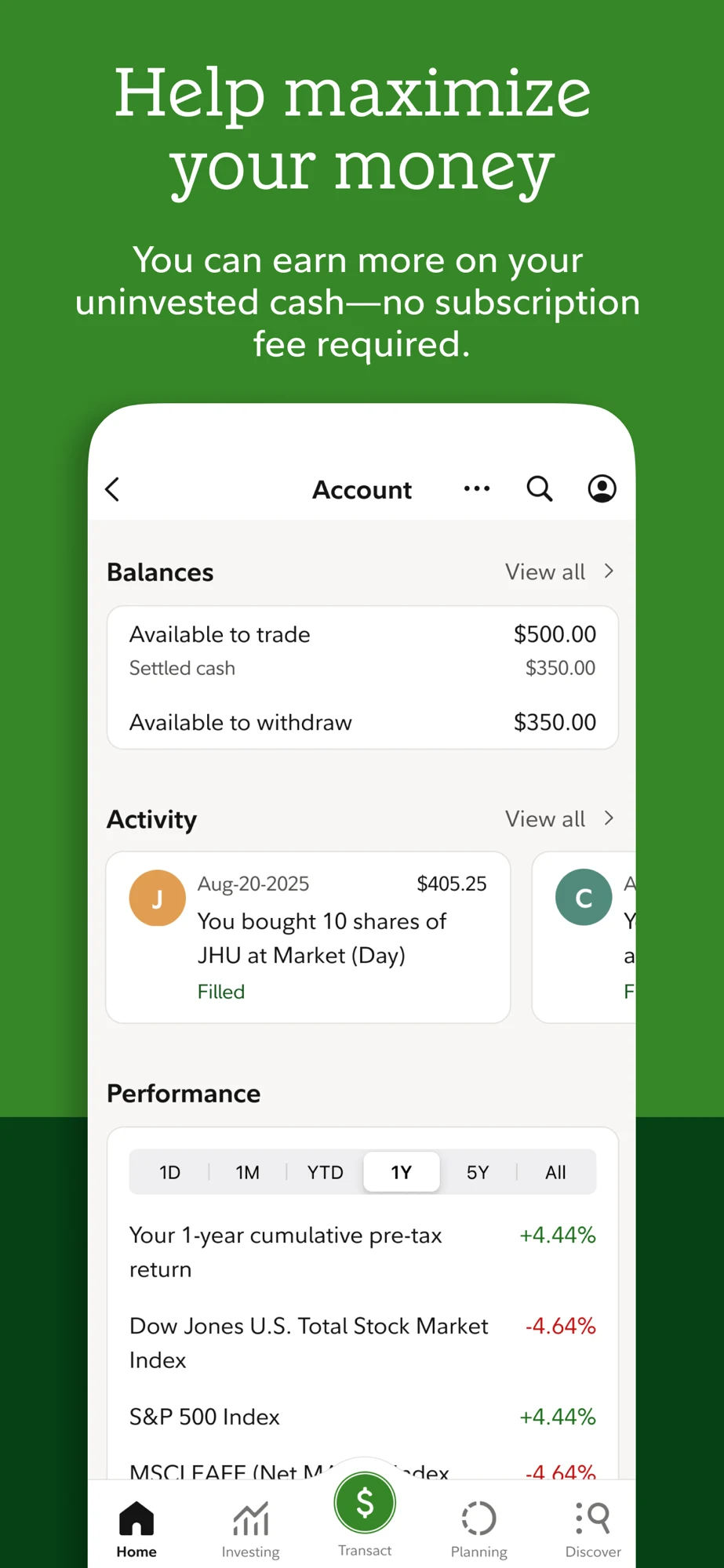
Fidelity: Account overview, assistance, recurring action and cash
Panel 1 · An account overview combines market data, balances and a period chart.Panel 2 · An advisory-team screen makes a specific assistance relationship visible.Panel 3 · A recurring-investment confirmation shows amount, cadence and a scheduled state.Panel 4 · A cash message sits above balance, activity and performance information.
The schedule frame provides concrete action proof. Its scheduled label should remain visible when adapted; it does not mean an investment has executed. The cash panel contains several different measures. Test a tighter cash-label crop or separate performance story, preserving product eligibility and calculation context.
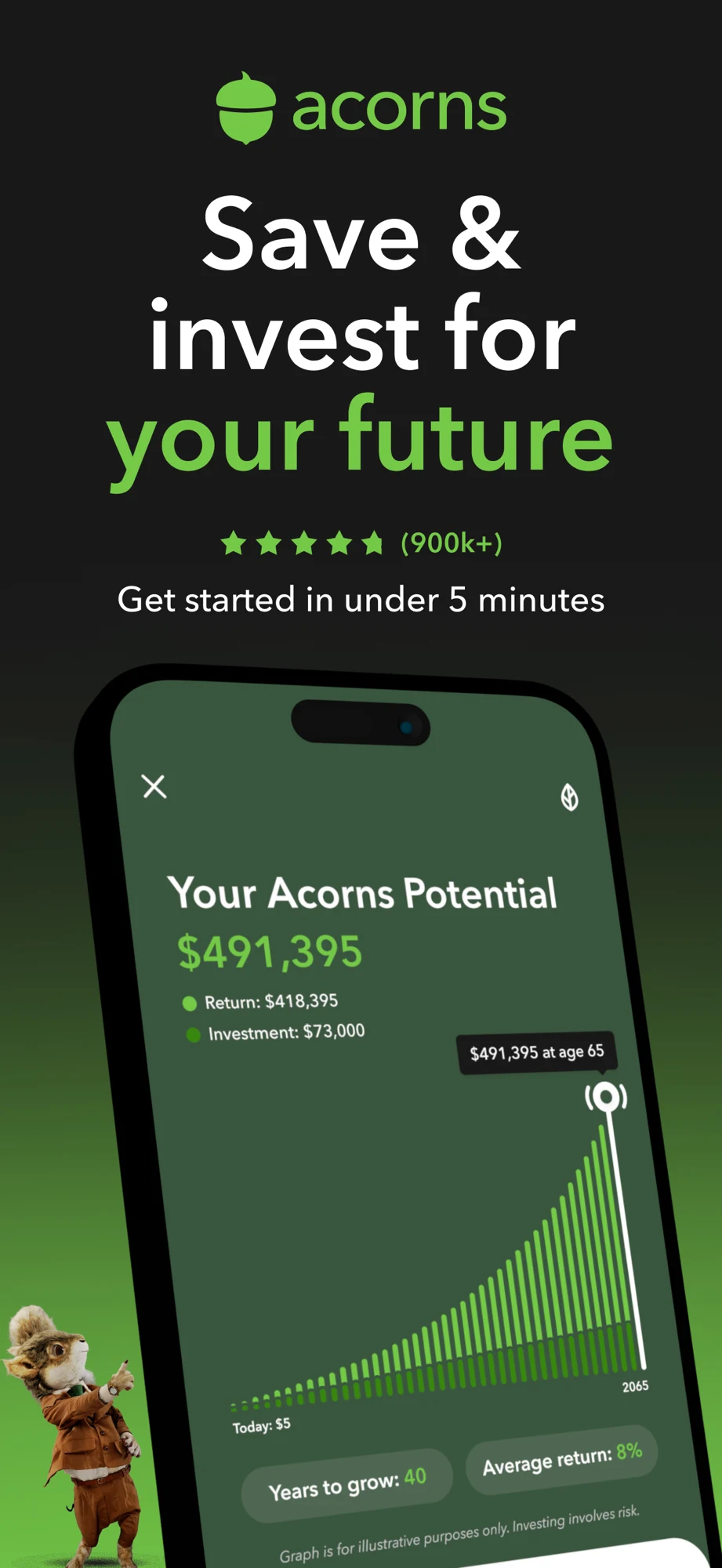
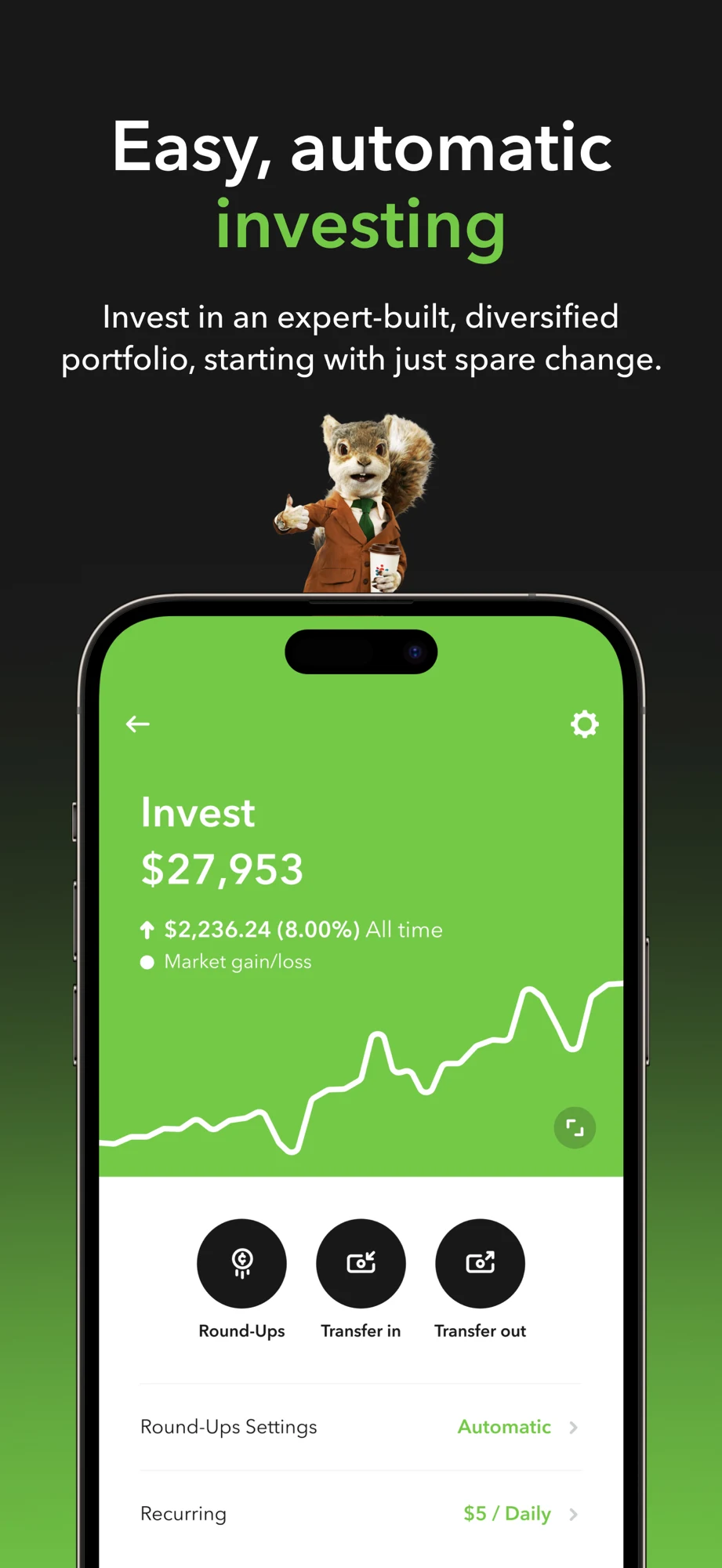
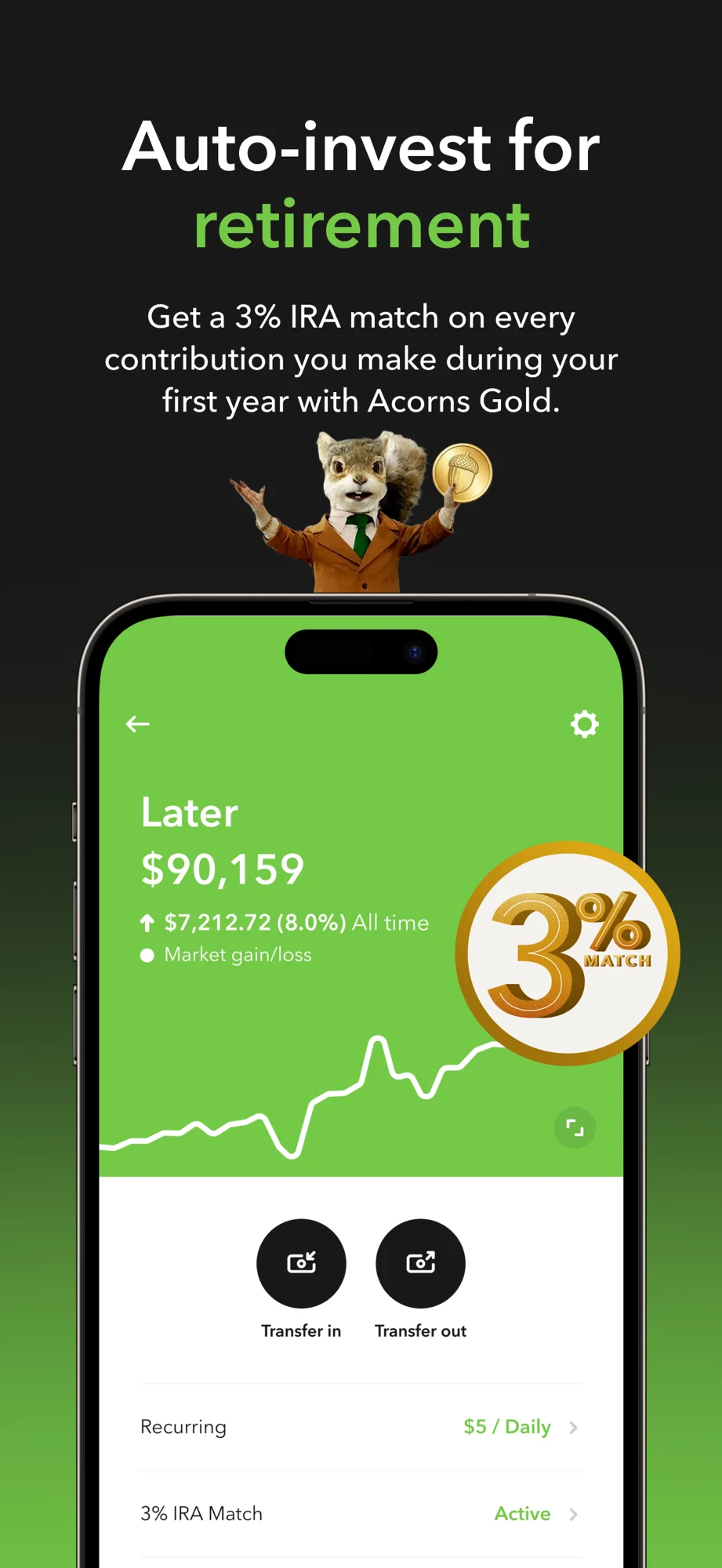
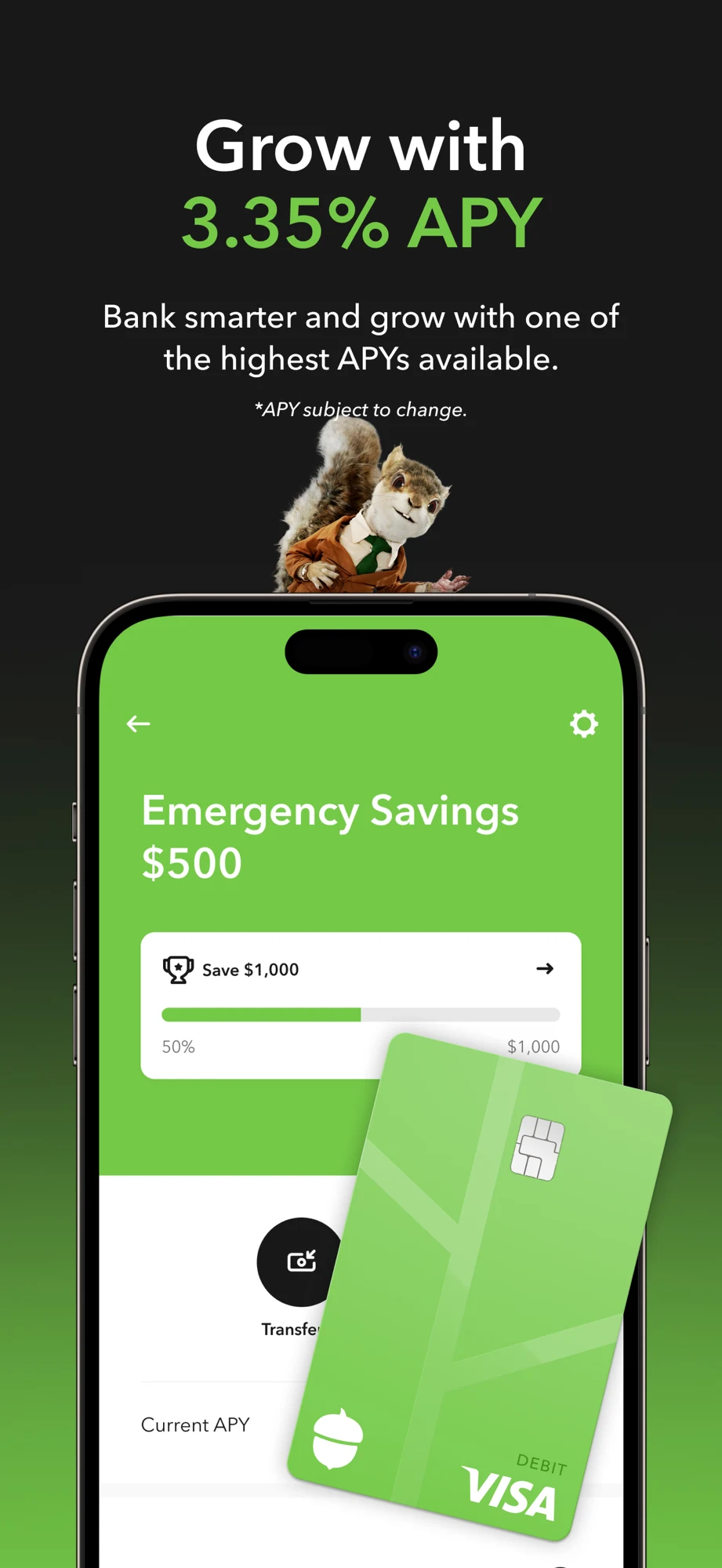
Acorns: A future illustration followed by habits and adjacent accounts
Panel 1 · A long-horizon projection appears beneath the opening future-focused message.Panel 2 · A portfolio view shows recurring and spare-change controls.Panel 3 · A retirement panel combines account UI with a conditional matching offer.Panel 4 · A savings panel shifts to cash interest and a goal balance.
The illustration labels its assumptions and risk, but those details are smaller than the future amount. Test the actual recurring-action controls earlier for habit-led intent. Keep projection, market movement, promotional matching and cash interest distinct. None of the depicted figures is a predicted customer result.
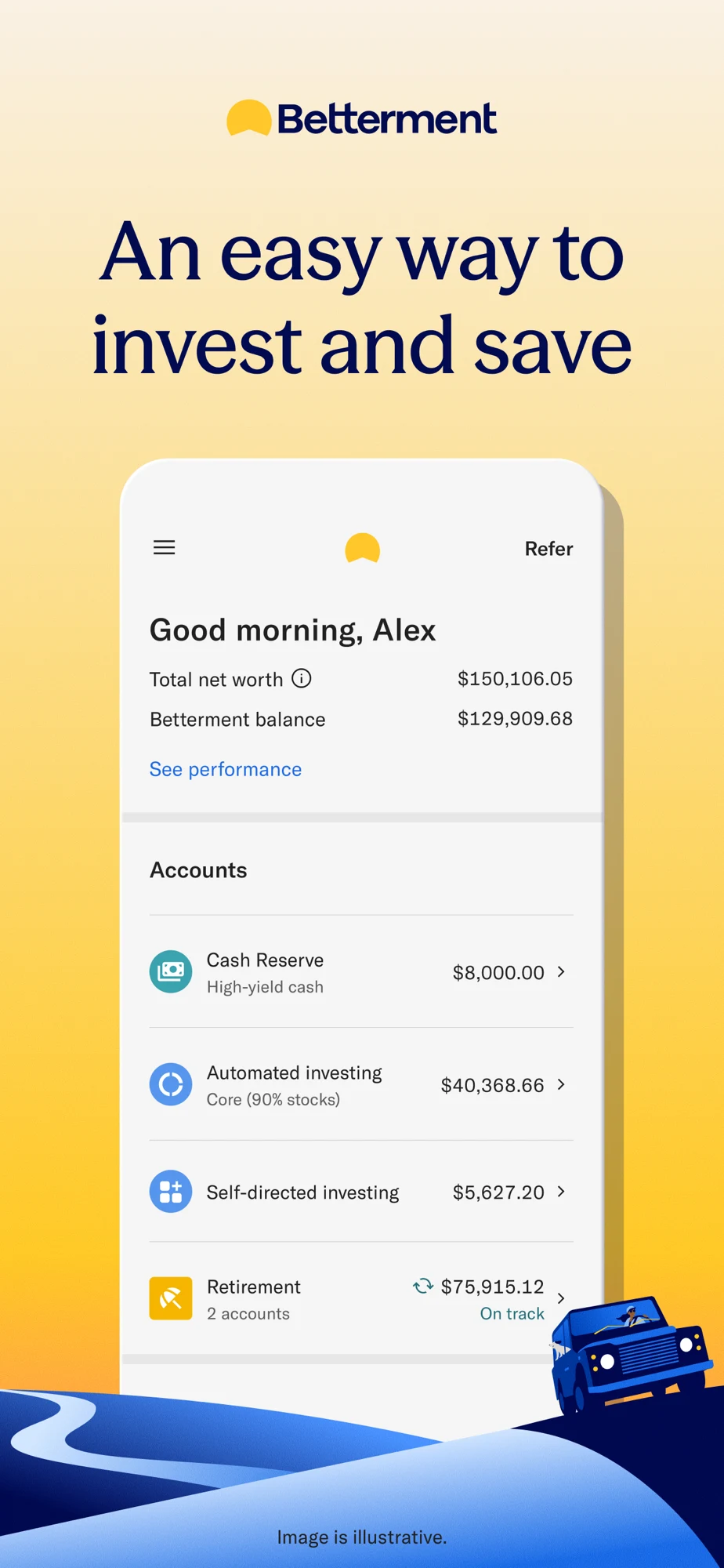
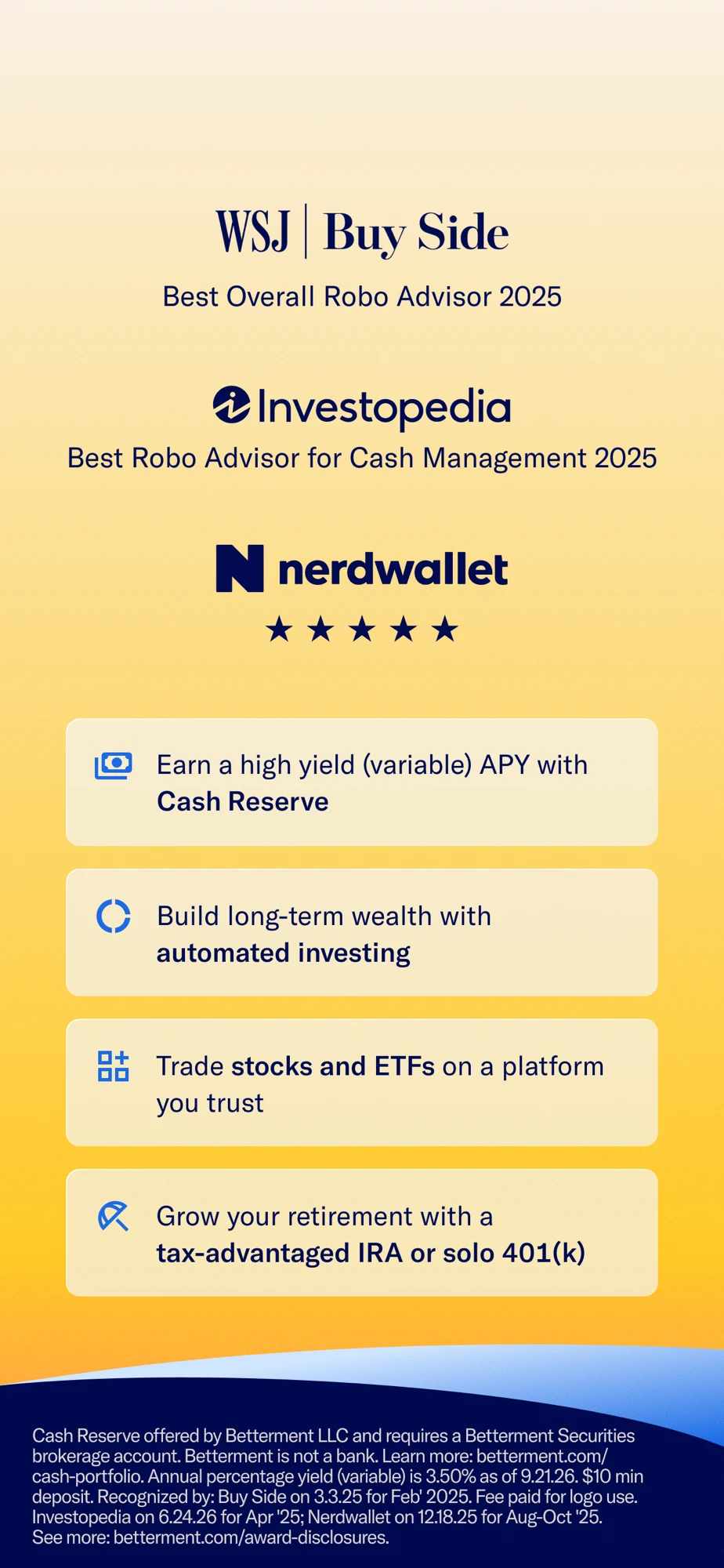
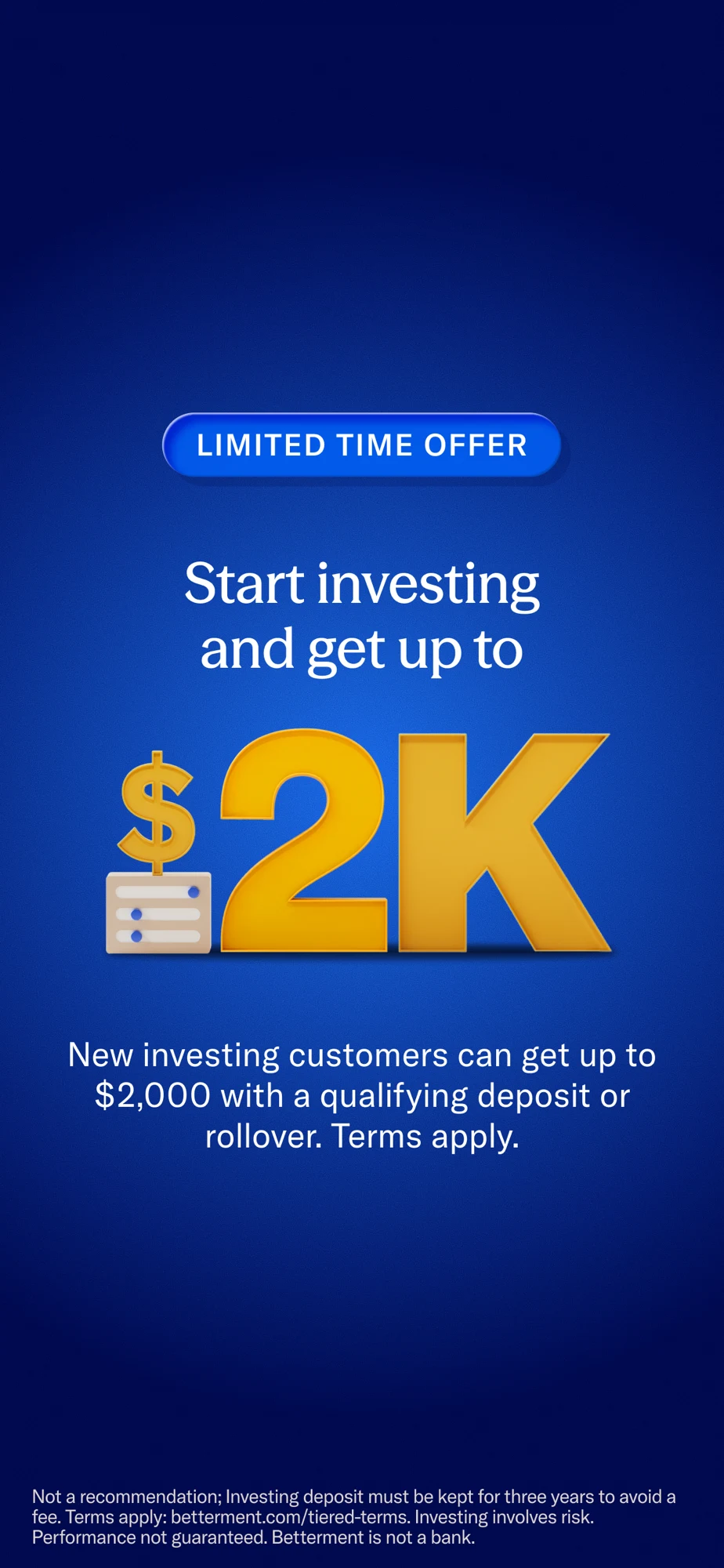
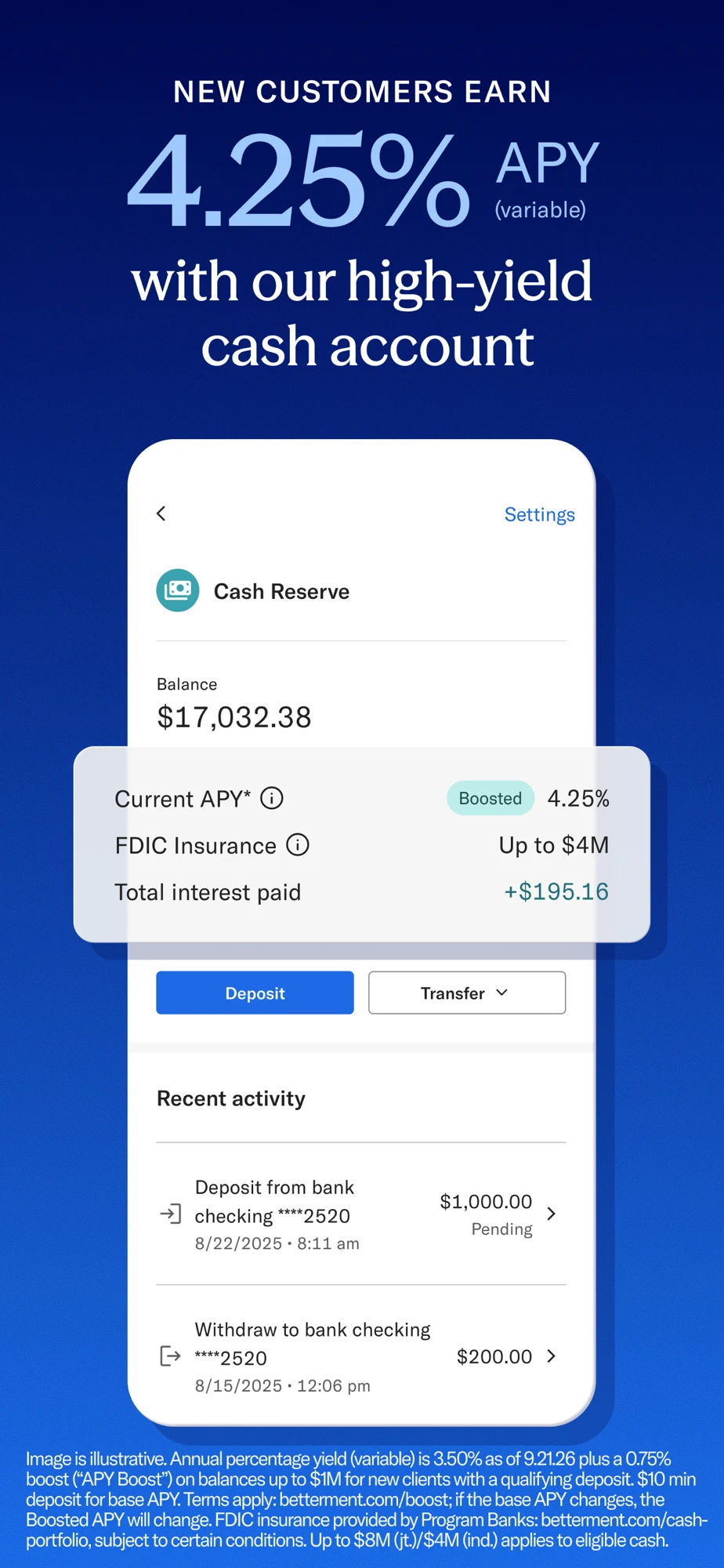
Betterment: Product choices followed by awards and offers
Panel 1 · An overview distinguishes cash, automated, self-directed and retirement accounts.Panel 2 · Awards and a service list introduce several product models.Panel 3 · A promotional panel emphasizes a conditional new-customer offer.Panel 4 · A cash-account panel enlarges a variable-rate and account-details overlay.
The first screen is useful product-choice evidence. Later panels emphasize offers and cash rather than a managed-investing task. For delegated-investing intent, test a clear setup or portfolio-management screen earlier. Award and offer context remains necessary; we have not verified their effect on conversion.
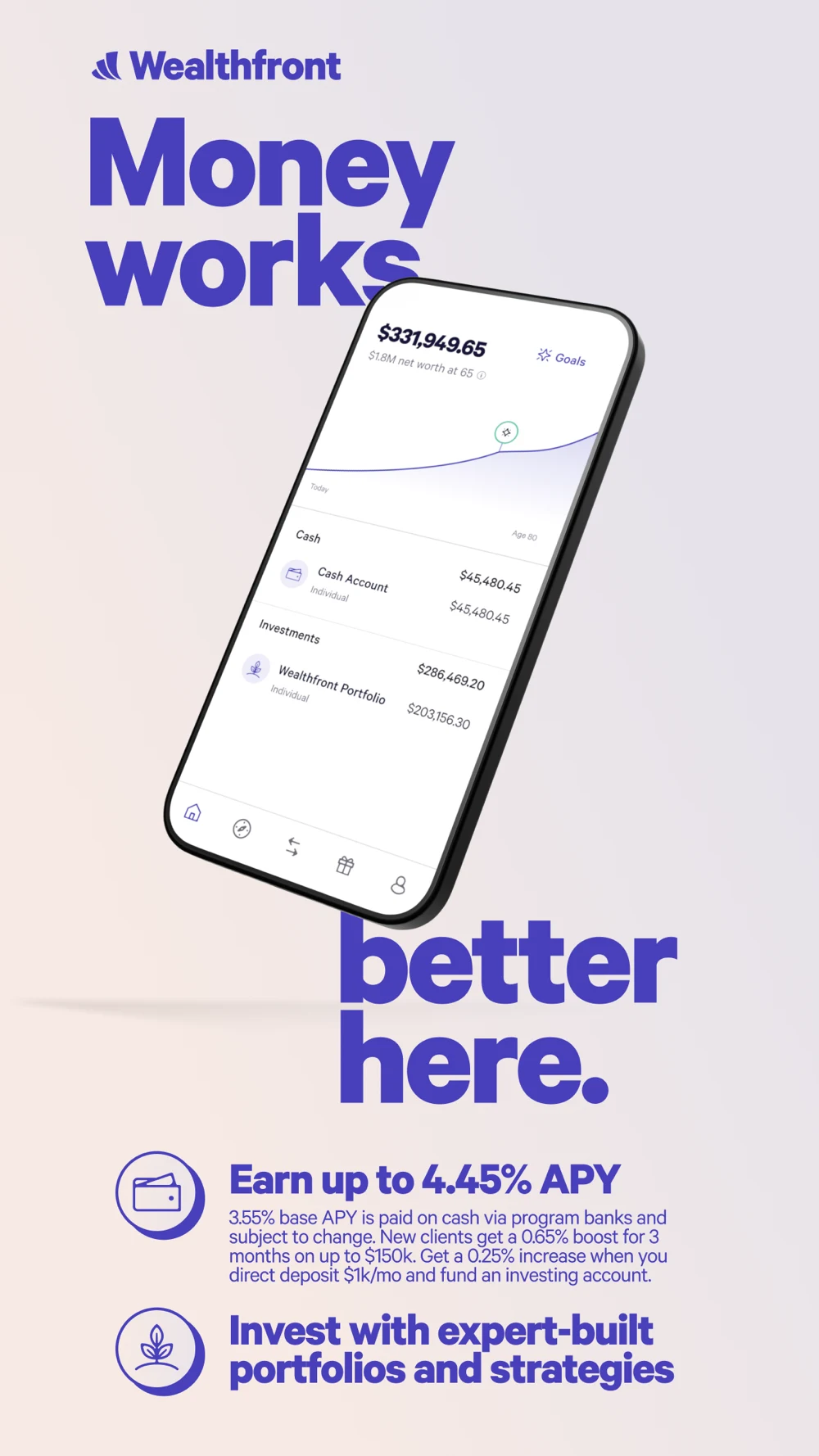
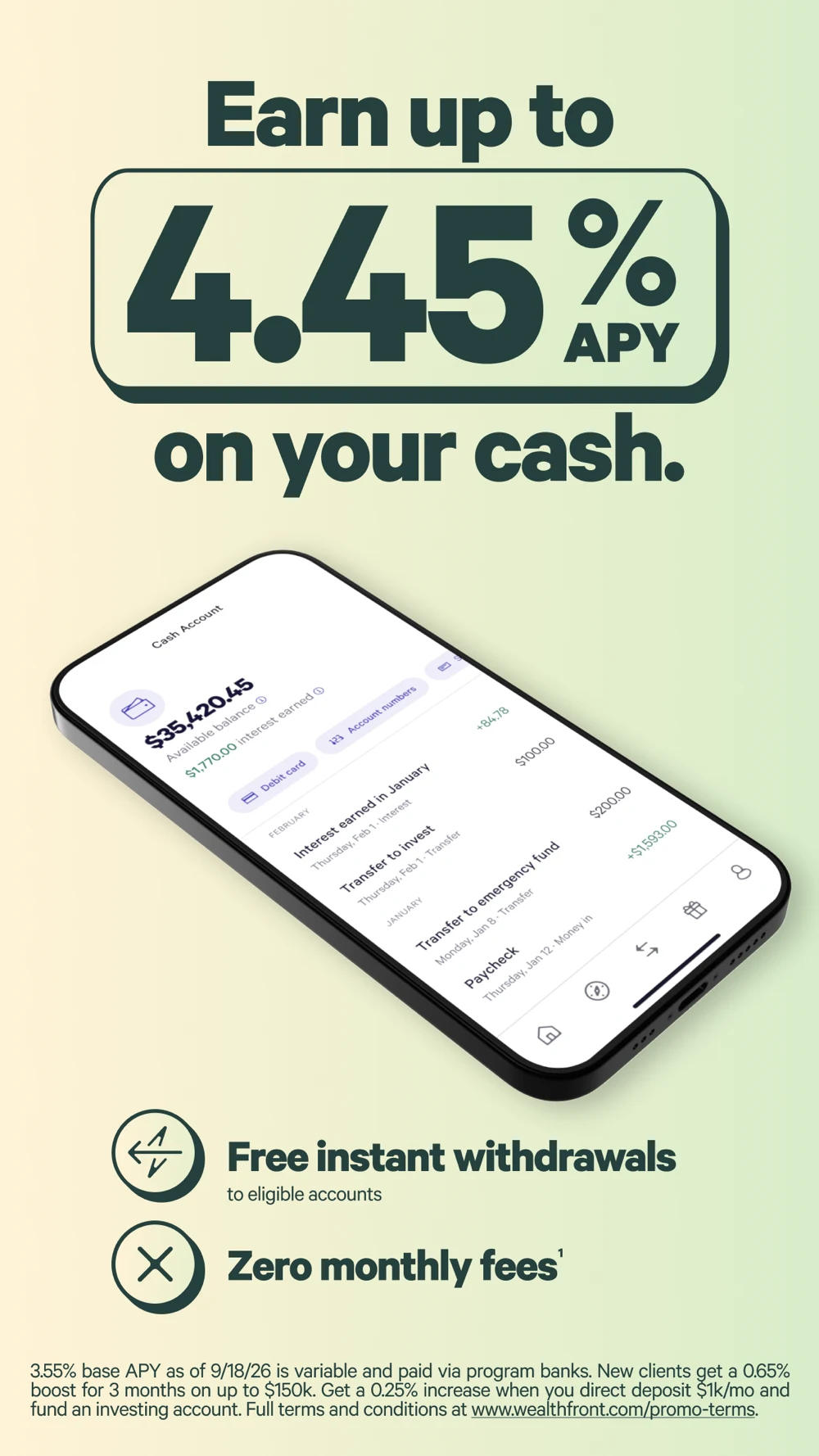
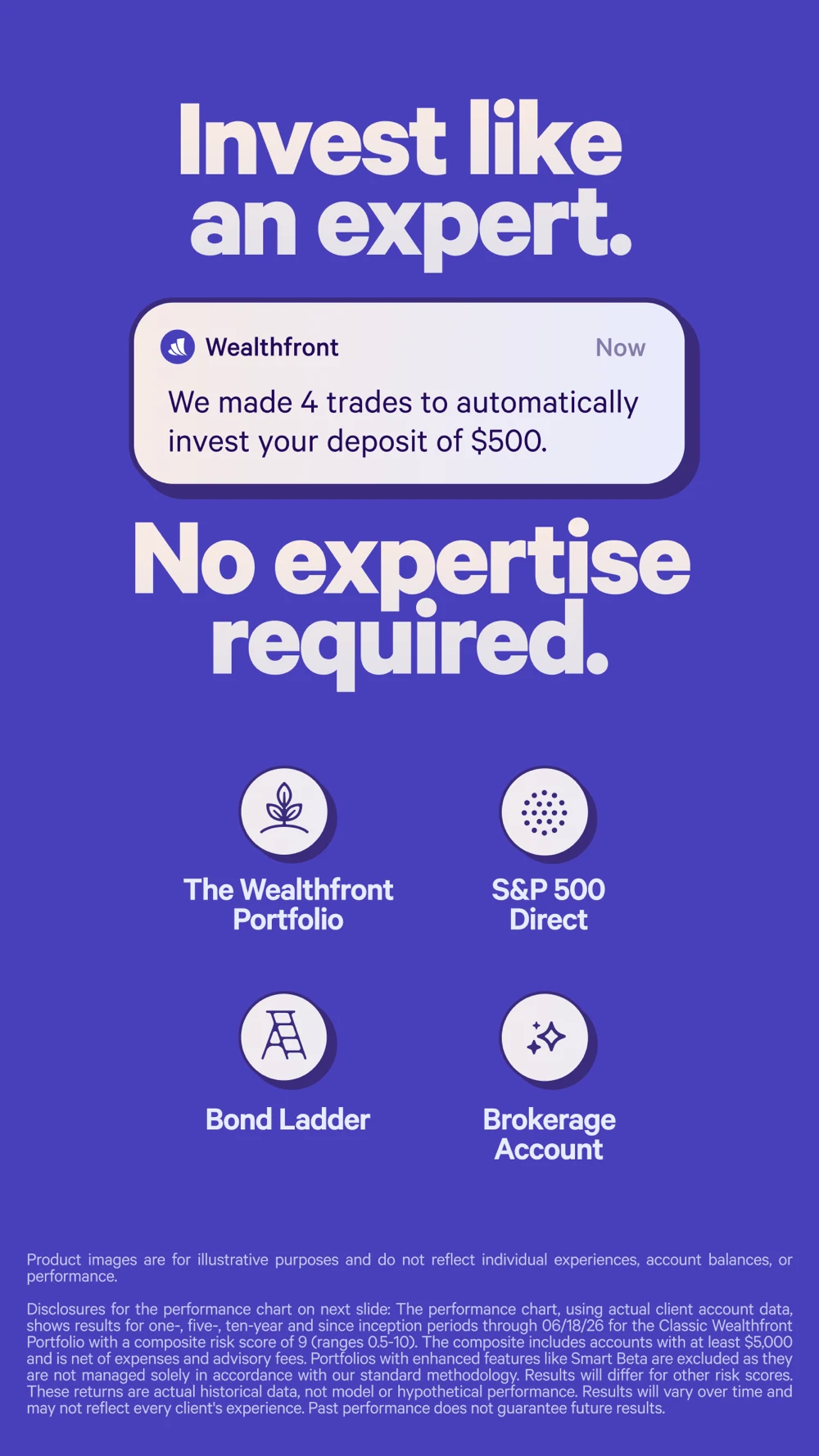
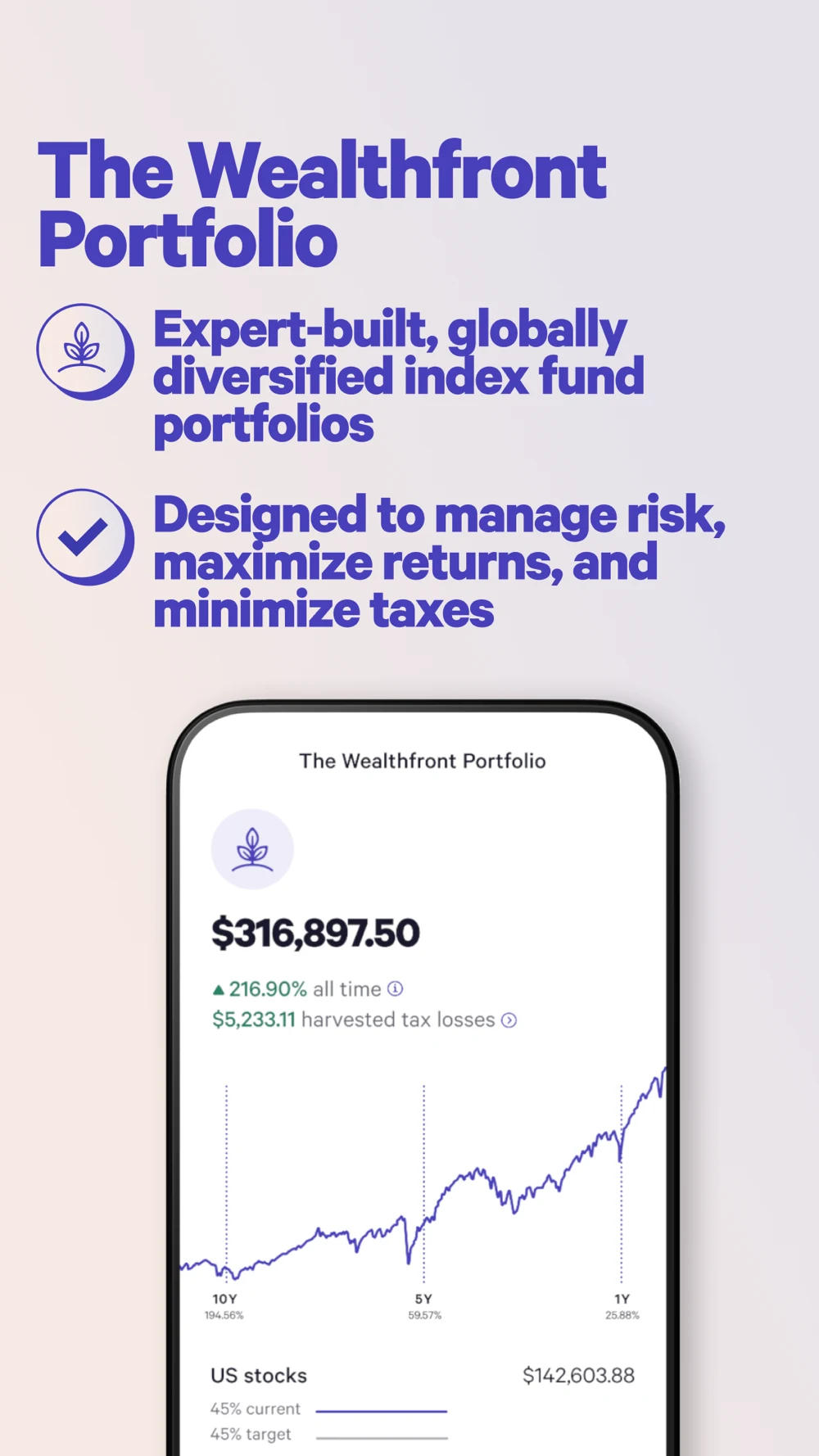
Wealthfront: Cash and investing breadth, then automation and portfolio detail
Panel 1 · An angled account overview combines cash and investment messaging.Panel 2 · A large cash-rate headline leads into account UI and conditions.Panel 3 · An enlarged notification demonstrates automated purchases alongside product choices.Panel 4 · A portfolio screen shows historical-performance and allocation information.
The notification explains an action more directly than the angled overview. For investing intent, test a frontal automation or allocation view first. Performance context appears partly on the preceding panel; preserve it when reordering. Historical results and cash rates should not become promises about a visitor’s investments.
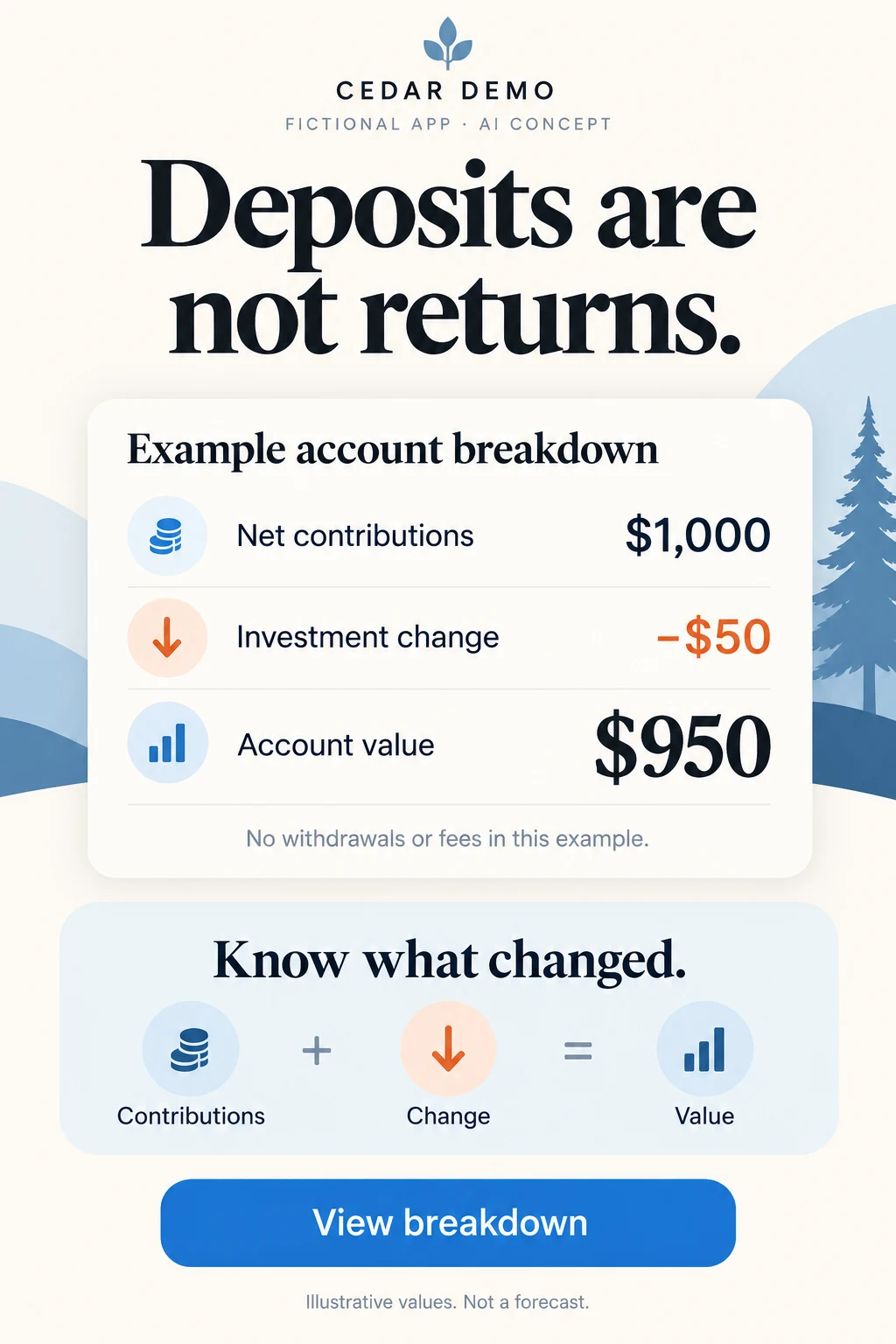
ContextNo withdrawals or fees in this simple example; not a forecast.
The diagram is deliberately simple: illustrative contributions of $1,000 plus investment change of −$50 give an account value of $950, with no withdrawals or fees in that example. It is not a return-calculation standard, a real account or a forecast. Real reporting may need deposits, withdrawals, income, fees and calculation methodology explained separately. Do not copy the arithmetic into a production performance feature without those definitions.
A screenshot can preserve that meaning without becoming a spreadsheet. Keep the selected period, value label and the most important explanatory measure visible. A rising account-value line can include deposits; a projection can include assumptions; a historical chart describes a particular past series. Those are different kinds of evidence. Use screenshot copy and sequence planning to make the distinction explicit.
Test comprehension before optimization. Show a frame to relevant participants, remove it and ask what caused the number to change. If people confuse money added with investment gain, revise the labels and hierarchy. A handful of interviews can expose a problem, but it cannot establish a population percentage or conversion uplift.
INVESTING APP ASO
Write copy that identifies the product and explains the next action.
The worked example below is a fictional product called Cedar Demo. Assume it supports self-directed research, eligible recurring purchases, holdings and account records in one approved market. Those assumptions must be true before any of this copy becomes usable. It does not advertise managed portfolios, options, crypto, personalized advice or a particular financial outcome.
4. Let the title identify investing. Let the screen explain the task.
TitleCedar Demo: Investing
Supporting copyPlans, holdings & statements
ScreenshotReview your recurring investment
ProofThe amount, asset, schedule and actual status
Swipe horizontally to compare all columns →
Illustrative metadata — character counts, not performance predictions
Review investment plans, inspect holdings and understand account activity.
74 / 80
The title identifies the category. The subtitle names three practical tasks. The keyword field adds relevant concepts without repeating the name or stuffing competitor brands into it. This is one coherent starting hypothesis, not a claim that these terms have demand or will rank. A real release should resolve overlaps, local terminology and feature eligibility using the app-name guide, subtitle guide and keyword-field process.
A useful description opening
Illustrative copy: “See what you hold and review what happens next. Cedar Demo brings supported investment research, recurring plans and account records into one place. Choose eligible investments yourself, inspect the details and review each instruction before continuing.”
“Set a recurring purchase for an eligible investment. Check the amount, funding source and schedule, then review the plan before activating it. Open the plan later to see its current status and the controls available for changing future actions.”
“Understand your account activity. Review holdings, contributions, investment changes and statements with their dates and labels. Availability, eligibility and fees depend on the actual account and service. Investments can lose value.”
This opening would still need the product’s exact cost, account and service information. Do not publish the generic availability sentence as a substitute for important specifics. The point is to explain the task in ordinary language before adding detail, not to hide restrictions beneath an attractive headline. Build the rest around verified features, supported accounts, actual assistance and accurate privacy information.
Swipe horizontally to compare all columns →
A screenshot sequence for the fictional self-directed product
Frame
Headline hypothesis
Actual evidence required
What the viewer should understand
Opening
Invest with a plan you can inspect
Real supported research and plan entry point
This is self-directed investing with practical controls
Research
See the details before you decide
Real security information with source and timestamp
What information is available and its limitations
Recurring plan
Review the amount and the schedule
Asset, amount, cadence and funding source
What repeats, how it is funded and whether it is active
Order state
Know where your instruction stands
Actual pending, submitted or filled state
An instruction and an executed transaction differ
Account view
Understand what changed
Holdings, contributions, period and change labels
Deposits and investment movement are distinct
Records
Find the record behind the number
Real activity details and statements
Where to check an action and its documentation
Use task-specific calls to action in the demonstrated UI: “Review plan,” “Review order,” “View breakdown” or “Open statement.” They should match the action the real control performs. “Start growing,” “Profit now” or a celebratory trade animation says little about the next step and can imply an outcome the product cannot promise. Screenshot headlines explain a benefit; UI controls explain an action.
An app preview could show one complete but unexecuted setup: choose an eligible asset, enter an amount, select funding and cadence, inspect the review screen, then show where the saved plan can be found. Keep state transitions truthful and leave critical labels visible long enough to read. Do not edit a draft directly into a successful fill or imply instant execution across different order conditions.
For Google Play, develop the short description around the same supported tasks and use the long description for organized explanations. Do not paste the iOS keyword field into prose. Evaluate the first screenshots at actual store size; a technically sharp export can still hide the information that matters.
INVESTING APP ASO
Catch the small wording errors that change the financial meaning.
The following are mistakes to check for, not allegations that every reviewed competitor makes them. A public image can reveal a possible misunderstanding; it cannot establish whether users are misled or how it converts. Write a specific hypothesis, preserve the original and test comprehension with the intended audience.
5. Do not turn a plan into an executed investment.
DraftThe customer is still choosing details.
ScheduledA future action is configured.
SubmittedAn instruction has been sent.
FilledUse only for the product’s actual execution state.
Swipe horizontally to compare all columns →
Errors to investigate in investing-app metadata and creative
Potential mistake
Why it matters
Practical correction
Treating cash yield as investment performance
Different products and measures are being collapsed
Label the cash product, conditions and rate separately from portfolio results
Calling an account-value increase a return
Deposits can increase the balance without investment gains
Show the period and appropriate contribution/change definitions
Making a projection look like a promised balance
Future values rely on assumptions
Clearly identify projections and keep necessary assumptions legible
Equating zero commission with no costs
Other costs may apply to the advertised service
Use precise approved fee scope instead of a blanket free claim
Calling an automatic deposit an automatic investment
Money movement and purchasing are different actions
Name the repeated action and show its destination
Showing scheduled as already filled
A future instruction is not execution evidence
Use the real state and explain what remains unfinished
Mixing managed and self-directed journeys
Visitors may misunderstand who makes decisions
Match the opening to the specific advertised product model
Presenting research as personalized advice
A chart or AI explanation does not establish an advisory relationship
Name the actual information service and its scope
Letting an old offer lead the page
Expired rates or conditions can survive in saved assets
Assign an owner and review trigger to offer-led frames
Filling the opening with awards
Recognition alone does not explain a customer task
Pair relevant proof with readable real product evidence
Using color alone to explain gain and loss
Meaning can disappear for some readers or after cropping
Use signs, words, periods and accessible labels
Translating account names literally
Foreign account types can mean different things locally
Verify local eligibility and terminology before targeting
Optimizing solely for trading frequency
More transactions do not necessarily mean a better customer relationship
Define suitable activation and retention with the product team
A status exercise is especially useful. Show a plan marked scheduled, a submitted order and a filled order separately. Ask what has happened and what might still change. Do not demand that every product use these exact labels; require consistency with its own system. Some recurring plans generate later instructions, and cancellation behavior can depend on the state. Marketing should preserve those distinctions.
For an account chart, ask what the selected period means, whether contributions are included, and whether the figure is historical or projected. For a cash offer, ask which account it applies to and what conditions are visible. Use the answers to improve readability and trust signals. Do not turn five interviews into a numerical market finding.
Keep the change log specific: frame, exact wording, UI version, audience, storefront and hypothesis. A failed test is still useful if it rules out a clear idea. A test that changes title, first image, offer and targeting together cannot isolate which change mattered. See test prioritization and metadata change logs.
INVESTING APP ASO
Build search campaigns around investor intent and qualified activation.
Use ASO research to structure Apple Ads around supported product jobs. The campaign is an extension of the product promise: a recurring-ETF query should reach a page that explains a real recurring purchase, while a managed-portfolio query needs a genuinely managed service. Do not buy a broad investing story and hope onboarding will resolve the mismatch.
6. Measure the customer relationship, not trading excitement.
SearchA supported product model and task
PageMatching feature proof and eligibility
ActivationA defined eligible account milestone
QualityRetention and expectation accuracy, not more trades alone
Swipe horizontally to compare all columns →
Campaign architecture hypotheses — not a live campaign or spending instruction
Campaign role
Example research input
Starting structure
Matching page and product check
Own brand
Your verified brand and supported product names
Separate brand reporting; inspect actual search terms
Official identity and accurate access or acquisition journey
Category: recurring purchases
recurring investments; recurring etf purchase
Focused exact-match ad group; Search Match off
Amount, eligible asset, cadence and review state
Category: managed service
managed portfolio app; automated investing
Separate only if the product actually offers managed investing
Who makes decisions, actual setup, fees and control scope
Category: research
etf research tools; stock research app
Research-focused exact group with a distinct hypothesis
Readable real research; do not imply individualized advice
Competitor exploration
Verified competitor names with relevant product overlap
Separate controlled budget and reporting
Your own product and identity; no implied affiliation
Discovery
Supported seed terms and known category language
Separate broad-match and Search Match exploration
General but accurate page; frequent term review
For the fictional Cedar Demo example, start only with the recurring-purchase job. Managed investing is excluded because it is outside the example’s assumed capabilities. Keep country, language, eligible audience, customer type and page consistent. Apple’s campaign-structure guidance separates brand, category, competitor and discovery purposes; the product model adds the category-specific discipline.
Exact match is not literal-only matching. Apple documents close variants, reordered words and translations; broad match can extend to related terms. Inspect what actually matched rather than treating the keyword label as the user’s complete intent. See current match-type behavior. Search Match should be off in the focused exact groups if the purpose is to isolate those targeted hypotheses.
Create a custom product page for recurring-purchase intent only when the feature is real. The first frame identifies the scheduled purchase; the next shows the review controls; another explains activity and records. Preserve the correct account and asset eligibility. Use Apple’s custom product page documentation for current capabilities and approval requirements. A more relevant page is a hypothesis, not a guaranteed improvement.
Work a search-term example all the way through
Suppose discovery matches “weekly ETF investment,” “paper trading practice” and “crypto trading bot.” These are illustrative queries, not observations from a real account. If Cedar supports the first job, inspect its search results, eligibility and downstream quality, then consider a controlled exact-match test. If Cedar offers neither paper trading nor automated crypto trading, record the mismatch and exclude the relevant queries using appropriate negatives.
Do not blindly exclude “stock” or “investment” because one phrase was irrelevant. A broad negative can remove useful related searches. Apple uses exact match by default for negative keywords and supports broad negatives with different coverage; follow its negative-keyword documentation. To move a useful term from discovery into a controlled group, plan routing and exclusions so the two experiments do not muddy the comparison.
Feed the learning back into ASO: does “weekly” describe a valuable real control? Does “ETF” need clearer evidence? Did users mean practicing without real money? A paid query supplies language and intent clues, not automatic permission to put the phrase in the title. Recheck feature fit and keyword gaps before changing metadata.
Define activation before deciding what a tap is worth
Agree a funnel with the business: ad tap, new install, eligible account application, approved account, funded account, a product-appropriate activation milestone and retained relationship. Returning logins are useful to customers but should not silently count as new acquisition. A deposit, an approved account and an executed investment are different events. The appropriate goal depends on the actual product and should not pressure customers to trade more.
Use mature cohorts and an approved economics model. Deposited principal and assets under management are not revenue. An acquisition ceiling needs the business’s actual contribution economics, costs, retention assumptions and uncertainty. Do not infer a profitable bid from the account balances shown in screenshots.
Illustrative planning arithmetic: assume a business has independently approved a $40 ceiling per qualified activated account. If 10% of new installs reach that milestone, the implied install ceiling is $4. If 40% of taps produce those new installs, the implied tap ceiling is $1.60. These invented inputs demonstrate multiplication only; they are not category benchmarks, recommended bids, predicted outcomes or an instruction to spend.
Swipe horizontally to compare all columns →
A bounded research pilot — hypothetical planning, not campaign execution
Pilot decision
Predefined rule
Why this belongs in the brief
Scope
One supported job, one storefront and one matching page
Reduces product-model and locale confusion
Budget
Approve a bounded spend cap and stop conditions before launch
Prevents exploratory spend from becoming open-ended
Timing
Allow the actual approval, funding and activation window to mature
Same-day installs do not represent completed account journeys
Primary outcome
Cost per defined eligible, qualified activation
Avoids treating every installation as equivalent
Quality checks
Expectation accuracy, account fit and retained relationship
Cheap traffic can still be unsuitable
Confounders
Record offers, market events, product changes and traffic shifts
Market attention can change the audience during a test
Decision
Expand, revise, stop or keep inconclusive against agreed evidence
Do not select a winner just because a dashboard has a larger number
Attribution and privacy limitations mean you may not be able to connect every query to every later account event. Report what is observable at each level, separate aggregates from user-level evidence and avoid unsupported causal claims. Align denominators with the conversion definitions, track ASO KPIs, and keep search and browse traffic distinct.
Paid results can guide a creative hypothesis, but they do not prove an organic ranking effect. Validate the resulting metadata or screenshot change in its own context. The connection between ASO and acquisition works best when both teams share the same product definitions and evidence limits.
INVESTING APP ASO
Follow the product differences behind the creative trends.
These are patterns in the dated eight-app comparison sample, not a market-share or market-growth report. They describe what the reviewed listings and panels emphasize. No percentage of the industry, demand trend or conversion advantage has been measured here.
Swipe horizontally to compare all columns →
Research patterns from public US iOS material — 27 October 2026
Pattern in this sample
Creative implication to investigate
Evidence still needed
Several brands combine investing with cash products
Separate the account and task behind each headline
Which journey a particular search audience wants
Recurring actions appear alongside wealth or balance stories
Test practical setup proof against broad outcome-led messaging
Task comprehension and qualified activation
Large projections and account totals compete for attention
Make assumptions, periods and contributions understandable
Whether readers interpret the number correctly
Promotions and awards occupy valuable early frames
Test whether product proof needs to appear sooner
Audience-specific behavior and current offer eligibility
Research, self-directed and managed models share category language
Use distinct openings for materially different services
Live query intent and actual supported capabilities
Automation can be shown as a real schedule or notification
Prefer explicit action, amount and state when those are the selling point
Whether the depicted control exists and is understood
The eight source listings establish product context; the twenty original panels show the creative details behind these observations. Cash rates, membership offers, interfaces and account availability can change. A captured screenshot is evidence of that publisher asset at capture time, not a current quotation or a recommendation to use the service.
Keep a register with the claim, product model, account type, market, source, owner and review trigger. Changes to an offer, fee, eligible asset, order state or account journey should trigger a creative check. For market commentary, collect real data over time with a consistent method before drawing a trend line. An explanatory diagram is more honest than a chart of invented adoption or conversion numbers.
INVESTING APP ASO
Use AI to clarify the action and explain the account.
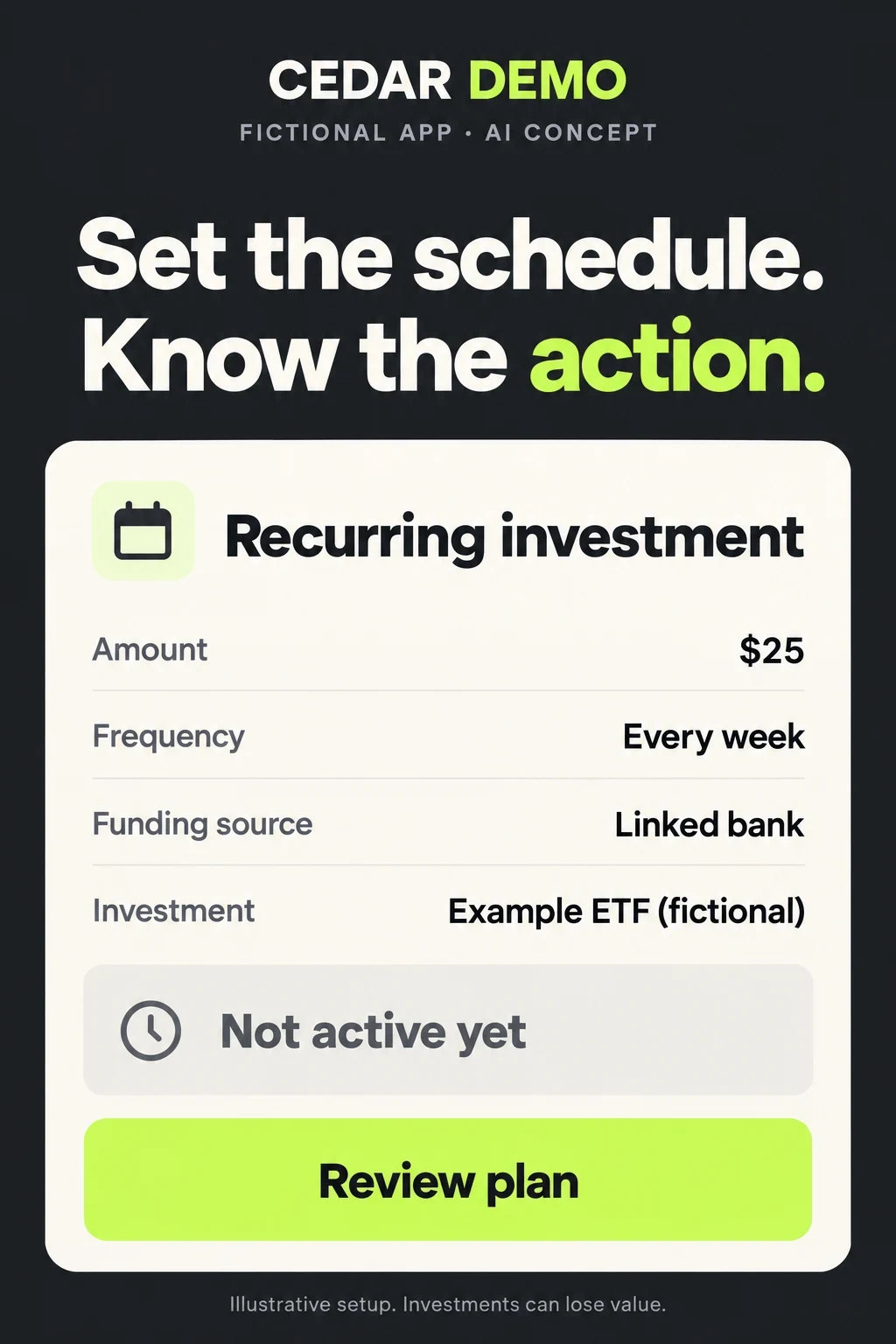
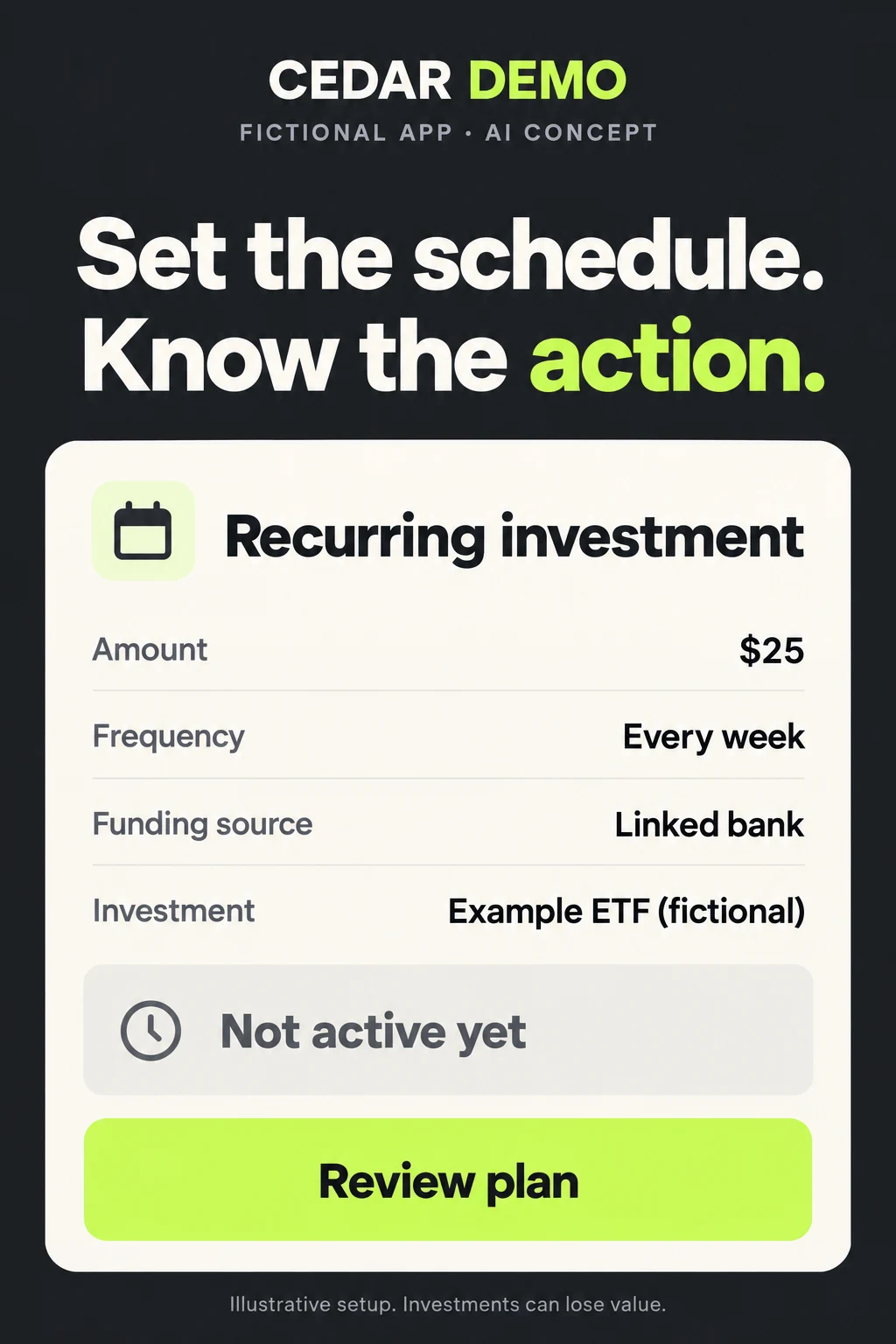
These original AI concepts use the fictional Cedar Demo identity. They propose two different improvements: make a recurring plan understandable, and separate money contributed from investment change. They are teaching graphics, not real app screens, competitor redesigns or evidence of better performance.
AI CONCEPT · A plan you can inspect before it becomes active · Open full size.AI CONCEPT · Deposits are not investment returns · Open full size.
7. Make AI show the product, not promise the outcome.
ProvideApproved UI, features and fictional account data
GenerateOne task or one explanation
InspectNumbers, labels, state, caveats and added claims
RebuildUse actual UI and approved language before testing
Swipe horizontally to compare all columns →
AI critique — readable concepts still need product validation
Concept
What works
What to change before production
Test question
Recurring-plan review
The amount, cadence, source and fictional asset are visible; not-active status prevents a false completion claim
Replace with approved UI; add the real next date, eligibility, applicable minimums and fee context; check footer readability
What repeats, where does the money go, and is the plan active?
Account breakdown
The arithmetic is coherent and contributions are distinct from investment change
Remove the decorative rising-bar icon beside a loss example; use the actual calculation method and period; improve secondary contrast
How much was contributed, what changed and what is the account value?
The second image deliberately uses a negative investment change. The model nevertheless added a rising-bar icon beside the account value. That decorative choice can contradict the story; replace it with a neutral account symbol or remove it in a production rebuild. The example also excludes withdrawals and fees, as its caption states. Real account reporting needs the product’s complete definitions, including relevant cash flows and income.
Both concepts are visually polished, but their brand symbols differ and some supporting text is relatively small. Standardize the identity, test contrast and rebuild with the actual interface. The first concept also says “every week” without a next execution date; a real product may require dates, market conditions and schedule rules. AI should not fill those gaps with plausible details.
Give AI a constrained product task
“Using this approved recurring-investment review screen, create three readable screenshot compositions. Preserve the actual asset, amount, funding source, cadence, next date, fees and current state. Use fictional test data. Keep scheduled, submitted and filled distinct. Do not add return forecasts, endorsements, unsupported assets or claims about safety. Identify any missing product information before drafting.”
For account interpretation: “Use the supplied calculation definitions and fictional account data. Separate contributions, withdrawals, investment change and account value with the correct period. Do not invent a return percentage or a decorative upward chart. Explain which question each composition answers, and keep essential context legible at store size.”
First agree the hypothesis, then supply approved inputs. Inspect every generated label, number, state and implied claim. Rebuild the chosen composition in the real design system, review accessibility and local terminology, and run a comprehension exercise. Only then consider a store experiment. The creative-brief guide helps separate source evidence, creative proposals and production assets.
Release a product promise people can understand and verify.
8. Localize the account meaning as well as the words.
ProductSupported account and asset types
LanguageLocally understood investing and fee terms
NumbersCurrency, period, contribution and performance labels
ReviewCheck the exact final assets and customer journey
Swipe horizontally to compare all columns →
Release checklist for investing-app ASO
Release check
Investing-specific detail
Evidence to retain
Product model
Self-directed, managed, research or tracking is identified accurately
Approved capability and decision-responsibility map
Account scope
Supported account types, market and eligibility are correct
Current account matrix and product review
Asset and action
Securities, minimums and purchase modes match the advertised journey
Actual product screens and feature confirmation
Costs and offers
Fee scope, conditions and expiry are visible where necessary
Approved current terms and review owner
Numbers
Account value, contributions, gain/loss and period have clear meanings
Validated fictional data and calculation definitions
Automation and order states
Deposit, purchase schedule, submitted order and fill remain distinct
Approved state definitions and journey capture
Projection context
Historical, illustrative and projected values are clearly distinguished
Source, methodology and required assumptions
Localization
Local account names, currency, language and service scope are accurate
Native-language and product-market review
Accessibility
Meaning survives without color; text, signs and controls are readable
Small-screen, contrast and assistive-technology checks
Measurement
New account activation and retention are separated from returning access and transaction frequency
Event definitions, attribution limits and cohort windows
Localize the account meaning as well as the words. An account label familiar in the US may describe a different product elsewhere or have no direct equivalent. Currency symbols, decimal separators, dates and performance periods need consistent treatment. Do not imply that a translated store page provides a fully localized account, disclosure or support journey. Use local keyword research, market prioritization, screenshot adaptation and localization QA.
Review the exported sequence at actual viewing size. A caveat on the previous frame may be lost when another image becomes the first screenshot or a paid variant uses a different selection. Keep the necessary meaning with the claim. Check that fictional balances agree across a journey and that a projected value is never relabeled as a current balance.
After a change, compare like-for-like storefronts, traffic sources, account models and mature cohorts. Record market news, promotions and onboarding changes that could affect the audience. Do not attribute every increase in installs to a screenshot revision. An inconclusive test remains inconclusive; an improvement in task comprehension is useful evidence but does not establish financial outcomes.
Start with one product job: document the model, choose a supported keyword cluster, audit the first three frames and define a test. An ASO audit can connect the findings; ASO services can coordinate research, copy, creative and measurement.
Research scope: eight public US iOS listings, five original screenshot sets and current official Apple and Google Play guidance. No Android competitor audit, private account testing, measured keyword demand or competitor conversion results. Audience hypotheses, niche opportunities, fictional copy and AI layouts need validation. This report explains app marketing; it does not recommend investments or financial providers.