Decide what the first frame must communicate.
The opening message should make the product’s most relevant benefit understandable quickly. Start with the audience and their problem. Then choose interface evidence that supports the claim. A dashboard screenshot is not automatically persuasive just because the team spent months building it.
I review the current sequence against the listing promise and the searches or campaigns bringing visitors to it.
Build a sequence, not a feature catalogue.
A useful sequence introduces the outcome, shows the mechanism and addresses an important hesitation. For a fictional meal planner, that might mean a week of meals organised, a quick way to build the plan, and a grocery list that follows from it. Each frame advances the argument.
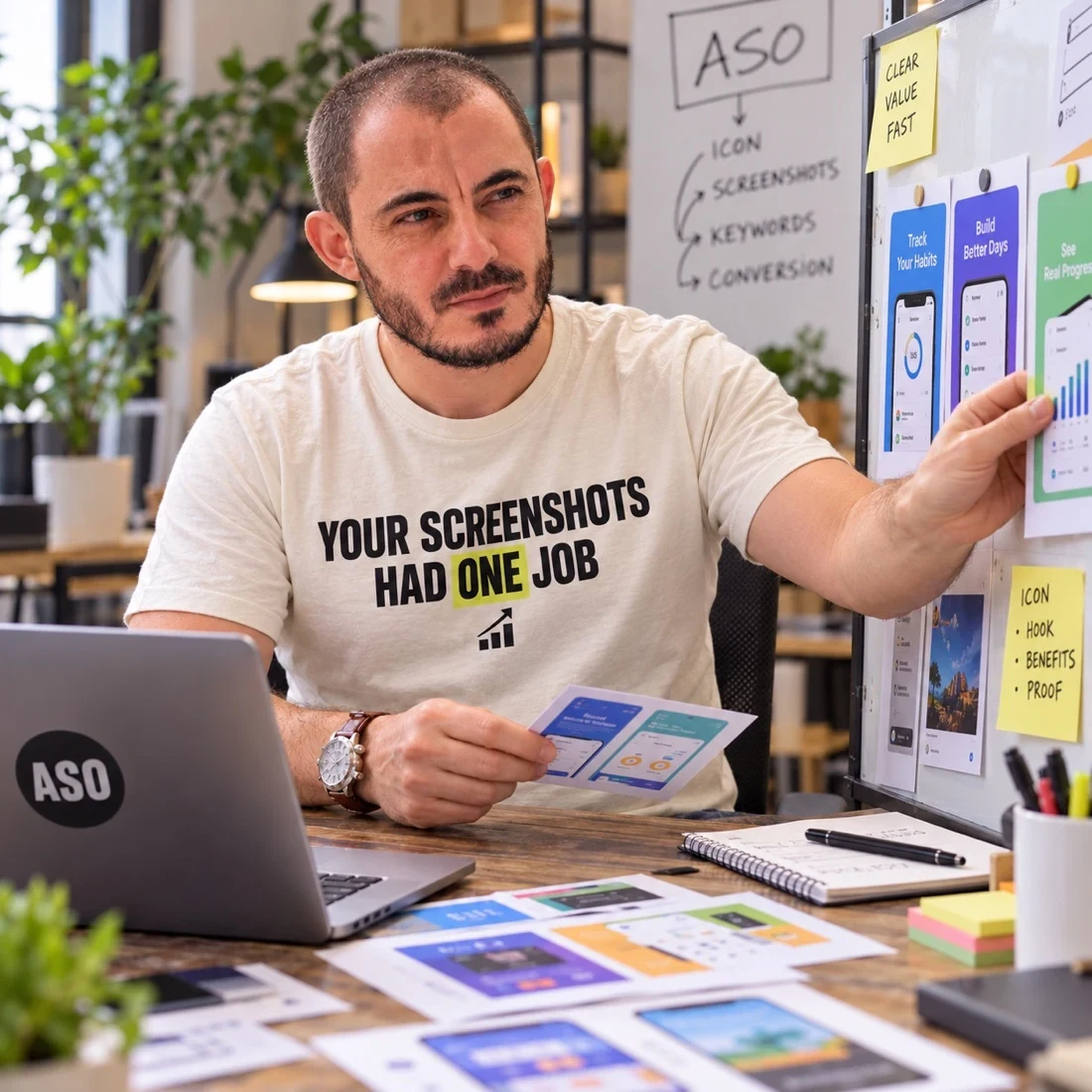
The storyboard above is an illustrative messaging concept, not a real app interface or a claimed client result. Finished creative should use accurate product screens.
Write captions that survive the store.
Copy needs to work at realistic viewing size and make sense without a presenter explaining it. I look for short, concrete claims supported by the screen. Decorative labels, vague superlatives and dense paragraphs make the visitor do unnecessary work.
The brief specifies the message, supporting interface, hierarchy and sequence. Device dimensions and export requirements are checked during production for the target store.
Give the designer a usable brief.
A screenshot engagement can include a critique, revised narrative, caption options, annotated direction and testing hypotheses. Production design, device mockups, exports and translated versions are separate unless included in the proposal. That separation keeps the deliverable and the budget clear.
The designer receives a rationale for the message, not just an instruction to make it pop. Your team owns final product accuracy and brand approval.
Test the argument you are changing.
A benefit-led sequence versus a workflow-led sequence asks a meaningful question about the audience. If many unrelated elements change at once, interpretation becomes harder. We choose the scope of the experiment deliberately and consider the available traffic before promising a conclusive result.
Pair this with conversion optimization. For the thinking behind the method, read screenshots as a sales conversation.