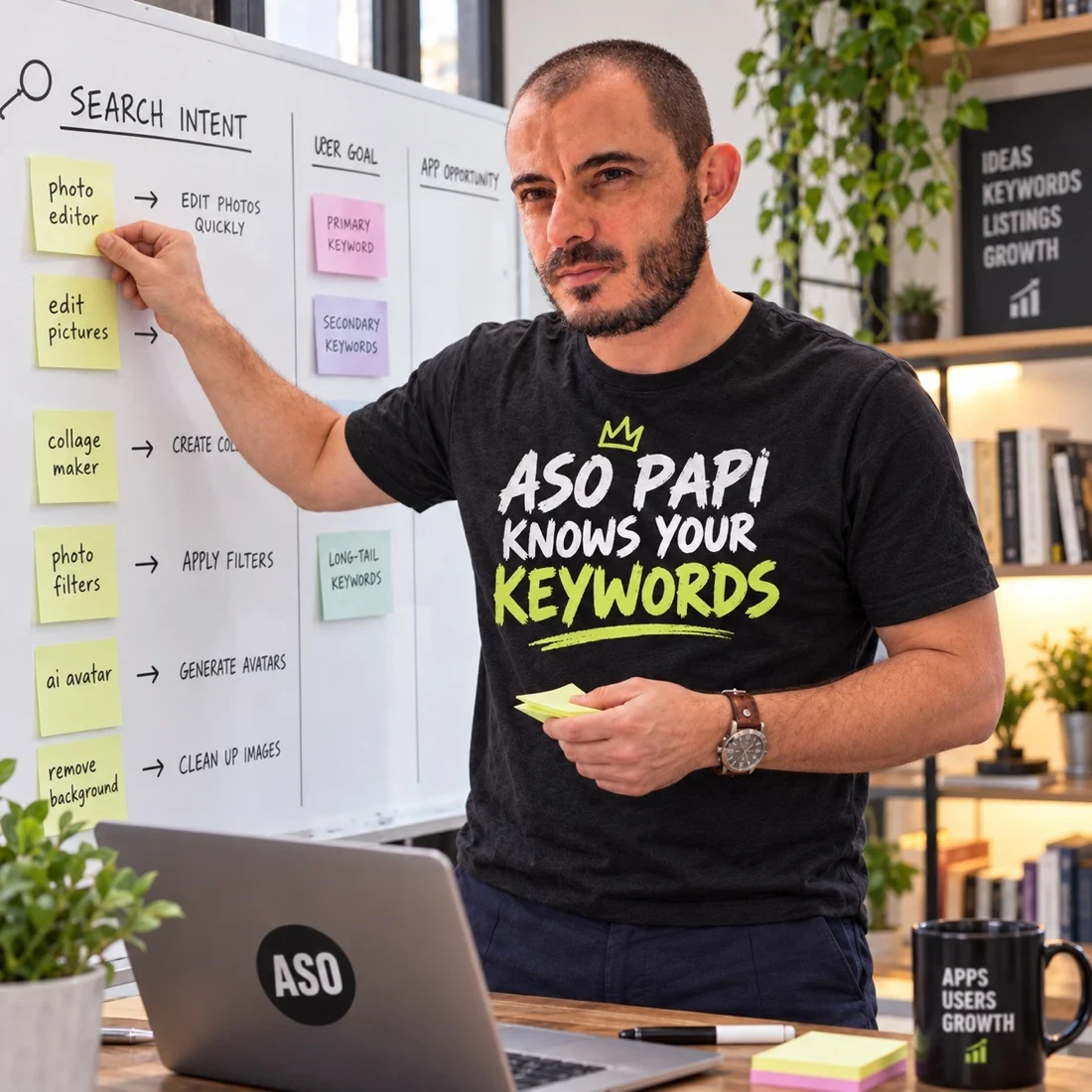
Start with the job your app does.
I begin with the product’s real use cases, the intended audience and the market. A running app might support route tracking, training plans or guided workouts. Those are related concepts, but they imply different expectations. Research should distinguish them before selecting language for a listing.
We build seed ideas from the product, user language and relevant alternatives. Tools can expand the candidate list; they cannot decide product fit for us.
Separate relevance from estimated demand.
A tool’s search-volume score is an estimate or index, not a verified count of everyone searching. Difficulty also depends on how a tool defines it. I use these signals as context alongside relevance, current visibility and the quality of competing results.
The output identifies uncertainty. It does not turn third-party estimates into precise forecasts of installs or revenue.
Group intent before writing metadata.
A keyword map should connect terms that express the same or adjacent needs. For a fictional planning app, weekly meal planning, grocery planning and calorie logging might form three different groups. If the product excels at planning but only lightly supports logging, the first group may deserve the main promise.
This illustrative example is about prioritisation, not a claim about demand. The right grouping depends on the app, language and actual research.
Deliver a map your copywriter can use.
The agreed output can include candidate terms, intent groups, relevance notes, priority recommendations and a field-mapping brief. Important exclusions are explained as well as inclusions. A smaller set of well-supported priorities is often more actionable than thousands of unreviewed rows.
Implementation differs between iOS metadata and Google Play copy. Native-language input is scoped when the market requires it.
Connect the search to the store experience.
If a listing attracts searches for an easy weekly plan, the screenshots should demonstrate that experience. A mismatch between search intent and the visual story can undermine the whole proposal. Keyword work therefore needs a handoff into messaging and creative, even when production is outside scope.
Read why ASO is not a keyword list, or pair research with screenshot strategy.