Name the constraint before choosing tasks.
A solo developer may be limited by time, design capacity or access to useful evidence. List the constraint alongside the desired outcome. A large checklist can create activity while delaying the work most likely to clarify the app’s promise.
Use budget prioritization to separate essential corrections from speculative ideas. Limited capacity makes focus more important, not accuracy optional.
Write the product promise plainly.
Describe the main task and the user it serves. Check whether the title, supporting copy and first screenshots communicate that task without a live explanation. Avoid hiding a useful product behind broad lifestyle language.
Use caption guidance and a few relevant keyword candidates. Research should help select clear language, not create a requirement to include every term.
Reuse a system without copying every decision.
A simple layout and repeatable review checklist can reduce production overhead. Still review each frame’s message and the actual interface evidence. Reusing a template does not mean repeating one caption across all screenshots.
Use a coherent sequence. Preserve source files and approved exports so small future updates do not require rebuilding the entire presentation.
Keep measurement modest and accurate.
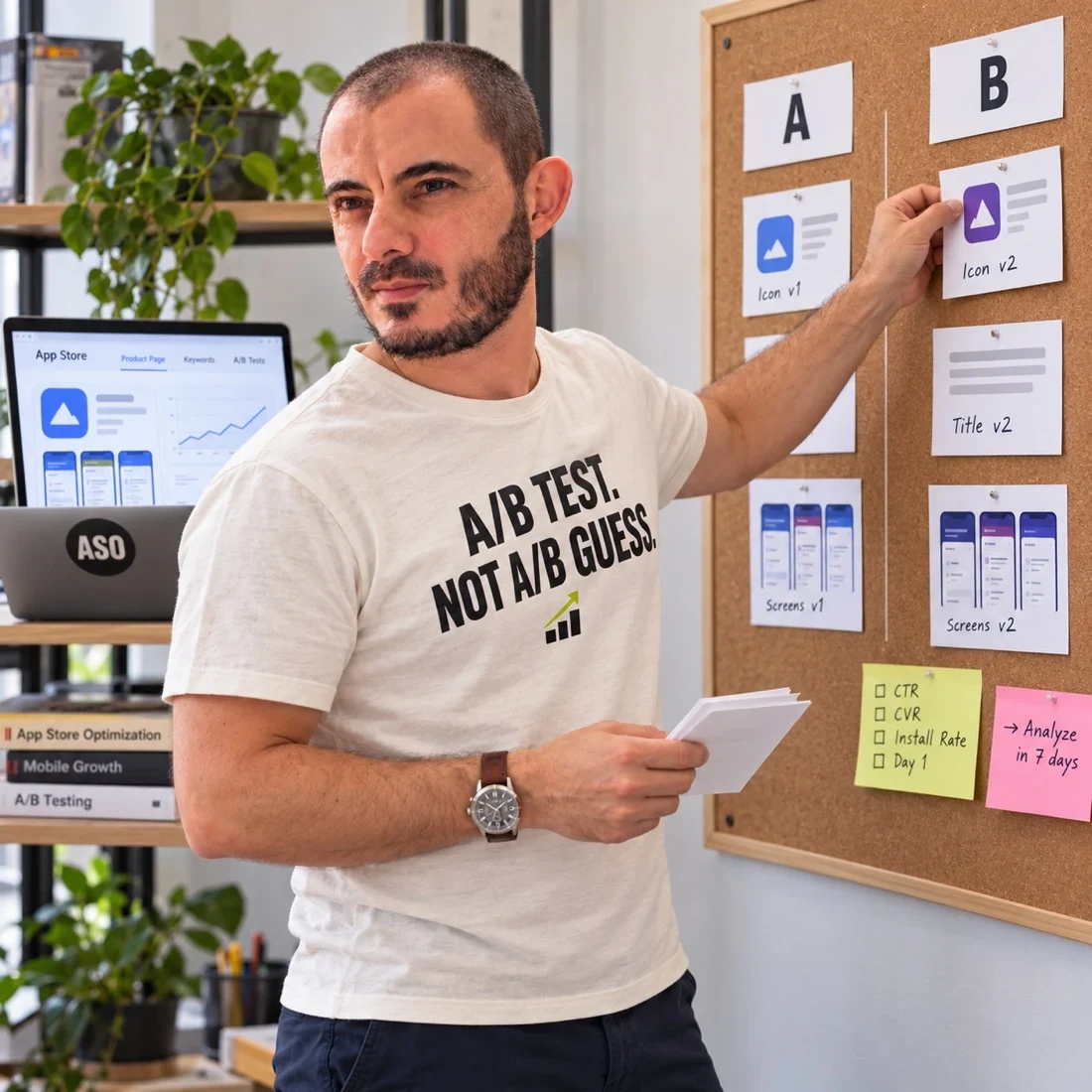
Choose a small set of defined measures you can inspect consistently. Record dates and concurrent changes. If traffic is insufficient for an informative experiment, use product and comprehension review without calling it measured conversion proof.
Use the KPI guide. A spreadsheet with a few well-defined observations is more useful than a complex dashboard whose numbers you cannot explain.
Ask for help at a specific bottleneck.
A focused review can be easier to scope than handing over everything. Identify whether the missing capability is diagnosis, research, design or implementation. Prepare context so outside help can address the real obstacle.
Use the brief builder and compare the proposed output with the work you can complete yourself. Keep ownership of the next action explicit.