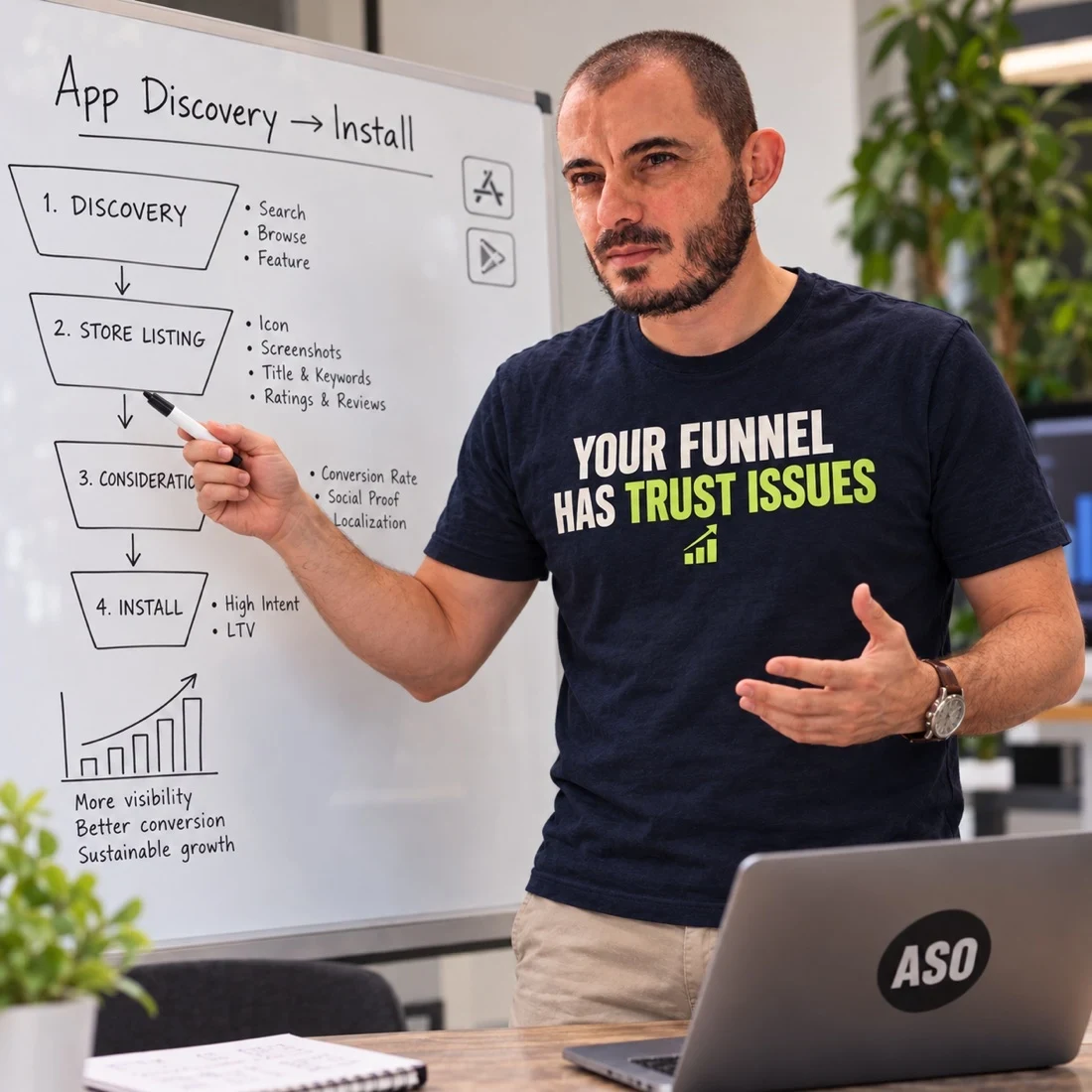
App store optimization is the work of making an app easier for the right people to discover and choose in an app store. Keywords are part of that work. They are not the whole job.
App store optimization (ASO) is the ongoing work of improving how an app is discovered and how clearly its store listing explains its value to suitable users. It includes research, metadata, creative and measurement; its success depends on both audience fit and an accurate product promise.
Your deliverable: Map the journey from a relevant search to a user who experiences the promised value.
Hypothetical simplified journey, not a store-report definition or client result. Bar widths are proportional to the illustrative counts.
01
Discovery and choice are connected.
A store listing has two related challenges: appear in a relevant discovery context and make a persuasive, accurate case for installation. Search language matters for the first. Positioning, screenshots, copy and product expectations matter for the second. Optimising one while ignoring the other leaves a gap in the journey.
Think of a budgeting app found by people searching for freelance invoicing. More visibility is not necessarily progress if the product does not issue invoices. Relevance is the connection between an impression and a useful prospective customer.
02
What ASO work actually includes.
A practical project can involve audience research, keyword prioritisation, competitor review, metadata writing, screenshot messaging and experiment planning. The exact mix follows the problem. An unclear listing may need a better explanation before it needs another export of possible keywords.
For the commercial scope, see ASO services. For a sequence you can apply yourself, use the ASO checklist. Neither assumes that every app needs every deliverable at once.
03
The store is not the whole business.
A listing cannot reliably compensate for a product that disappoints its users. Pricing, onboarding, reliability and the fit between the product and audience remain important. A more attractive promise can even create a worse experience if it describes something the app cannot deliver.
ASO therefore needs input from product and acquisition teams. Ask what happens after installation and whether the visitors being attracted are the people the business wants. Treat download volume as one signal rather than a complete definition of success.
04
Measure the decision you tried to influence.
Record the relevant baseline, audience, store and date range before making a change. If discovery was the problem, review available discovery evidence. If the listing argument changed, evaluate the appropriate conversion measure. Check whether campaigns, releases or market mix changed at the same time.
There is no universal promise of a number-one ranking or a fixed uplift. Good ASO makes the reasoning and uncertainty visible. When you cannot identify the constraint, start with a structured audit.
WORKED EXAMPLE / FICTIONAL APP
A walking app with two different growth problems
TrailPocket is a fictional app for finding short local walks. Its team calls every acquisition problem an ASO problem. One visitor cannot find a suitable route in search; another installs successfully but discovers that the advertised offline feature does not exist. Both experiences matter, but they need different owners. Treating them as one keyword problem would send the team in the wrong direction.
How to reason through it
Draw the journey on paper: a person has a need, encounters a listing, evaluates its promise, chooses an action, then uses the product. Under each transition, record the evidence you actually have. A search-position observation belongs near discovery. A screenshot comprehension interview belongs near evaluation. An activation event belongs after acquisition. Do not substitute one signal for another just because it is easier to obtain.
The next practical move
For TrailPocket, first remove the unsupported offline claim and notify the product owner. Then inspect whether the listing explains short nearby walks clearly. Only after those decisions should the team prioritise relevant search themes. This ordering does not guarantee growth; it prevents the listing from attracting people on a false premise. A smaller, better-matched audience can be a more useful starting point than a larger disappointed one.
Swipe horizontally to compare the decision map →
A walking app with two different growth problems: illustrative decision map
Decision area
What to inspect
What it means for the work
Discovery
People searching for short walks cannot identify the app
Research intent and describe the supported job
Choice
Visitors think the app is for multi-day hiking
Show a short local route and practical details
Experience
The advertised offline workflow is missing
Correct the promise and involve the product owner
The trap to avoid
Do not describe ASO as a substitute for product quality or distribution. It is work on how an app is discovered and understood within a larger acquisition system. A good listing cannot manufacture a missing feature, and a keyword position is not a count of satisfied users.
When the situation gets more complicated
When stakeholders disagree, ask each one to name a decision and the evidence that would change it. “We need more downloads” is an objective, not a diagnosis. “We need to know whether visitors understand that our routes fit a lunch break” is an investigable question. Keep the first learning cycle narrow enough that an answer can influence an actual change.
FROM METHOD TO DELIVERABLE
What belongs in an ASO project?
Use this scope map when someone asks you to “do ASO.” Agree the deliverable and the team boundary before assigning tasks. Ownership can vary by company; the important distinction is between work on the listing and work on the product experience it promises.
Swipe horizontally to read the complete example →
Illustrative ownership map: agree responsibilities for your own team.
Analytics helps with attribution and downstream events
Why do people abandon setup?
Flag a promise/experience mismatch
Product team investigates and fixes onboarding
ASO, SEO and paid acquisition: where the work meets
A website SEO project works on a web property; an ASO project works on the app’s store presence. Paid acquisition buys distribution to an audience. They can share research and messaging, but each has different implementation surfaces and evidence. If a campaign sends people to the listing, the campaign promise and store promise should agree. Do not assume that improving either surface proves the other caused a result.
A first session that produces something useful
Open one current listing and write down its apparent audience, promise and supporting screen. Compare that with one complete product workflow. Mark one mismatch or one unresolved question, then identify who can resolve it. This is a first-pass review, not a full audit. Finish with an evidence request or a specific correction rather than a long list of speculative tactics.
What progress looks like before growth is measurable
An accurate claim, a documented audience choice and an implementable creative brief are meaningful delivery milestones. They are not proof of acquisition growth. Keep delivery progress and outcome evidence separate in reporting, so work can be evaluated honestly while enough behavioural evidence accumulates.
A meditation app has rising store visits but fewer users complete their first session. Which two questions should you ask before rewriting its metadata?
Reveal the reasoning
Ask whether the incoming audience or campaign promise changed, and whether onboarding or session availability changed. Inspect listing evidence too, but falling activation alone does not establish that metadata is the cause. The store and product teams may need to investigate together.
Your working brief
Use your own app for this exercise. Fill in the six fields below and attach the evidence behind each answer. If you cannot complete a field, write the missing question and the person who can resolve it. Do not replace unknowns with optimistic assumptions.
Priority audience and the job they need done
Promise visible in the listing
Product evidence supporting that promise
Discovery evidence and its source
Listing-choice evidence and its definition
Post-install evidence and responsible owner
For each field, distinguish an observation from an interpretation. Add the date and source where available, then identify the decision that follows. A colleague should be able to trace your recommendation back to the evidence without needing you to explain the entire project again.
Refine the value proposition if visitors could misunderstand the product.
The worked example is an original editorial framework. Its fictional app, decisions and scenarios are not an industry dataset or a claim of measured uplift.
They share concerns such as relevance and clear information, but app stores have their own fields, discovery systems and conversion surfaces. A website SEO checklist is not an app-store implementation plan.
Does ASO replace paid acquisition?
No. Organic discovery and paid campaigns can inform one another. Listing clarity matters to visitors from either source.
Where should a beginner start?
Define the audience and product promise, inspect the current listing, then use the checklist to identify the most important evidence gaps.